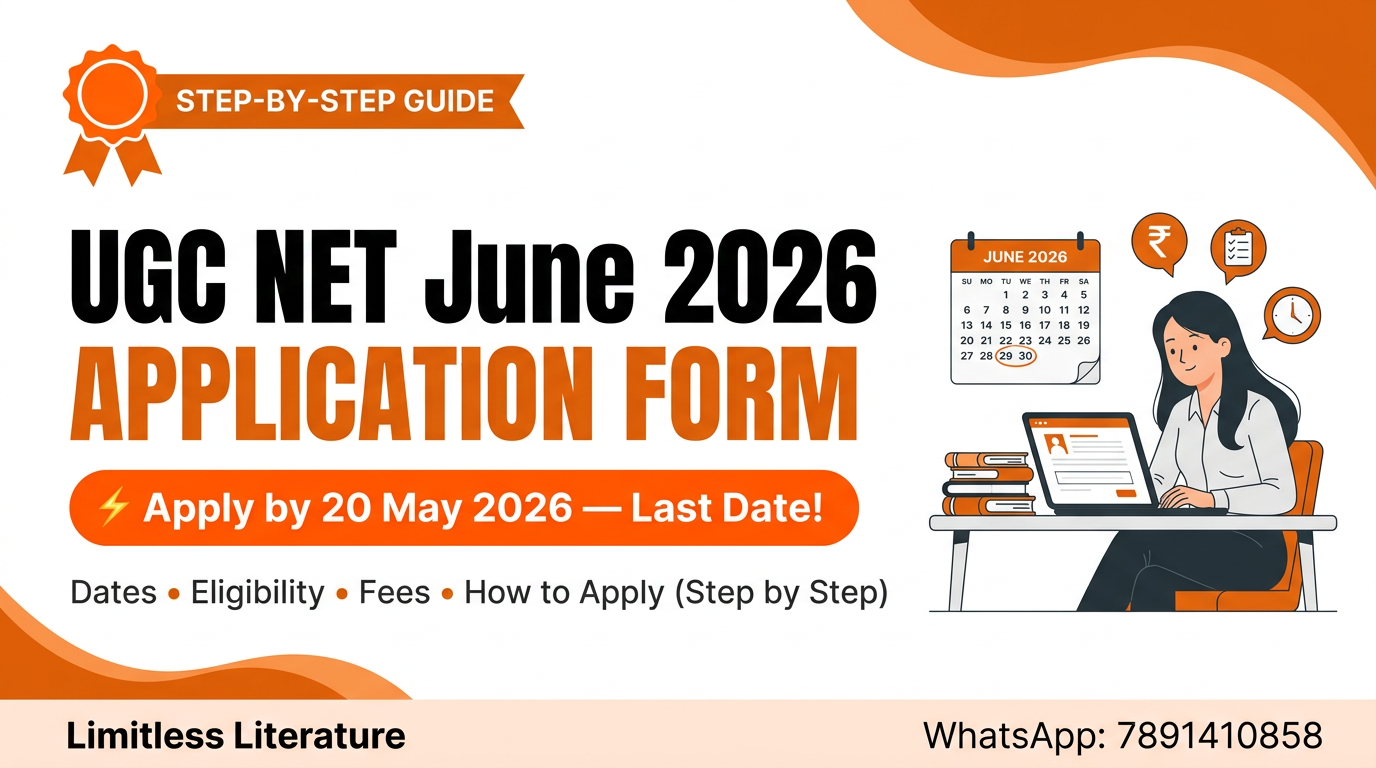
NTA dropped the UGC NET June 2026 notification on 29 April 2026. If you’ve been waiting for this, the clock is already ticking — the application window closes on 20 May 2026, and the exam runs from 22 to 30 June.
Here’s everything you need to know: dates, eligibility, fees, exam pattern, and a step-by-step walkthrough of the application process.
No fluff, just the stuff that actually matters when you’re filling out that form.
What’s new this cycle?
One change worth noting: Statistics has been added as a subject, bringing the total to 85. Other than that, the structure is the same as December 2025 — same fee, same pattern, same portal.
Over 7 lakh candidates appeared in the December 2025 cycle, and about 1.76 lakh qualified for JRF and Ph.D. admission. So yes, it’s competitive.
But those numbers also mean plenty of people do clear it every cycle.
Important dates you should save right now
The application window opened on 29 April 2026. Last date to apply is 20 May 2026. There’s a correction window from 22 to 24 May, but treat it as a backup — not your plan.
Admit cards are expected around 15 June 2026, and the exam itself runs from 22 to 30 June 2026 in CBT (Computer-Based Test) mode.
If you’re reading this and haven’t started yet, aim to submit by 15 May. The NTA portal slows down badly in the last 48 hours before every deadline.
Every cycle, thousands of students complain about the same thing. Don’t be one of them.
Application fee
General category pays ₹1,150. OBC-NCL and EWS candidates pay ₹600.
SC, ST, PwD, and Third Gender candidates pay ₹325. You can pay online via debit card, credit card, net banking, or UPI.
One important rule: you can submit only one application. Multiple submissions lead to disqualification. So get it right the first time.
Who can apply?
You need a Master’s degree (or equivalent) from a UGC-recognised university with at least 55% marks if you’re in the General or EWS category.
For OBC (Non-Creamy Layer), SC, ST, PwD, and Third Gender candidates, the minimum is 50%.
And here’s something people get wrong every cycle: 54.99% is not 55%. NTA does not round up. If your marksheet says 54.99, you’re not eligible under the General category. Period.
Final-year PG students can apply provisionally — but they need to complete the degree with the required marks within two years of the result declaration.
One more thing: candidates with a four-year undergraduate degree under the NEP framework can now apply directly, subject to specific conditions laid out in the information bulletin.
Age limit — read this carefully if you want JRF
For Assistant Professor eligibility, there’s no upper age limit. Apply at 25 or 45 — doesn’t matter.
For JRF, the maximum age is 30 years as on 1 January 2026. OBC-NCL, SC, ST, PwD, women, and Third Gender candidates get a 5-year relaxation (so 35 years). Ex-servicemen get additional relaxation per government norms.
The JRF cutoff is strict. One day over 30 (or 35 with relaxation) and you’re out of JRF consideration. You’d still qualify for Assistant Professor and Ph.D., but you won’t get the fellowship.
There’s no limit on the number of attempts, as long as you’re within the age range for whichever category you’re applying under.
How to apply — step by step
Before you start, gather these documents: a valid email ID and mobile number (you’ll need these active throughout the cycle — admit card and results come here), a recent passport-size photograph (10–200 KB, JPG/JPEG format), your signature (4–30 KB, JPG/JPEG), mark sheets for Class 10, 12, graduation, and postgraduation, category certificate if applicable, PwD certificate if applicable, and Aadhaar or any government photo ID.
Step 1: Go to ugcnet.nta.nic.in.
Step 2: Click “New Registration.” Enter your name, date of birth, mobile number, and email ID through the MeriPehchaan (National Single Sign-On) platform. Write down the Application Number and password that get generated — save them in two different places.
Step 3: Log in and fill the form. Enter your personal details, category, educational qualifications (graduation and postgraduation marks), subject choice, and four exam city preferences.
Step 4: Upload your photograph and signature in the prescribed format. Upload category or PwD certificates if applicable. Double-check the file sizes — wrong specs mean rejection.
Step 5: Pay the fee online.
Step 6: Cross-check every single field before final submission. Download the confirmation page as a PDF. Take a screenshot of the fee receipt. You’ll need these later.
Common mistakes that cost people six months
Wrong subject choice. Your Paper 2 subject must match your postgraduation subject or a closely related one from UGC’s eligibility list. Picking the wrong subject can lead to outright rejection.
Assuming the correction window will save you. The correction window is just three days (22–24 May), and some fields — like your name as it appears on Aadhaar — may not even be editable. Fill the form as if there’s no correction window.
Waiting until the last day. The server historically crashes or slows to a crawl in the last 48 hours. Submit by 15 May.
Thinking exam city is your choice. You pick four preferences. NTA allots based on capacity. You might not get any of them.
What clearing UGC NET actually gets you
There are three levels of qualification:
JRF + Assistant Professor: Top scorers get Junior Research Fellowship — ₹37,000 per month for the first two years, then ₹42,000 per month for the next three years, plus HRA. You’re also eligible to teach as Assistant Professor and pursue a Ph.D. This is the one everyone’s aiming for.
Assistant Professor + Ph.D.: You can teach at Indian universities and colleges and get Ph.D. admission, but without the JRF stipend.
Ph.D. only: Eligibility for Ph.D. admission, nothing else.
On top of this, NFSC (for SC students), NFOBC (for OBC students), and the Maulana Azad National Fellowship (for minority students) are all awarded based on UGC NET scores.
For context, an Assistant Professor’s starting salary in a government university is roughly ₹57,700 per month plus DA and HRA. That’s before promotions.
Your action plan from today
This week (by 5 May): Read the official Information Bulletin PDF from start to finish — download it here. Gather all documents. Check that your category certificate is valid and not expired.
Next week (by 12 May): Complete registration on the NTA portal. Save your Application Number and password in two separate places.
Before 15 May: Submit the full application, pay the fee, download the confirmation page. Do not wait for 20 May.
22–24 May: Use the correction window only if you absolutely must. Even if you change nothing, log in and verify your form one more time.
1–14 June: Final revision. Take 2–3 full-length mock tests per week. Focus on Paper 1 weak spots — that’s where marks slip without you noticing.
15 June onwards: Download your admit card. Plan travel and accommodation for your allotted exam city. On exam day, carry your original photo ID and admit card.
Key takeaways
- The application deadline is 20 May 2026, but submit by 15 May to avoid server issues.
- 54.99% does not count as 55% — NTA doesn’t round up.
- You get one application. Multiple submissions mean automatic disqualification.
- JRF age limit is 30 years (35 with relaxation) calculated as on 1 January 2026 — not a single day of flexibility.
- Paper 1 is where most candidates quietly lose marks. Don’t skip it in your preparation.
All dates and figures are from the NTA UGC NET June 2026 Information Bulletin released on 29 April 2026. Always verify the latest information at ugcnet.nta.nic.in before applying.