If you are preparing for UGC NET English Literature, you cannot afford to leave John Milton to chance.
He is one of the most heavily tested writers in the exam, with questions appearing almost every single year across multiple units of the syllabus. NTA loves Milton because his works span poetry, prose, drama, and political writing — which means questions can pop up in British Poetry, British Prose, Drama, and even Literary Criticism sections.
This guide breaks down exactly what you need to study, what NTA actually asks, and how to cover Milton efficiently even if you are running short on time.
Milton (1608–1674) lived through one of the most politically turbulent periods in English history.
He was a poet, a polemicist, a government official under Oliver Cromwell, and by the time he wrote his masterpiece Paradise Lost, he was completely blind. That biographical detail alone has generated multiple UGC NET questions over the years.
Why John Milton is important for UGC NET
Milton appears in at least two major units of the UGC NET English Literature syllabus. His poetry falls under British Poetry (Unit covering 16th–17th century), and his prose works like Areopagitica show up under British Prose and Non-Fiction.
Questions about the Age of Milton also test your knowledge of his contemporaries — Andrew Marvell, John Bunyan, and the Metaphysical poets.
Based on an analysis of previous year question papers, Milton attracts 2–4 questions per exam on average.
Some papers have gone as high as 5 questions when you count indirect references (questions about the English Civil War period, epic conventions, or blank verse that use Milton as an answer option).
If you look at the June 2025 question paper, you will see that NTA continues to test Milton consistently.
For a writer-wise breakdown of how questions are distributed, check the subject-wise previous year questions collection — it will show you exactly how much weight Milton carries.
Major works you must know (with dates)
NTA frequently tests chronological ordering of Milton’s works. Get these dates locked in your memory:
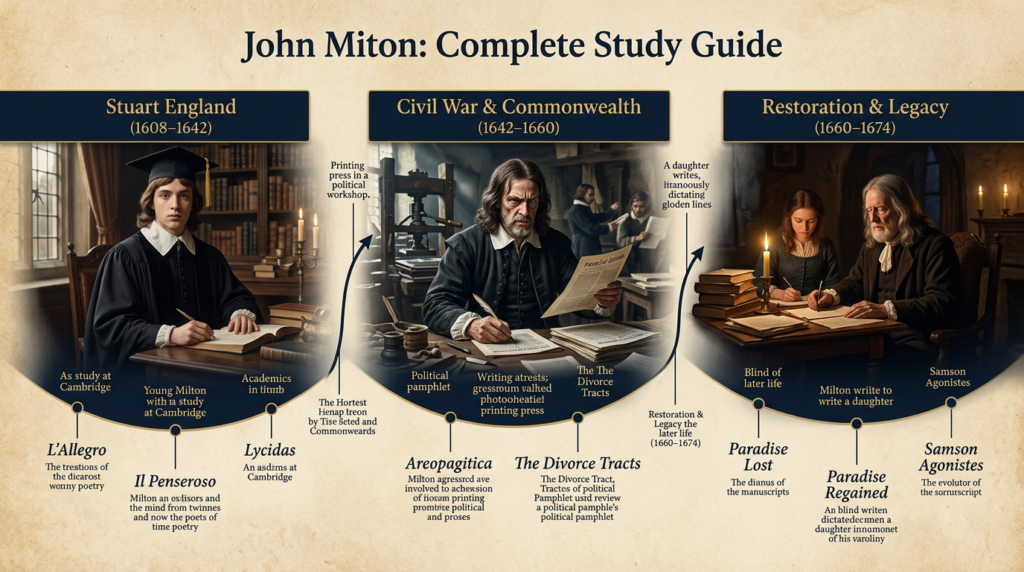
- “On the Morning of Christ’s Nativity” (1629) — Milton’s first major poem, written when he was just 21. Often called the “Nativity Ode.”
- “L’Allegro” and “Il Penseroso” (c. 1631, published 1645) — Companion poems contrasting the cheerful and the contemplative temperament. NTA has asked which poem describes which mood.
- Comus (1634, performed; published 1637) — A masque, not a play. This distinction matters in MCQs. It was performed at Ludlow Castle.
- “Lycidas” (1637) — A pastoral elegy for Edward King. One of the most frequently tested Milton poems after Paradise Lost. Know that it is written in irregular verse, not strict couplets.
- Areopagitica (1644) — A prose pamphlet arguing against pre-publication censorship. NTA tests both its content and its title’s origin (named after a speech by Isocrates to the Athenian assembly, the Areopagus).
- The Tenure of Kings and Magistrates (1649) — Milton’s defence of regicide after Charles I’s execution. Rarely tested directly, but knowing it exists helps with elimination.
- Paradise Lost (1667, first edition in 10 books; 1674, second edition in 12 books) — The big one. More questions come from this than all his other works combined.
- Paradise Regained (1671) — A brief epic in 4 books, focused on Christ’s temptation in the wilderness. Not the sequel students assume it is — it is a much shorter, more restrained work.
- Samson Agonistes (1671) — Published in the same volume as Paradise Regained. A closet drama (meant to be read, not performed) modelled on Greek tragedy. NTA has tested its genre, its biblical source (Book of Judges), and its use of a chorus.
That chronological order question — “Arrange Milton’s works in order of publication” — appears almost every other year.
The most common version asks you to order Comus, Lycidas, Areopagitica, Paradise Lost, and Samson Agonistes.
Key themes and concepts tested in UGC NET
When NTA frames Milton questions, they tend to focus on a few recurring areas. Here is what gets tested most:
The Satan debate. William Blake wrote in The Marriage of Heaven and Hell (1790) that Milton was “of the Devil’s party without knowing it.” This quote has appeared in UGC NET papers multiple times.
Know that it is Blake who said it, not Shelley, not Dryden. Percy Bysshe Shelley later made a similar argument in A Defence of Poetry, saying Satan in Paradise Lost is morally superior to God. C.S. Lewis disagreed sharply in A Preface to Paradise Lost (1942), arguing that Satan progressively degrades through the poem.
Epic conventions. NTA tests whether you can identify epic features in Paradise Lost: invocation of the Muse (Milton invokes Urania, the Heavenly Muse, in Book I and Book VII), starting in medias res, epic catalogues (the list of fallen angels in Book I), epic similes, and the grand style.
Blank verse. Milton wrote Paradise Lost in unrhymed iambic pentameter. He added a note to the 1668 edition defending his choice, calling rhyme “the invention of a barbarous age.” NTA has tested this specific phrase.
Free speech and censorship. Areopagitica is Milton’s argument that truth will prevail in a free marketplace of ideas. The famous line — “Who kills a man kills a reasonable creature, God’s image; but he that destroys a good book, kills reason itself” — is a favourite for quote-identification questions.
The Fall and free will. The theological centre of Paradise Lost is that Adam and Eve fell through their own free choice, not because God predetermined it.
Milton’s position (called Arminianism) differs from strict Calvinist predestination. This has shown up in questions about Milton’s theology.
Milton’s feminism (or lack of it). Book IV of Paradise Lost contains the famous lines where Eve says to Adam: “God is thy law, thou mine.”
Feminist critics like Sandra Gilbert and Susan Gubar (The Madwoman in the Attic) have argued that Milton presents a deeply patriarchal vision. NTA has tested this critical perspective.
Work-by-work breakdown: what to focus on
Paradise Lost
This is where the bulk of your Milton preparation should go. Here is what to prioritise by Book:
Book I: Satan’s speeches on the burning lake. The phrase “Better to reign in Hell than serve in Heaven.”
The catalogue of fallen angels (Moloch, Belial, Mammon, Beelzebub). The building of Pandemonium. The mention of Galileo as the “Tuscan artist” — NTA has tested which real historical figure appears in Paradise Lost.
Book II: The council in Hell. The allegory of Sin and Death at the gates of Hell. Sin is Satan’s daughter, born from his head (paralleling Athena’s birth from Zeus). Death is the offspring of Satan and Sin. This allegory is a common MCQ topic.
Book IV: Satan’s soliloquy (“Which way I fly is Hell; myself am Hell”). The description of Eden. Adam and Eve’s relationship. Eve’s account of her own creation and her initial attraction to her own reflection in the water — a Narcissus parallel that has been tested.
Book IX: The temptation and Fall. Eve eats the fruit first. Adam eats it knowingly, out of love for Eve. The distinction between Eve’s deception and Adam’s conscious choice matters for exam questions.
Book XII: Michael’s prophecy of human history. Adam and Eve’s expulsion from Paradise.
The closing lines: “The world was all before them, where to choose / Their place of rest, and Providence their guide.” This ending has been tested in identification questions.
Lycidas
Know these facts cold: it is a pastoral elegy for Edward King, a fellow student at Cambridge who drowned in the Irish Sea. It uses the conventions of pastoral poetry (shepherds, nature imagery) but breaks them to discuss religious corruption (“blind mouths” passage attacking corrupt clergy).
The poem’s structure moves from grief to consolation to the hope of resurrection. It is 193 lines long and written in irregular verse paragraphs with occasional rhyming couplets and triplets.
Areopagitica
Despite its importance, students often skip this because it is prose. That is a mistake. NTA regularly includes a question on Areopagitica.
It was written in response to the Licensing Order of 1643 passed by Parliament. Milton argues against prior restraint (pre-publication censorship) but does not argue for complete freedom of speech — he explicitly excludes “popery” (Catholicism) from his defence of tolerance. That exception is a trick question favourite.
Common exam traps and how to avoid them
Trap 1: Confusing the two editions of Paradise Lost. The 1667 first edition had 10 books. The 1674 second edition reorganised the poem into 12 books (splitting the original Books VII and X).
When NTA asks “How many books does Paradise Lost have?” the answer is 12. But if they ask about the first edition specifically, it is 10.
Trap 2: Attributing the “Devil’s party” quote to the wrong person. It is William Blake, not Percy Shelley. Shelley made a different argument about Satan’s heroism in A Defence of Poetry. Students mix these up constantly.
Trap 3: Calling Comus a play. Comus is a masque — a specific dramatic form involving music, dance, and spectacle, performed for aristocratic audiences.
NTA has offered “play,” “masque,” “opera,” and “interlude” as options. The answer is always masque.
Trap 4: Thinking Areopagitica argues for total free speech. Milton excluded Catholic literature from his defence. The argument is specifically against pre-publication licensing, not against all forms of censorship.
Trap 5: Getting the Muse wrong. Milton invokes Urania, the Muse of Astronomy, but redefines her as a Heavenly Muse — the divine spirit of Christian inspiration. He does not invoke Calliope (the classical Muse of epic poetry), though he mentions her.
This distinction has appeared in at least two previous papers.
How to study John Milton in 5 days (exam strategy)
If you are short on time, here is exactly how to cover Milton. Pair this with the 40-day exam preparation guide for your overall strategy.
Day 1: Paradise Lost Books I and II. Read a summary with key quotes. Memorise the list of fallen angels and their characteristics. Understand the council scene and the Sin-Death allegory.
Day 2: Paradise Lost Books IV, IX, and XII. Focus on Satan’s soliloquy, the temptation scene, and the expulsion. These three books generate the most questions.
Day 3: Lycidas + Comus + the shorter poems. Read Lycidas carefully — every section of it gets tested. For Comus, just know the genre (masque), setting (Ludlow Castle), and theme (virtue vs. temptation). For L’Allegro and Il Penseroso, know which is cheerful and which is contemplative.
Day 4: Areopagitica + Milton’s prose. Read the key arguments and memorise 2–3 famous quotes. Understand why Milton wrote it (Licensing Order of 1643) and what he actually argued (against pre-publication censorship, not total freedom).
Day 5: Critical perspectives + PYQ practice. Cover Blake’s “Devil’s party” argument, Shelley’s defence of Satan, C.S. Lewis’s counter-argument, and feminist critiques (Gilbert & Gubar). Then solve all available John Milton previous year questions to test your preparation.
For more British Poetry previous year questions covering Milton and his contemporaries, and British History, Novels and Prose questions that include Areopagitica, use the linked collections.
To understand how NTA structures the overall exam, read the 2025 UGC NET English detailed breakdown — it maps out exactly where Milton fits within the paper.
Practice with actual exam papers and solve questions until the patterns feel automatic.
The more PYQs you solve, the more you will notice that NTA recycles question formats with minor variations.
Preparing for UGC NET English Literature? Our course covers John Milton and 50+ other high-weightage authors with video lectures, topic-wise MCQs, and 13 physical booklets delivered to your door. Learn more about the course here.