
Wordsworth appears in more UGC NET units than most students realise — Romantic poetry, literary criticism, even British literary history.
Between the Preface to Lyrical Ballads, The Prelude, and half a dozen shorter poems, there’s a lot of ground to cover. This post tells you what to prioritise and what to skip so you’re not reading 14 books of The Prelude when NTA only tests three episodes from it.
Why William Wordsworth is important for UGC NET
Wordsworth sits at the centre of British Romantic poetry (1798–1830), which is one of the highest-weightage periods in the UGC NET English Literature syllabus.
He appears in at least two units: Unit IV (British Romantic Literature) and the Literary Criticism unit (through the Preface to Lyrical Ballads).
In past UGC NET papers, Wordsworth questions have appeared consistently — sometimes 2–3 questions in a single paper.
These questions test poem identification, critical concepts from the Preface, biographical facts, and The Prelude. You can see the full collection of Wordsworth previous year UGC NET questions here to get a sense of what NTA asks.
What makes Wordsworth tricky is that NTA doesn’t just ask about his poetry. They test his critical theory — his definition of poetry, the “spontaneous overflow” concept, his views on poetic diction. So you need to prepare him as both a poet and a critic.
Major works you must know (with dates)
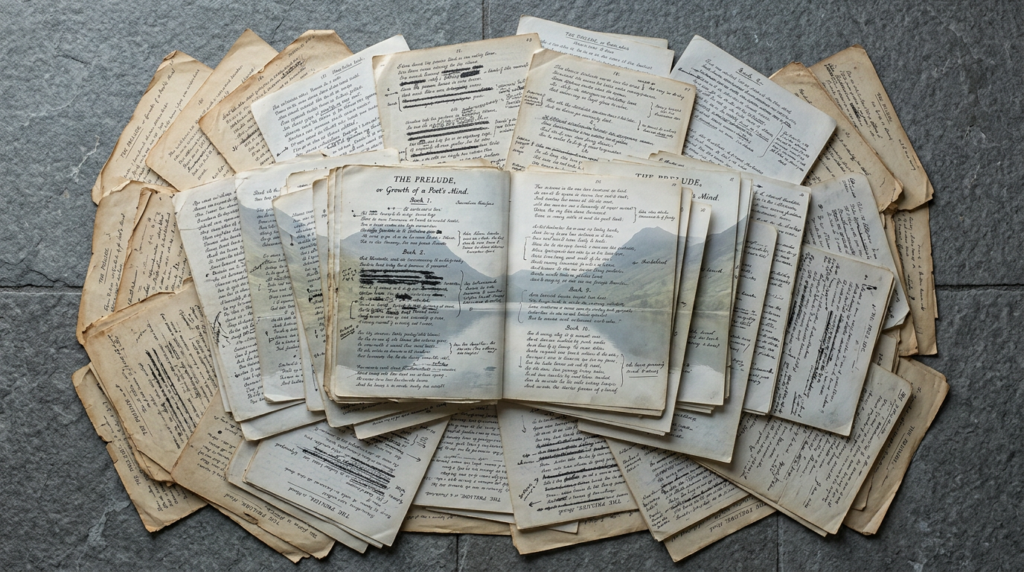
Here is the chronological list of Wordsworth’s important works. NTA frequently tests dates and publication order, so memorise these carefully.
Poetry:
- An Evening Walk (1793) — early descriptive poem, pre-Romantic style
- Descriptive Sketches (1793) — written during his walking tour of the Alps
- Lyrical Ballads (1798, with S.T. Coleridge) — the founding text of English Romanticism
- Lyrical Ballads 2nd edition (1800) — includes the famous Preface
- “Tintern Abbey” (1798) — full title: “Lines Composed a Few Miles above Tintern Abbey”
- “Michael: A Pastoral Poem” (1800)
- “Resolution and Independence” (1807, written 1802) — the Leech-gatherer poem
- Poems, in Two Volumes (1807) — contains “Ode: Intimations of Immortality,” “I Wandered Lonely as a Cloud,” “The Solitary Reaper,” and the “London, 1802” sonnet
- The Excursion (1814) — long philosophical poem, part of a planned but unfinished trilogy called The Recluse
- The Prelude (1850, posthumous) — autobiographical epic; begun 1798, 2-part version completed 1799, 13-book version in 1805, revised 14-book version published 1850
- Ecclesiastical Sonnets (1822)
Prose:
- Preface to Lyrical Ballads (1800; expanded 1802) — his manifesto on poetry, poetic diction, and the role of the poet
- A Guide Through the District of the Lakes (1810/1835)
Key date trap: The Prelude has three versions (1799, 1805, 1850). NTA loves asking when it was “begun” vs. “finished” vs. “published.”
The 1805 version is the one most scholars prefer, but the 1850 version was published first (posthumously). Know all three dates.
Key themes and concepts tested in UGC NET English Literature
NTA doesn’t ask vague questions about Wordsworth. They target specific concepts. Here are the ones that appear most frequently:
1. “Spontaneous overflow of powerful feelings”
This is Wordsworth’s most quoted definition of poetry, from the Preface to Lyrical Ballads. But students often forget the second half: poetry “takes its origin from emotion recollected in tranquillity.”
NTA has tested the full quote, the source, and asked students to distinguish it from other Romantic definitions.
2. Poetic diction — “language really used by men”
Wordsworth argued against the artificial, ornate diction of 18th-century poetry (Pope, Dryden).
He wanted poetry to use the “real language of men in a state of vivid sensation.” NTA asks about what Wordsworth rejected and what he proposed instead.
3. Nature as teacher and moral guide
Wordsworth saw nature as a living force that educates the human soul. This is different from earlier pastoral poetry where nature was decorative.
For Wordsworth, nature shapes moral character. “One impulse from a vernal wood / May teach you more of man, / Of moral evil and of good, / Than all the sages can” (“The Tables Turned”).
4. The growth of the poet’s mind
The Prelude traces how childhood experiences in nature formed Wordsworth’s poetic imagination.
NTA tests specific episodes — the boat-stealing scene (Book I), the skating scene, the spots of time.
5. Imagination vs. Fancy
Wordsworth distinguished between Imagination (a creative, transforming power) and Fancy (a lighter, associative faculty). Coleridge developed this distinction further in Biographia Literaria, but it originates with Wordsworth.
This is a frequent match-the-concept type question. For more practice with such concepts across all topics, check the subject-wise previous year questions collection.
6. The child as father of the man
From “My Heart Leaps Up” (1802). NTA has asked students to identify the source of this line.
It also connects to the “Intimations Ode” which Wordsworth used as an epigraph.
Poem-by-poem breakdown for UGC NET
These are the poems NTA tests most. Focus your preparation here.
“Lines Composed a Few Miles above Tintern Abbey” (1798)
The last poem in Lyrical Ballads. Memory, nature, and the passage of time are central.
Wordsworth revisits the Wye Valley after five years and reflects on how nature has sustained him through city life.
Key lines: “felt in the blood, and felt along the heart.” Know the five stages of man’s relationship with nature that Wordsworth outlines here. NTA frequently quotes lines from this poem and asks you to identify it.
“Ode: Intimations of Immortality from Recollections of Early Childhood” (1807)
The most important Wordsworth poem for UGC NET. It deals with the loss of childhood vision — “There was a time when meadow, grove, and stream… / Apparelled in celestial light.”
The child comes from God (“trailing clouds of glory”) and gradually loses that divine perception as he grows older.
The famous line “Our birth is but a sleep and a forgetting” has appeared in multiple NET papers. Know the Platonic philosophy behind this ode.
“I Wandered Lonely as a Cloud” (1807) The daffodils poem. Simple on the surface, but NTA tests the concept of “emotion recollected in tranquillity” through it — the final stanza where Wordsworth remembers the daffodils while lying on his couch is the recollection part.
“The Solitary Reaper” (1807) A Highland girl singing while reaping. Wordsworth doesn’t understand the words but is moved by the music. NTA asks about the comparisons Wordsworth makes (nightingale, cuckoo) and the setting (Scottish Highlands).
“Michael: A Pastoral Poem” (1800) A narrative poem about a shepherd who loses his son to the city. Tests Wordsworth’s concept of rural characters with deep feeling. Less glamorous than the odes, but NTA has tested it.
The Prelude (1850) NTA typically asks about specific episodes: the boat-stealing scene, crossing the Alps (Book VI), the ascent of Snowdon (Book XIV in the 1850 version, Book XIII in 1805). Know the “spots of time” concept — moments from childhood that have a renovating power on the adult mind. Also know that the subtitle is “Growth of a Poet’s Mind.”
For more British poetry previous year questions across all Romantic poets, practise those alongside Wordsworth-specific ones.
Wordsworth as literary critic: the Preface to Lyrical Ballads
This deserves its own section because NTA tests it separately under Literary Criticism.
What the Preface argues:
- Poetry should use the language of common people, not artificial poetic diction
- The subject of poetry should be “incidents and situations from common life”
- Poetry is “the spontaneous overflow of powerful feelings” recollected in tranquillity
- The poet is “a man speaking to men” — not a prophet or a special being
- Metre is a “superadded” charm, not the essence of poetry
- There is no essential difference between the language of prose and metrical composition
What NTA tests from the Preface:
- Source identification: “Which critic said poetry is the spontaneous overflow…?”
- Comparison with Coleridge: Coleridge disagreed with Wordsworth on poetic diction in Biographia Literaria Chapter XVII. NTA asks what specifically Coleridge objected to.
- Match the following: pairing Wordsworth’s concepts with the correct work
Know the Preface well enough to answer both direct quotes and conceptual questions.
Common exam traps and how to avoid them
Trap 1: Confusing The Prelude’s dates. Students write 1850 as the composition date. Wrong. Wordsworth wrote it between 1798 and 1805. It was published posthumously in 1850 by his wife Mary. The version he finished in 1805 has 13 books; the 1850 published version has 14.
Trap 2: Attributing “willing suspension of disbelief” to Wordsworth. This phrase belongs to Coleridge (Biographia Literaria, Chapter XIV). Students mix up the two because they collaborated on Lyrical Ballads. Wordsworth’s famous phrase is “spontaneous overflow of powerful feelings.”
Trap 3: Thinking Wordsworth and Coleridge agreed on everything. Coleridge specifically disagreed with Wordsworth’s claim that there is no essential difference between the language of prose and verse. NTA has asked about this disagreement. Know which side each poet took.
Trap 4: Missing the philosophical backbone of the Intimations Ode. The poem draws on Platonic philosophy — the idea of pre-existence. The soul exists before birth in a divine realm and gradually forgets that glory as it ages. Students who don’t know this misread the entire poem. NTA has tested the Platonic connection directly.
Trap 5: Calling Wordsworth a “first-generation Romantic” without qualification. Wordsworth and Coleridge are indeed first-generation Romantics (active from 1798). Keats, Shelley, and Byron are second-generation. But NTA sometimes tests whether students know the distinction and what “generation” means in this context — it is about chronology, not quality.
How to study William Wordsworth in 5 days (exam strategy)
Here is a focused plan if you are short on time before UGC NET.
Day 1: The Preface to Lyrical Ballads Read the full text (it is about 20 pages). Underline every major claim Wordsworth makes.
Write down the 6 key arguments listed above from memory. This single document can get you 1–2 questions right. For a broader approach to last-minute prep, see this guide on what to do 40 days before UGC NET English Literature.
Day 2: The Intimations Ode + Tintern Abbey Read both poems carefully. For the Ode, note the Platonic philosophy, the “celestial light” imagery, and the progression from childhood to adulthood. For Tintern Abbey, note the five stages and the role of memory.
Day 3: The Prelude (selected episodes) You don’t need to read all 14 books. Focus on: Book I (childhood, boat-stealing, spots of time), Book VI (crossing the Alps, Imagination passage), Book XIV (ascent of Snowdon). Know the subtitle and the three version dates.
Day 4: Shorter poems + previous year questions Read “The Solitary Reaper,” “Michael,” “I Wandered Lonely as a Cloud,” and “My Heart Leaps Up.” Then solve every Wordsworth PYQ you can find. Pattern recognition is your best friend here.
Day 5: Revision + Coleridge comparison Revise the Preface, re-read your notes on the Ode and Prelude, and specifically study how Coleridge’s views in Biographia Literaria differ from Wordsworth’s. This comparison appears in almost every other NET paper.
Previous year question patterns
Based on analysis of recent UGC NET papers, here is how NTA frames Wordsworth questions:
Type 1: Line identification (most common) NTA gives a 2–4 line quote and asks you to name the poem. Favourites: “Our birth is but a sleep and a forgetting,” “The Child is father of the Man,” and “I wandered lonely as a cloud.” These are direct recall — either you know them or you don’t.
Type 2: Concept matching Match the critic with the concept. Wordsworth = “spontaneous overflow,” “real language of men,” “emotion recollected in tranquillity.” These appear in match-the-following format alongside other critics like Coleridge, Sidney, Arnold, and Eliot.
Type 3: Biographical and chronological When was Lyrical Ballads published? Who wrote the Preface? What year did Wordsworth become Poet Laureate (1843)? Which poet did he succeed (Robert Southey)? These are factual questions that reward memorisation.
Type 4: Critical disagreements NTA asks what Coleridge objected to in Wordsworth’s theory. The answer is Wordsworth’s claim about no essential difference between prose and verse language.
This has appeared in the June 2025 paper and earlier papers. For a detailed breakdown of how the 2025 paper was structured, see the 2025 UGC NET English detailed breakdown.
Type 5: Fill in the blank from famous lines “Poetry is the ______ overflow of powerful feelings.” “The child is ______ of the man.” These are scoring questions if you have read the primary texts.
The single best thing you can do for Wordsworth preparation is solve all available previous year questions.
Patterns repeat. NTA recycles concepts with slightly different framing. Start with the subject-wise English Literature previous year questions to see how Wordsworth fits into the broader exam.
Preparing for UGC NET English Literature? Our course covers William Wordsworth and 50+ other high-weightage authors with video lectures, topic-wise MCQs, and 13 physical booklets delivered to your door. Learn more about the course here.