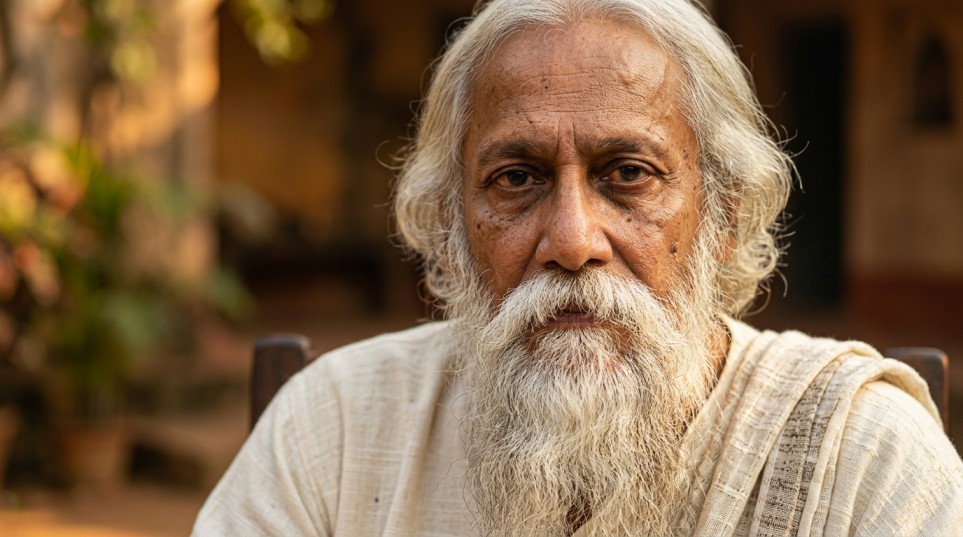
If you are preparing for UGC NET English Literature, Rabindranath Tagore appears across multiple sections of the syllabus — Indian Writing in English, Indian poetry, Indian drama, even literary criticism — and NTA has tested him consistently in recent papers.
The December 2024 paper alone carried 24 questions on Indian Writing in English, and Tagore featured in several of them.
This post breaks down exactly what you need to study, which works matter most, and where students lose marks on Tagore-related MCQs.
Tagore (1861–1941) was a poet, novelist, playwright, essayist, painter, composer, and educational reformer.
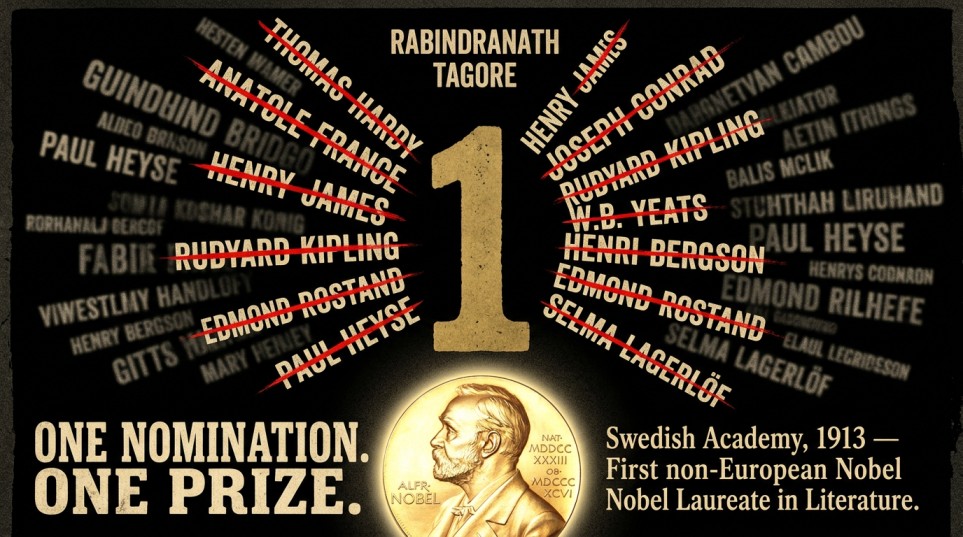
He wrote the national anthems of two countries — India’s Jana Gana Mana and Bangladesh’s Amar Sonar Bangla. In 1913, he became the first non-European to win the Nobel Prize in Literature. That single fact generates more MCQs than almost anything else about him.
Why Rabindranath Tagore is important for UGC NET

Tagore falls primarily under Unit 9: Indian Writing in English in the UGC NET English Literature syllabus. But his reach extends further.
His plays like The Post Office and Red Oleanders show up under Indian Drama questions. His essays on nationalism and education appear in non-fiction sections.
His influence on writers like Kamala Das and other Indian English poets makes him relevant to questions about the broader Indian literary tradition.
Based on previous year question analysis, you can expect 2–4 questions directly or indirectly related to Tagore in any given UGC NET paper.
These questions test chronology, work identification, thematic understanding, and his philosophical positions. The December 2025 topic-wise breakdown shows Indian Literature remains one of the highest-weighted sections.
Major works you must know (with dates)
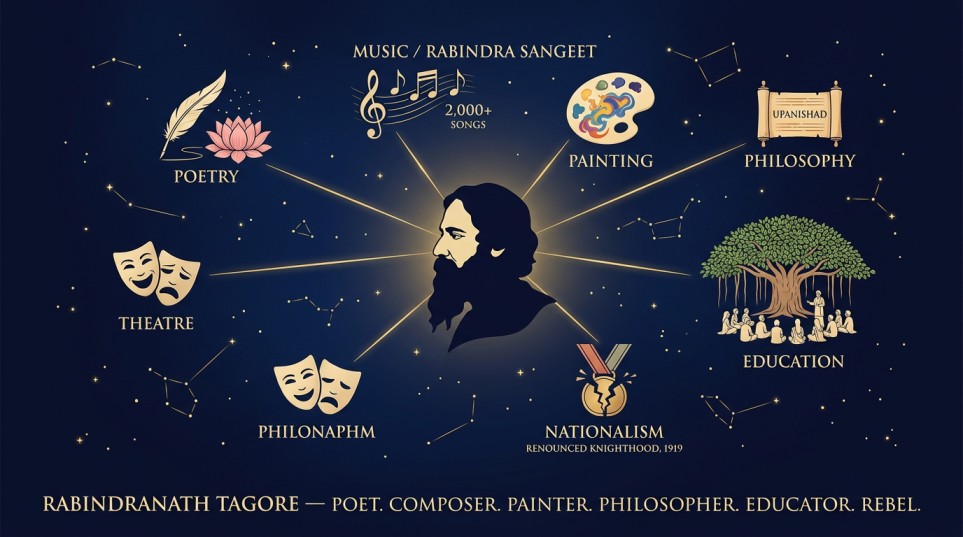
NTA loves chronology questions. Memorise these dates — they show up as direct MCQs and as “arrange in order” questions.
Poetry collections
- Manasi (1890) — early collection, shows influence of Bengali literary tradition
- Sonar Tari / The Golden Boat (1894) — explores themes of fleeting beauty and loss
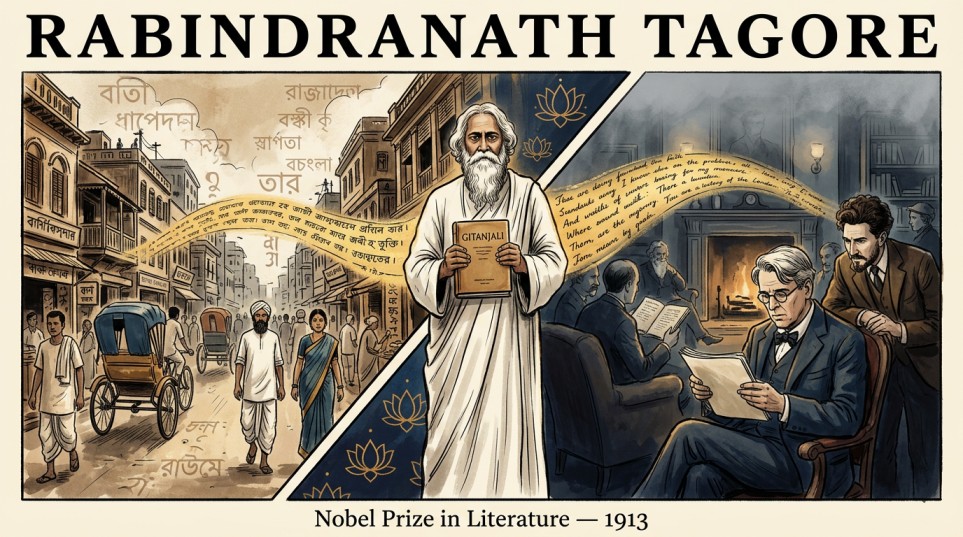
- Gitanjali / Song Offerings (1910 in Bengali; English translation 1912) — the work that won him the Nobel Prize
- Gitimalya / Wreath of Songs (1914)
- Balaka / The Flight of Cranes (1916) — marks a shift toward modernist experimentation
- Purabi (1925) — written during his European tour
Novels
- Chokher Bali / A Grain of Sand (1903) — explores extramarital desire and female psychology
- Gora (1910) — his longest novel; questions of identity, nationalism, religion, caste
- Ghare-Baire / The Home and the World (1916) — Swadeshi movement, personal vs political, filmed by Satyajit Ray in 1984
- Yogayog / Crosscurrents (1929) — marital discord and power dynamics
- Shesher Kobita / Farewell, My Friend (1929) — his only novel with a modern, self-aware protagonist
Plays and dance dramas
- Raja / The King of the Dark Chamber (1910) — allegorical play about faith and the unseen
- Dakghar / The Post Office (1912) — his most famous play internationally; about a sick boy named Amal
- Achalayatan / The Immovable (1912)
- Muktadhara / The Waterfall (1922) — political allegory about dams and power
- Raktakaravi / Red Oleanders (1926) — critique of industrialisation and dehumanisation
- Chandalika (1938) — dance drama based on a Buddhist legend about caste discrimination
- Tasher Desh / The Land of Cards (1933) — satirical dance drama
Short stories
- “Kabuliwala” (1892) — fatherhood, otherness, cross-cultural empathy
- “The Postmaster” (1891) — loneliness, urban-rural divide
- “Punishment” / “Shasti” (1893) — patriarchy, betrayal, female agency
- “The Hungry Stones” (1895) — supernatural, obsession
- “Streer Patra” / “The Wife’s Letter” (1914) — proto-feminist, a wife asserting independence
Non-fiction and essays
- Nationalism (1917) — lectures critiquing Western nationalism
- Sadhana: The Realisation of Life (1913) — philosophical essays on spirituality
- The Religion of Man (1931) — Hibbert Lectures at Oxford
- Crisis in Civilisation (1941) — his last major essay, written months before death
Key themes and concepts tested in UGC NET
NTA frames questions around specific themes and ideas. Here is what gets tested most frequently:
Universalism vs nationalism. Tagore was deeply suspicious of aggressive nationalism. His lectures in Nationalism (1917) argue that the nation-state crushes individuality. This puts him in direct contrast with many of his contemporaries. Expect questions that pair Tagore’s position against Gandhi’s or against Bankimchandra’s nationalism.
Spiritual humanism. Gitanjali is not religious poetry in a narrow sense. It presents a personal, intimate relationship with the divine that draws from Upanishadic thought, Baul music tradition, and Vaishnava devotion. Questions often test whether students understand Tagore’s spirituality as non-sectarian.
Feminism and female agency. “Streer Patra” is one of the earliest works in Indian literature where a wife walks out of a marriage. “Punishment” ends with Chandara choosing death over returning to her husband. Ghare-Baire gives Bimala her own narrative voice. These are tested regularly.
East-West encounter. Gora directly addresses the tension between Western education and Indian identity. The Home and the World dramatises the conflict between cosmopolitan modernity and insular nationalism. NTA uses these novels to test students on cultural hybridity and colonial encounter themes.
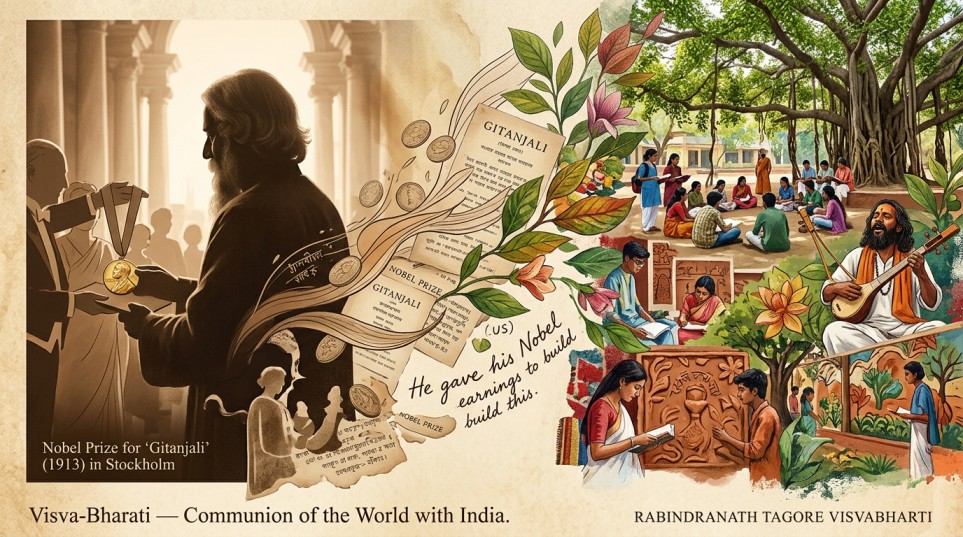
Education and freedom. Tagore founded Visva-Bharati University at Santiniketan in 1921, based on his belief that education should happen in open nature, not in rigid classrooms. His educational philosophy connects to his literary themes of liberation from rigid structures.
If you want to practise MCQs on these themes, the subject-wise previous year question bank has hundreds of questions sorted by topic.
Work-by-work breakdown: what NTA actually asks
Gitanjali (1910/1912)
This is the single most tested Tagore work. Know these facts cold:
- Original Bengali Gitanjali (1910) had 157 poems. The English Gitanjali: Song Offerings (1912) had 103 prose poems — and these 103 were drawn from multiple Bengali collections, not just the original Gitanjali.
- W.B. Yeats wrote the introduction to the English edition. This fact appears in MCQs regularly.
- The Nobel Prize citation praised “his profoundly sensitive, fresh and beautiful verse.”
- Poem 35 (“Where the mind is without fear”) is the single most quoted Tagore poem in exams.
- The English translation uses free verse prose poetry — Tagore translated his own work, and the English versions are quite different from the Bengali originals.
Gora (1910)
Tagore’s longest and most politically complex novel. The protagonist Gora is a Hindu nationalist who discovers he was born to Irish parents — his entire identity collapses. The novel critiques rigid religious identity and caste. NTA asks about the twist ending, the character dynamics (Gora vs Binoy, Sucharita vs Lalita), and the novel’s position on nationalism.
The Post Office (1912)
A dying boy named Amal, confined to a room, waits for a letter from the King. The play works as allegory — the letter represents death as liberation, the room represents societal confinement. André Gide translated it into French and it was performed in Paris during the Nazi occupation. NTA tests symbolism here.
Red Oleanders (1926)
Set in a dystopian mining town called Yakshapuri, ruled by a faceless King. Nandini, the protagonist, represents freedom and natural joy against mechanised oppression. Questions focus on its allegorical criticism of industrialisation and the symbolism of the red oleander flower.
Chandalika (1938)
Based on a Buddhist Jataka tale. A Chandal (Dalit) girl named Prakriti is transformed when Buddhist monk Ananda treats her with compassion. Her mother uses black magic to attract Ananda. The dance drama explores caste, desire, and spiritual awakening. This shows up in questions about Indian drama and dance drama forms.
For more practice on Indian poetry questions from previous years, check our dedicated PYQ section.
Common exam traps and how to avoid them
Trap 1: Confusing the Bengali and English Gitanjali. The Bengali collection has 157 poems; the English has 103 prose poems drawn from multiple collections. NTA has tested this distinction. If a question says “Gitanjali contains 157 poems,” it is referring to the Bengali original.
Trap 2: Thinking Tagore was pro-nationalism. Students who have not read Nationalism (1917) assume Tagore supported the independence movement in the same way as Gandhi. He did not. He returned his knighthood after the Jallianwala Bagh massacre (1919), but his critique of nationalism was philosophical, not just political. He opposed nationalism itself as a Western construct.
Trap 3: Wrong dates for the Nobel Prize. Tagore received the Nobel Prize in 1913, not 1912. The English Gitanjali was published in 1912. Students mix these up. The award was in 1913.
Trap 4: Attributing “The Postmaster” (short story) to “The Post Office” (play). These are two completely different works. “The Postmaster” (1891) is a short story about a lonely postmaster in a rural village. The Post Office (1912) is a play about a dying boy. NTA has used both titles in the same question to confuse students.
Trap 5: Ignoring Tagore’s paintings. NTA occasionally tests the fact that Tagore began painting seriously around 1928, at age 67, and held exhibitions in Europe. His visual art is considered proto-modernist. One or two MCQs across recent papers have referenced this.
How to study Rabindranath Tagore (exam strategy)
If you are short on time before the June 2026 UGC NET exam, here is a focused plan:
Day 1: Gitanjali deep dive. Read at least 15–20 poems from the English Gitanjali (especially Poems 35, 11, 12, 67, 69, 72). Memorise: Bengali publication 1910, English translation 1912, Nobel Prize 1913, Yeats wrote the introduction. Understand it as spiritual but non-sectarian poetry.
Day 2: Novels — Gora and Ghare-Baire. You do not need to read the full novels. Read detailed summaries and focus on characters, plot twists (Gora’s parentage reveal), and thematic questions (nationalism, identity, women’s agency). Know the publication dates.
Day 3: Plays and dance dramas. Focus on The Post Office, Red Oleanders, and Chandalika. Know the allegorical meaning of each. Who translated The Post Office into French? (André Gide.) What does Yakshapuri represent? (Industrial dehumanisation.) What is the Buddhist source of Chandalika?
Day 4: Short stories and essays. Read summaries of “Kabuliwala,” “Punishment,” “The Postmaster,” and “Streer Patra.” Read the key arguments from Nationalism. Know about Visva-Bharati and Santiniketan (founded 1921). Know he returned his knighthood in 1919.
Day 5: MCQ practice and revision. Solve all available Tagore PYQs. Revise dates, the Bengali vs English Gitanjali distinction, and the five exam traps listed above. Use our complete previous year question papers to find Tagore-related questions from past exams.
Previous year question patterns
Based on analysis of recent papers including the June 2025 question paper and the 2025 UGC NET detailed breakdown, NTA frames Tagore questions in four ways:
Type 1: Factual recall. “Who wrote the introduction to the English Gitanjali?” (Yeats.) “In which year did Tagore win the Nobel Prize?” (1913.) These are free marks if you have memorised the basics.
Type 2: Work identification. “Which Tagore play is set in Yakshapuri?” (Red Oleanders.) “Which Tagore story features an Afghan fruit-seller?” (Kabuliwala.) “Which novel ends with the protagonist discovering his Irish parentage?” (Gora.) Straight identification — know your titles.
Type 3: Match the following. NTA gives 4–5 works in Column A and themes/characters/dates in Column B. This is where chronology knowledge pays off. If you know your dates, these become easy.
Type 4: Conceptual and thematic. “Tagore’s critique of nationalism is best reflected in which work?” “Which of the following is NOT a theme in Ghare-Baire?” These require actual understanding, not just memorisation. This is why reading at least summaries of the major works matters.
For a focused look at how Indian Literature questions were structured in recent exams, the Indian Literature previous year questions section has everything organised by author and topic.
Preparing for UGC NET English Literature? Our complete course covers Rabindranath Tagore and 50+ other high-weightage authors with video lectures, topic-wise MCQs, and 13 physical booklets delivered to your door.