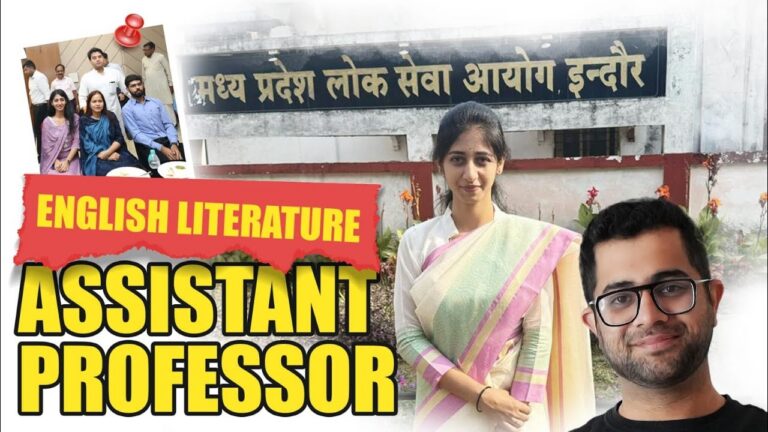
Shortlisted for the MPPSC Assistant Professor English interview? This guide shows you what actually happens inside the room. It is built from the first-hand accounts of two of our students who were selected in the previous MPPSC Assistant Professor English recruitment: Priyal Srivastava, who secured Rank 6, and Nandini Goalkar. Below you will find the questions their panels asked, how the panel is set up, how they prepared their DAF and hometown, and a 30-day plan you can start today.
MPPSC Assistant Professor English Interview at a Glance
Quick answer: The interview carries 100 of the 900 total marks (800 for the written exam and 100 for the interview). In the last recruitment it was taken by a three-member panel, a chairperson and two subject experts, and lasted between 5 and 20 minutes. Expect your DAF and hometown first, then your MA subjects and favourite authors, then higher education, NEP 2020 and teaching.
| Recruitment | Assistant Professor (English) Exam 2025, Advertisement No. 11/2025 |
| English posts | 56 (UR 15, SC 9, ST 11, OBC 15, EWS 6) |
| Written exam | 2 August 2026 (Paper 1 General Studies, Paper 2 English) |
| Interview shortlist | Declared on 28 September 2026 |
| Interview date | Not announced yet (as of 23 October 2026); MPPSC announces it separately |
| Marks | Written 800 + Interview 100 = 900 |
| Panel | 3 members: a chairperson and two subject experts |
| Duration | Usually 5 to 20 minutes |
| Language | Greetings may be in Hindi; subject questions are mostly in English. Answer in the language you are asked in. |
Panel, duration and language are as reported by our selected students. Always confirm dates and instructions on the official MPPSC website, mppsc.mp.gov.in.
Real Questions Asked in the MPPSC Assistant Professor English Interview
These are the questions Priyal and Nandini reported from their own interviews. Panels change, but the pattern repeats: you and your hometown first, then your MA subjects, then teaching and higher education.
| Area | Question asked | Asked to |
|---|---|---|
| Hometown | What does your district have that no other place in Madhya Pradesh has? Follow-ups: its name in English, its botanical name, and which part of the plant is used. | Priyal |
| Hometown | Who is the famous saint of the Nimar region (Sant Singaji), why is he famous, and what is the book of his bhajans called and who wrote it? | Nandini |
| Hometown | Which world-famous personality comes from Khandwa (Kishore Kumar), and why is he famous? | Nandini |
| Hobbies | What is the difference between painting and sketching? What do you paint? Then a mythology question about a painter in Indralok. | Nandini |
| Shakespeare | Who is wrong, Othello or Iago? This turned into a 15 to 20 minute discussion. | Priyal |
| Shakespeare | What are the Quarto and the Folio, what are their years, and how do they differ in size? | Priyal |
| Drama and poetry | What is the difference between a dramatic monologue and a soliloquy? | Priyal |
| Poetry | Identify the poem from a quoted line about the Duke’s commands (Browning’s My Last Duchess). | Priyal |
| Poetry | Who is your favourite poet, and which poem do you like most? (Her answer: Wordsworth, Daffodils.) | Nandini |
| Victorian age | What do you mean by the Victorian Compromise? Follow-up: how did science challenge faith? | Priyal |
| Indian English fiction | What do the serpent and the rope symbolise in Raja Rao’s The Serpent and the Rope? What is the protagonist’s full name? Nandini heard this question was put to many candidates. | Nandini |
| Linguistics | Which subjects did you study in your MA? Then: what is morphology, what are the different forms of words, and what are competence and performance? | Nandini |
| Grammar | What are antonyms and synonyms? Give examples. Other candidates that day reported many grammar questions. | Nandini |
| Teaching | Which quality of your favourite English teacher will you adopt for your own students? | Nandini |
| NEP 2020 | Several questions on the National Education Policy, including how you would connect the Indian Knowledge System with English literature. | Priyal |
| Current affairs | Have you read today’s newspaper? Nandini says many candidates were asked this. | Nandini |
What the Interview Panel Is Really Testing
- Personality, not only knowledge. Nandini calls it a personality test: how calmly you handle pressure and how well you present yourself counts as much as what you know.
- Honesty. Nandini could not answer five or six questions and was still selected. A polite ‘I am sorry, I am not able to recall this’ is better than a guess.
- Conviction. Priyal said Othello was wrong, stuck to her answer and defended it for the whole discussion. Once you take a position, support it with the text.
- Balance. Priyal’s advice: keep answers unbiased towards women, marginalised groups and the LGBTQ+ community, and if one answer sounded one-sided, balance it in the next.
- Clear definitions. In mock interviews many candidates could not answer ‘What is literature?’ Prepare a one-line definition of every genre, form and theory: ode, sonnet, Marxism, post-structuralism.
- Standing out. Priyal noticed that half the candidates prepare The Road Not Taken. She prepared a less obvious poem, Browning’s Prospice, that she could explain in depth.
From Nakul: A lot of students simply study literature and walk into the interview. They never prepare their DAF, their hometown or higher education, and those are exactly the questions that come first.
How to Prepare: The Three-Part DAF Notebook Method
Both students divided their interview preparation into three parts.
| Part | What to prepare |
|---|---|
| 1. English literature | Your 10-unit syllabus, the characteristics of every age (not only its authors and works), your MA subjects, and one-line definitions. Panels pick from the syllabus first because a short interview leaves no time for anything else. |
| 2. Your DAF | Every line you filled in. The meaning of your name and surname and famous people who share them. Your hometown’s history, rulers, rivers, national parks, forts, tribes and education figures. Your school, college and university, and the people they are named after. Your date of birth and anyone famous who shares it. Your hobbies, in depth. |
| 3. Higher education | The career ladder (Assistant Professor, Associate Professor, Professor), the UGC, NEP 2020 and its pillars, the Indian Knowledge System, the difference between school and college teaching, evaluation and assessment, and current affairs of Madhya Pradesh and India. |
Their method: write down every question your DAF can trigger, write your own answer to each one, then polish the language until it sounds professional. Both also watched UPSC and RPSC mock interviews to learn how to sit, listen and answer calmly.
Prepare for the interview with Nakul: English Literature Career Accelerator
An 8-week interview mentorship programme for Assistant Professor aspirants: DAF mastery framework, hometown research strategy, demo teaching practice, mock interviews with detailed feedback reports, an academic CV and personal mentorship.
View the interview course Ask on WhatsApp30-Day MPPSC Interview Preparation Plan
| Days | Focus | What you should have at the end |
|---|---|---|
| 1 to 7 | DAF and hometown | One notebook page for every DAF line, and a hometown section: history, geography, tribes, education, famous people |
| 8 to 14 | Literature | Age-wise characteristics, your MA subjects, a favourite author with two poems you can explain, one-line definitions |
| 15 to 21 | Higher education and teaching | NEP 2020, the Indian Knowledge System linked to literature, UGC and the career ladder, teaching methods, one demo-teaching topic |
| 22 to 30 | Mock interviews | At least three full mock interviews with feedback, the newspaper every day, and rewritten answers for every weak spot |
Watch: Priyal (Rank 6) and Nandini on Their MPPSC Interviews
Priyal Srivastava, Rank 6: her panel, the Othello debate, the Victorian Compromise question and her three-part preparation.
Nandini Goalkar: how her interview moved from her hometown to linguistics, poetry, prose and grammar, and how she prepared her DAF.
More Guides for MPPSC and Assistant Professor Aspirants
- MPPSC English literature preparation strategy 2026
- 1000+ literary theory MCQs: revise the theories you must define in one line
- English literature authors A to Z: guides for your favourite-author questions
- UP Assistant Professor English (UPESSC) guide, for the next interview cycle
- More success stories from our students
MPPSC Assistant Professor English Interview: Frequently Asked Questions
How many marks is the MPPSC Assistant Professor interview?
The interview carries 100 marks. The written exam carries 800, so the final merit is out of 900.
When is the MPPSC Assistant Professor English interview in 2026?
The interview shortlist for the English exam was declared on 28 September 2026. As of 23 October 2026 the interview dates have not been announced; MPPSC releases them separately on mppsc.mp.gov.in.
Who sits on the MPPSC Assistant Professor interview panel?
Our selected students faced a three-member panel: a chairperson and two subject experts. The chairperson usually opens with your DAF and hometown, and the subject experts take over for English.
Is the MPPSC interview in English or Hindi?
Greetings and the opening may be in Hindi, but the subject questions are mostly in English. Answer in the language in which you are asked.
What questions are asked in the MPPSC Assistant Professor English interview?
Questions on your DAF and hometown, your MA subjects, your favourite authors and specific texts (Othello, The Serpent and the Rope, My Last Duchess), linguistics and basic grammar, NEP 2020 and the Indian Knowledge System, teaching, and current affairs.
What should I do if I don’t know an answer?
Say so honestly and politely. Nandini could not answer five or six questions and was still selected; honesty leaves a better impression than a guess.
How should I start preparing for the interview?
Build a DAF notebook in three parts (English literature, your DAF and hometown, higher education), write an answer to every question your DAF can trigger, then practise with mock interviews.
Shortlisted for the MPPSC interview?
Practise with Nakul before the real panel: DAF review, hometown research, demo teaching and mock interviews with detailed feedback.
Join the interview course
