UGC NET English PYQs from 2008 to 2026, Organised by Topic, Not by Year
✔ Solved: every question with the answer and a short explanation
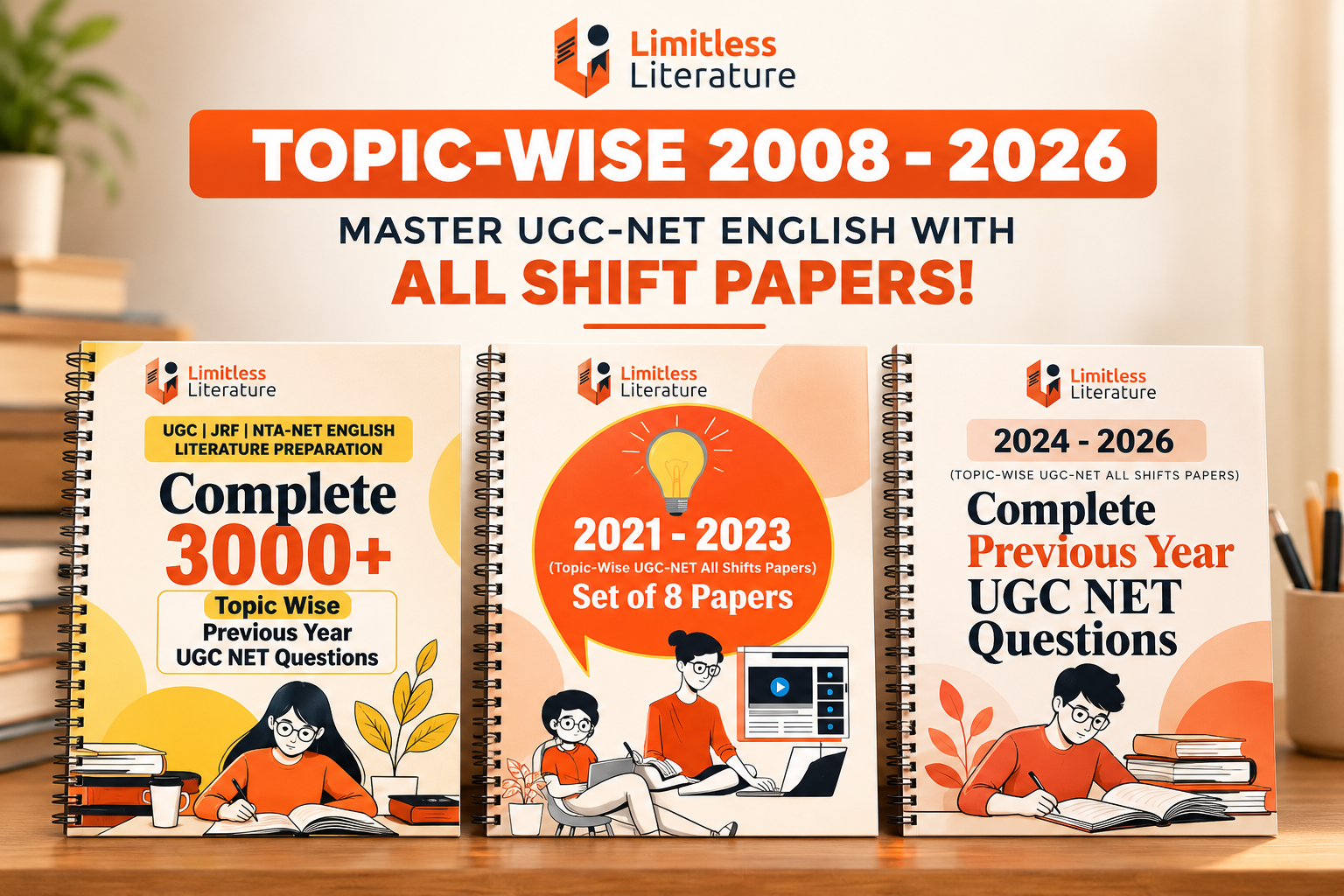
A printed set of UGC NET English Literature questions from 2008–2023 (both shifts) and the latest 2024–2026 papers, grouped by subject so you can see which topics keep coming back and revise those first.
Secure online payment · Tracking ID sent on dispatch · 1,000+ students
📦 Printed and delivered to your door. No PDF.
“Paper 2 exam me sab aapke booklet se hi aaya tha.. maine utna cover ni kiya.. but jitna bhi padha tha.. sab aapke material se hi puccha gaya tha.”
In the Paper 2 exam, everything came from your booklet. I hadn’t covered all of it, but whatever I had read was asked from your material.
Ruksar Sana“So many questions I got common from your materials Sir….”
Sayani Misra“Thank you so much sir, actually your study material contributed a lot for this exam, more direct questions have been asked.”
Abin M.R.WhatsApp messages from students who studied with Limitless Literature’s printed material. More below.
The Same Topics Keep Coming Back
In the 2024–2026 papers alone, 5 of the 6 Structuralism questions were on Saussure.
Langue and parole, the synchronic approach, the sign, the speaking circuit: the examiner keeps returning to the same few ideas. You only notice this when the questions sit together by topic. In a year-by-year paper, they are scattered across six different exams.
- See which authors and ideas are asked again and again
- Revise the repeated topics first, then the rest
- Check every answer with a short explanation, right below the question
This is how the whole set works, from British Literature to Research Methodology.
1. Choose the correct statements with regard to the binary pair Langue and Parole introduced by Ferdinand de Saussure:
- (A) Langue is translated as speech and parole as language.
- (B) Langue is the internal structure of a language; not language itself.
- (C) Parole is the event of language.
- (D) Parole and language are a set of vocabulary only.
- (E) There is no distinction between Parole and Langue.
- (1) A and C only (2) A and E only (3) C and B only (4) A and D only
2. Match the List-I with List-II
- (A) Langue (B) Parole (C) Signifier (D) Signified
- (I) Meaning conveyed (II) Socially shared language (III) Speech (IV) Word
- (1) A-II, B-III, C-IV, D-I
- (2) A-I, B-IV, C-III, D-II
- (3) A-III, B-II, C-I, D-IV
- (4) A-IV, B-III, C-II, D-I
3. Who said that language is a system of signs whose parts must be considered in their synchronic solidarity?
- (1) Saussure (2) Bloomfield
- (3) Roman Jakobson (4) Sigmund Freud
4. Who has coined the phrase “Bricolage”?
- (1) Claude Levi Strauss (2) Raymond Williams
- (3) Martin Heidegger (4) Michel Foucault
5. According to Ferdinand de Saussure, what is the minimum number necessary to complete the speaking-circuit?
- (1) 1 (2) 2 (3) 3 (4) 4
6. Fill in the blanks in the following statement from the options provided below. Ferdinand de Saussure undertook a ______ approach which saw language as a ______ that could be studied in its entirety at a given point in time.
- (1) historical, web (2) philological, rule
- (3) diachronic, utterance (4) synchronic, structure
A real page from the 2024–2026 section. Highlighted: the Saussure questions.
What’s Inside
We’ve taken the questions asked in the UGC NET English Literature exam and organised them by topic in one printed set:
2008–2020 · 2021–2023 (both shifts) · 2024–2026, the latest papers
Every question comes with the correct answer and a one- or two-line explanation, so you know why an option is right, not just which one. It took us over three months to compile and organise, and more than a thousand students have already used it. It suits any English Literature competitive exam aspirant, not just UGC NET.
- 01British Novels & Prose
- 02British Drama
- 03British Poetry
- 04Literary Theory
- 05World Literature
- 06Literary Criticism
- 07English Education in India
- 08Indian Literature
- 09Language & Linguistics
- 10Research Methodology
- 11American Literature
- 12Literary Movements, Awards & Magazines
- 13Reading Comprehension
1. What is the title of Mary Wollstonecraft’s autobiographical novel?
- (1) Maria; or, the Wrongs of Woman (2) Mary: A Fiction
- (3) Wives and Daughters (4) The Well of Loneliness
5. From the statements given below, what is true about the Gothic Novel?
- (A) It appeared in 14th Century American Literature.
- (B) It often uses the medieval form of architecture as setting.
- (C) It is a form of baroque art.
- (D) It represents a style of mosaic and fresco wall painting.
- (E) It aims at evoking chilling terror by exploiting mystery and a variety of horrors.
- (1) A and D only (2) C and E only (3) B and D only (4) B and E only
Real pages from the 2024–2026 section. The 2008–2020 and 2021–2023 sections follow the same layout.
Topic-Wise Questions, 2008–2026
- British Literature: Poets
- British Literature: Dramatists and Novelists
- Literary Theory
- Literary Criticism
- African American Literature
- American Literature
- Indian Literature
- World Literature
- English Education in India
- Language
- Magazines, Bibles & Literary Movements
- Research Methodology
How to Use It in 30 Days
- Days 1–8British Literature: poetry, drama, novel and prose
- Days 9–14Literary Theory and Literary Criticism
- Days 15–19Indian Literature and American Literature
- Days 20–23World Literature, Language, Research Methodology, English Education in India
- Days 24–27Literary movements, awards and magazines; reading comprehension
- Days 28–30Go back only to the questions you got wrong
- Attempt a topic’s questions before you look at the answers.
- Mark every question you got wrong or guessed.
- Read the explanation, and note the names that keep repeating.
- In the last three days, revise only what you marked.
What Students Say About Our Printed Material
Real WhatsApp messages from students who studied with Limitless Literature’s printed material. Tap a screenshot to read it in full.
 “Paper 2 exam me sab aapke booklet se hi aaya tha…”Ruksar Sana
 “So many questions I got common from your materials Sir….”Sayani Misra
 “…your study material contributed a lot for this exam, more direct questions have been asked.”Abin M.R.
 “As i read your booklet it gives me confidence that yes I’m on right path.”A student
 “Your notes and guidelines both are excellent and yes when I saw this question paper your notes… always knock in my mind during exam Sir.”Sima Barman
 “Entire content in the booklets are wonderfully structured that even average students can also understand the difficult topics in a easier way.”Meena
 “Thank you so much for the wonderful study material (Paper 2) Sir. You designed it very neat and clear…”Chethana K.
 “…surely your help (specifically the material), I got through NET.”Harica Paul
More student stories on our Achievers page.
Order Details
| What you get | Printed topic-wise PYQs, solved with answers and short explanations |
| Coverage | 2008–2023 (both shifts) + 2024–2026, all in print |
| Format | Printed only (no PDF) |
| Price | ₹1,799 (online payment) |
| Delivery | Free, 5–7 days, tracking ID provided |
We dispatch as soon as your order comes in.

Questions? Message Nakul directly.
We’ll dispatch your order as soon as it’s placed and send a tracking ID so you can follow it online. For anything else, whether it’s deciding if this suits your prep or a delivery question, reach out directly.
💬 WhatsApp: +91-7891410858Common Questions
Are the answers and explanations included?
Yes. Every question comes with the correct answer and a one- or two-line explanation right below it, so you understand why an option is right.
How is this different from downloading previous papers for free?
Free PYQ PDFs are arranged by year and usually come without explanations. This set regroups the questions from 2008–2026 by topic (Literary Theory, British Literature, Indian Literature and so on) and solves every one, so you can revise subject by subject and see which topics keep coming back.
Does it cover the latest papers (2024, 2025, 2026)?
Yes. The 2024–2026 papers are included in the set, printed and delivered together with the 2008–2023 questions.
Do I get a PDF or digital copy?
No. This is a fully offline, printed set delivered to your address. There is no PDF.
How long does delivery take?
5–7 days, with free delivery. We dispatch as soon as the order is placed and send you a tracking ID so you can follow it online.
Is this enough on its own, or do I need the full course too?
The set is a standalone PYQ resource, organised by topic. If you want structured lectures and notes alongside it, that’s a separate product. Message us on WhatsApp and we’ll help you figure out what fits your prep stage.
Which exams is this useful for?
Built from UGC NET English Literature papers, but the topic-wise organisation makes it useful for any English Literature competitive exam, including GATE, CUET PG and state-level exams.
What if I have a question after ordering?
WhatsApp Nakul Grover directly at +91-7891410858, or email limitlessliteratureugcnet@gmail.com.
2008–2026. Organised. Solved. In Print.
UGC NET English Literature PYQs sorted by topic, with answers and short explanations, delivered to your door, so you know exactly what to study next.
Order Now for ₹1,799 →