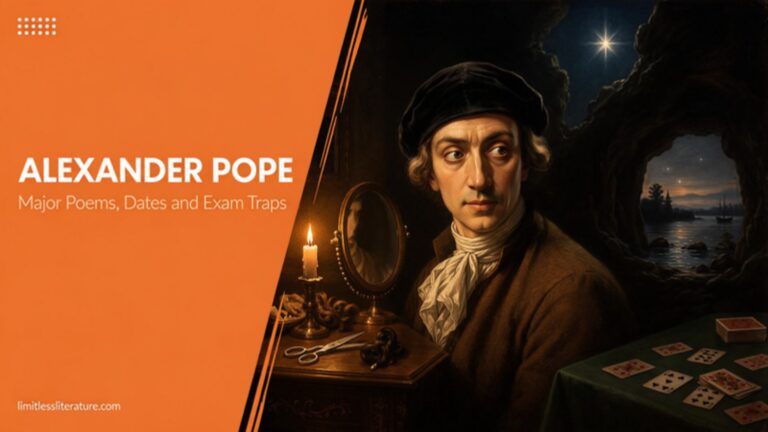
In 1712 The Rape of the Lock was a short poem in two cantos. Two years later it had five. Pope did not just lengthen it: he added the sylphs, the gnome Umbriel, the Cave of Spleen and the game of ombre, which are the very parts exam setters love. So when a question asks how many cantos the poem has, the honest answer is “it depends on the year”, and the paper usually tells you the year. Read the stem slowly. That small habit decides a surprising number of Pope questions.
Quick answer: Alexander Pope (1688–1744) is the leading poet of the Augustan or neoclassical age and the master of the heroic couplet. For exams, know four works cold: An Essay on Criticism (1711), The Rape of the Lock (1712, enlarged 1714), The Dunciad (1728, final four-book version 1743) and An Essay on Man (1733–34), plus the portraits of Atticus and Sporus in the Epistle to Dr Arbuthnot.
Asked in: UGC NET and JRF, State SET, GATE English, KVS and State PGT/TGT, and Assistant Professor recruitment exams.
What only our question bank can tell you
How often Pope is asked: we counted the solved previous year questions on our own topic-wise and year-wise pages. At least 34 questions name Pope or one of his works, and he appears as a wrong option in at least 15 more. The year-labelled papers on our site that ask him run from January 2025 to June 2026; the older topic-wise pages, including the Alexander Pope PYQ page (14 questions), do not carry year labels.
The exam trap: setters hide Pope’s lines among his own poems. “Wretches hang that jury-men may dine” sounds like a maxim from An Essay on Criticism, and the option list puts it beside “A little learning is a dangerous thing” and “Fools rush in where angels fear to tread”. It is from The Rape of the Lock. The second trap is the reverse: Pope is offered as the author of things he did not write, such as Verses on the Death of Dr Swift (Swift wrote it about himself) or “Where ignorance is bliss” (Gray).
In Nakul’s words: “Alexander Pope was the sharpest poet of the eighteenth century. The interesting thing is that he kept insulting everyone in his poetry, and with such elegance that the other person did not even realise they had been mocked.” And on The Rape of the Lock: “It is not about Belinda’s curl. Pope was targeting upper-class British society, its shallow priorities and drama: you make small things so big, as if the world is ending.” (Nakul Grover, translated from Hindi, The Rape of the Lock: The Art of the Polite Insult, May 2026.)
Pope at a glance
Born: 21 May 1688, London
Died: 30 May 1744, Twickenham, near London
Age: Augustan or neoclassical, the Age of Pope
Signature form: the closed heroic couplet (rhymed iambic pentameter)
Circle: the Scriblerus group with Swift, Gay and Arbuthnot
Background: a Roman Catholic, so barred from university and public office; largely self-taught
Why exams keep returning to Pope
Pope gives a paper setter everything in one name. He is a poet (The Rape of the Lock), a critic in verse (An Essay on Criticism), a satirist (The Dunciad, the Arbuthnot portraits), a philosopher in verse (An Essay on Man) and a translator (Homer). So he turns up on the British poetry pages and on the literary criticism PYQ page, which very few poets manage. If you are short of time, spend it on the Essay on Criticism and The Rape of the Lock: between them they account for just over half of the questions we counted.
The question types repeat. Identify the poem from two lines. Arrange four works in order of publication. Name the real person behind a satiric portrait. Pick the statement that is not true of a poem. Each of these rewards exact knowledge of a small number of facts, which is good news for you.
Works with dates
| Year | Work | Form and what to remember |
|---|---|---|
| 1709 | Pastorals | Four pastorals for the seasons, printed in Tonson’s Poetical Miscellanies; drafted years earlier |
| 1711 | An Essay on Criticism | Verse essay in heroic couplets, three parts; “follow Nature” |
| 1712 | The Rape of the Lock (first version) | Mock-epic in two cantos |
| 1713 | Windsor-Forest | Topographical poem, celebrates the Peace of Utrecht |
| 1714 | The Rape of the Lock (enlarged) | Five cantos; sylphs and gnomes added |
| 1715–20 | Translation of Homer’s Iliad | Made his fortune; paid for the Twickenham villa |
| 1717 | Works (first volume), with Eloisa to Abelard and Elegy to the Memory of an Unfortunate Lady | Same year Clarissa’s speech entered The Rape of the Lock |
| 1725 | Edition of Shakespeare | Attacked by Lewis Theobald, who became the hero of the first Dunciad |
| 1725–26 | Translation of the Odyssey | Done with two helpers, Broome and Fenton |
| 1728 | The Dunciad; Peri Bathous, or the Art of Sinking in Poetry | Mock-epic on dullness, hero Theobald; the Variorum with mock notes followed in 1729 |
| 1731–35 | Moral Essays (Epistles to Several Persons) | Four epistles: to Cobham, to a Lady (Martha Blount), to Bathurst, to Burlington |
| 1733–34 | An Essay on Man | Four epistles addressed to Bolingbroke; “Whatever is, is right” |
| 1733–38 | Imitations of Horace | Satires and epistles adapted to London life |
| 1735 | Epistle to Dr Arbuthnot | Verse apology; Atticus (Addison) and Sporus (Lord Hervey). Printed January 1735, so some books give 1734 |
| 1743 | The Dunciad in four books | Colley Cibber replaces Theobald as hero; the fourth book had appeared as The New Dunciad in 1742 |
One order to learn by heart, because it was asked directly: Essay on Criticism (1711), Rape of the Lock (1712), Dunciad (1728), Essay on Man (1733–34). Criticism comes before the Rape; most students guess the other way round.
The poems exams ask about
An Essay on Criticism (1711)
Pope was in his early twenties when this came out, and it reads like a confident young man laying down the law. It is in three parts: the sources of taste and the rule to “follow Nature”, the causes of bad criticism (pride first of all, “the never-failing vice of fools”, a line asked in January 2025), and the character of the good critic, closing with a short history of criticism. The ancients Pope praises are Aristotle, Horace, Dionysius, Petronius, Quintilian and Longinus; an option that slips in Dryden or Durfey is wrong. Boileau’s L’Art poétique stands behind the poem, which is why it appears in neoclassicism statements. De Quincey later called it the feeblest of Pope’s works, “a metrical multiplication table” of commonplaces, and that remark has been asked too.
The Rape of the Lock (1712; 1714; 1717)
A real quarrel started it. Lord Petre cut a lock of Arabella Fermor’s hair, the two Catholic families fell out, and John Caryll asked Pope to laugh them back into friendship. In the poem Belinda wakes, is guarded by the sylph Ariel, sails to Hampton Court, wins at ombre, and loses the lock to the Baron’s scissors. The gnome Umbriel brings a bag of sighs and a vial of tears from the Cave of Spleen; Thalestris stirs the battle; Sir Plume makes a feeble demand; Clarissa, in the speech added in 1717, tells everyone to keep good humour. The lock rises to heaven as a star. Belinda’s lapdog is Shock, and Pope keeps comparing her to the sun. This is mock-epic: epic machinery applied to a trivial event, which is exactly Nakul’s point above.
The Dunciad (1728–1743)
A mock-epic on the empire of Dullness. Its idea comes from Dryden’s Mac Flecknoe, where a dull poet is crowned heir to dullness. The hero changes: Lewis Theobald in 1728, Colley Cibber in 1743. The final book ends with Chaos restored and “Universal Darkness buries All”. If an option asks which poem best captures religious and political turmoil after the Restoration, The Dunciad is a distractor; that answer is Absalom and Achitophel.
An Essay on Man (1733–34)
Four verse epistles addressed to Henry St John, Lord Bolingbroke, whose ideas lie behind it. The argument is a theodicy: man’s place in the chain of being, his passions, society and happiness. Two traps: it is a poem, not a prose essay, and “Great wits are sure to madness near allied” is Dryden (Absalom and Achitophel), not this poem.
Epistle to Dr Arbuthnot (1735)
Pope’s defence of his own career as a satirist, in the form of a talk with his friend and physician. Learn the two portraits: Atticus is Addison (the man who would “damn with faint praise”), and Sporus is Lord Hervey (“Who breaks a butterfly upon a wheel?”). The lines “Born to no pride, inheriting no strife” describe Pope’s father. The advice to “keep your piece nine years” is Horace’s, from the Ars Poetica.
Also worth one look
Eloisa to Abelard (1717), a heroic epistle in Ovid’s manner, is the source of “Eternal sunshine of the spotless mind”. The Moral Essays matter only for their four addressees. Pope also wrote the epitaph on Isaac Newton (“Nature and Nature’s laws lay hid in night”), and with Gay and Arbuthnot the farce Three Hours after Marriage (1717).
Asked in exams: real questions from our pages
| Question (short) | Answer | Source |
|---|---|---|
| “Oh, say what stranger cause, yet unexplored, / Could make a gentle belle reject a lord?” Identify the poet | Alexander Pope (The Rape of the Lock) | June 2026, Q16 |
| “Of all the causes which conspire to blind / Man’s erring judgement… Is pride, the never-failing vice of fools”: which text? | An Essay on Criticism | January 2025, Q67 |
| “Fop at the toilet, flatt’rer at the board, / Now trips a lady, and now struts a lord” is from | Epistle to Dr Arbuthnot | Pope PYQs, Q1 |
| “First follow ___ and your judgement frame / By her just ___, which is still the same” | Nature, standard | Pope PYQs, Q2 |
| The main idea of The Dunciad was taken from | Mac Flecknoe | Pope PYQs, Q3 |
| Whom does Pope satirise as Sporus? | Lord Hervey | Pope PYQs, Q4 |
| The Rape of the Lock was published in 1712 in how many cantos? | Two | Pope PYQs, Q5 |
| In the 1717 revision Pope inserted a speech by | Clarissa | Pope PYQs, Q13 |
| Arrange: Dunciad, Rape of the Lock, Essay on Man, Essay on Criticism | Criticism, Rape, Dunciad, Man | Literary criticism PYQs, Q81 |
| Which line is NOT in An Essay on Criticism? | “Wretches hang that jury-men may dine” | Literary criticism PYQs, Q61 |
| An Essay on Man is based on the ideas of | Lord Bolingbroke | Literary criticism PYQs, Q40 |
| The four Moral Essays are addressed to | Martha Blount, Lord Cobham, Bathurst, Burlington | Literary criticism PYQs, Q130 |
| “Some are bewildered in the maze of schools…” is from | An Essay on Criticism | Criticism PYQs (set 2), Q54 |
| Who collaborated on the satire Three Hours after Marriage? | Gay, Pope and Arbuthnot | Remaining dramatists PYQs, Q24 |
For the full sets, use the subject-wise previous year questions collection and the British poetry PYQs, where Pope mostly appears as the tempting wrong option.
Confused pairs
| Students write | Correct | How to keep them apart |
|---|---|---|
| Pope, Verses on the Death of Dr Swift | Jonathan Swift | Swift imagined his own death and his friends’ reactions, Pope among them |
| Pope, “Where ignorance is bliss, ’tis folly to be wise” | Thomas Gray | Gray’s Eton College ode; Gray also wrote Hymn to Adversity |
| Pope, “Great wits are sure to madness near allied” | Dryden, Absalom and Achitophel | It describes Achitophel (Shaftesbury); Dryden wrote it in 1681, before Pope was born |
| Mac Flecknoe and The Dunciad by the same poet | Dryden and Pope | Dryden crowns Shadwell; Pope crowns Theobald, then Cibber |
| Essay on Man as prose philosophy | A verse poem in four epistles | Dryden’s Essay of Dramatic Poesy and Locke’s Essay are the prose ones |
| Atticus = Hervey, Sporus = Addison | Atticus = Addison, Sporus = Hervey | A for Atticus, A for Addison |
Quotation bank
| Line | Poem |
|---|---|
| “A little learning is a dangerous thing” | An Essay on Criticism |
| “To err is human, to forgive divine” | An Essay on Criticism |
| “Fools rush in where angels fear to tread” | An Essay on Criticism |
| “True wit is Nature to advantage dressed, / What oft was thought, but ne’er so well expressed” | An Essay on Criticism |
| “The sound must seem an echo to the sense” | An Essay on Criticism |
| “What dire offence from amorous causes springs, / What mighty contests rise from trivial things” | The Rape of the Lock, opening |
| “And wretches hang that jury-men may dine” | The Rape of the Lock, Canto III |
| “Hope springs eternal in the human breast” | An Essay on Man, Epistle I |
| “Know then thyself, presume not God to scan; / The proper study of mankind is man” | An Essay on Man, Epistle II |
| “Damn with faint praise” | Epistle to Dr Arbuthnot (Atticus) |
| “Eternal sunshine of the spotless mind” | Eloisa to Abelard |
Exam traps and the right answer
- Canto count. Two cantos in 1712, five in 1714. Clarissa’s speech arrives only in 1717. Check the year in the stem.
- Lines from the wrong poem. “Wretches hang that jury-men may dine” is The Rape of the Lock, not An Essay on Criticism.
- Publication order. Essay on Criticism (1711) comes before The Rape of the Lock (1712). An Essay on Man (1733–34) comes after The Dunciad (1728).
- The Dunciad’s hero. Theobald in 1728, Cibber in the four-book version of 1743. If the question gives no date, read the options for a clue.
- Whose ideas. An Essay on Man rests on Bolingbroke, not Theobald or Hervey; those two are targets of Pope’s satire.
- The ancients Pope praises. Aristotle, Horace, Dionysius, Quintilian and Longinus. Dryden and Durfey are modern, so an option with either is wrong.
Pope reads best beside the poet he learned from and the critic who judged him: see our guides to John Dryden and Samuel Johnson, whose Lives of the Poets includes a long life of Pope. For the ancients Pope praises, read Aristotle and Longinus. Every other author is on the Authors A–Z page.
For a longer life and context, see Britannica’s entry on Alexander Pope.
Test yourself
1. The Rape of the Lock first appeared in 1712 in
(A) five cantos (B) two cantos (C) three cantos (D) four cantos
Answer: B. The five-canto version with the sylphs came in 1714.
2. In the Epistle to Dr Arbuthnot, “Sporus” stands for
(A) Joseph Addison (B) Colley Cibber (C) Lewis Theobald (D) Lord Hervey
Answer: D. Addison is Atticus; Theobald and Cibber are the heroes of The Dunciad.
3. “A little learning is a dangerous thing” comes from
(A) An Essay on Criticism (B) An Essay on Man (C) The Dunciad (D) The Rape of the Lock
Answer: A. It opens a famous passage in Part II of the Essay on Criticism.
4. An Essay on Man is addressed to
(A) John Arbuthnot (B) Jonathan Swift (C) Lord Bolingbroke (D) Martha Blount
Answer: C. Henry St John, Lord Bolingbroke, whose ideas shape the poem.
5. Who replaced Theobald as hero of the 1743 Dunciad?
(A) Colley Cibber (B) Thomas Shadwell (C) John Dennis (D) Richard Bentley
Answer: A. Shadwell is Dryden’s target in Mac Flecknoe, not Pope’s hero.
FAQ
Which Pope works are asked most in English literature exams?
An Essay on Criticism and The Rape of the Lock, followed by the Epistle to Dr Arbuthnot, An Essay on Man and The Dunciad. In our solved papers these five cover most Pope questions.
How many cantos does The Rape of the Lock have?
Two in the first version of 1712 and five in the enlarged version of 1714, which added the sylphs and gnomes. Clarissa’s speech was added in 1717.
Why is Pope studied under literary criticism as well as poetry?
Because An Essay on Criticism (1711) is a verse treatise on taste and the good critic, written under the influence of Horace and Boileau, so it is asked on criticism papers too.
Who are Atticus and Sporus?
Two satiric portraits in the Epistle to Dr Arbuthnot (1735): Atticus is Joseph Addison and Sporus is Lord Hervey.
Keep going
One author down. Here is where to go next.
- English Literature Authors A–Z: every author guide, mind map and question set on this site
- 5,000+ topic-wise previous year questions from UGC NET, GATE and SET
- UGC NET English guide: syllabus, exam pattern and preparation plan
Preparing for UGC NET English June 2027?
Eklavya Batch | UGC NET June 2027. From foundation to final: printed booklets for the full syllabus, 300+ video lectures and every-day Google Meet sessions with Nakul Sir.
See the Eklavya Batch → 💬 WhatsApp Nakul Sir: 78914 10858