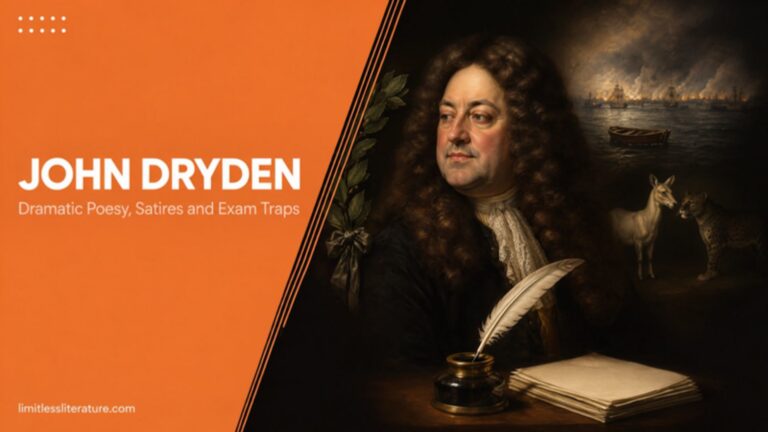
Most students read the word “Essay” in Dryden’s most famous critical work and picture a writer arguing in his own voice, paragraph after paragraph. That picture costs marks. Of Dramatic Poesy: An Essay (1668) is a dialogue. Four gentlemen take a boat down the Thames in June 1665 to listen to the guns of the Second Dutch War, and when the firing fades they argue about plays. Our criticism question pages ask the form of the work outright, and half the other Dryden questions only make sense once you know who is speaking.
So this guide starts with the speakers, then moves to the satires, the religious poems and the plays. That order matches what examiners actually ask.
Quick answer: John Dryden (1631–1700) was the leading poet, dramatist and critic of the Restoration, England’s first official Poet Laureate (1668), and the writer whose name is given to the age. For exams, know Of Dramatic Poesy (1668) and its four speakers, the satires Absalom and Achitophel (1681) and Mac Flecknoe (1682), the religious poems Religio Laici (1682) and The Hind and the Panther (1687), All for Love (1677) and the Preface to Fables (1700).
Asked in: UGC NET, State SET, GATE, KVS and State PGT/TGT, and Assistant Professor exams.
What our own question bank says about Dryden
How often he is asked: Dryden or one of his works is named in at least 38 questions across our solved previous year question pages. At least 19 sit on the literary criticism PYQ page alone, eight on the British poetry page and five on the John Dryden PYQ page. The dated ones come from the June 2024, June 2025 and June 2026 papers; the topic-wise pages do not print the year.
The exam trap: the options are built from near-misses. One question on the Essay offers “the relative merits of French and English theatre” and, right below it, “the relative merits of French and English poetry”. Only theatre is correct. Another lists five statements about Religio Laici; the wrong ones say it attacks the Anglican Church, came out in 1690 and is a prose treatise. It is a verse defence of a layman’s Anglican faith, printed in 1682.
In Nakul’s words: “Remember C for Classical: Crites is always defending the Ancients. Lisideius, think of the lily, the symbol of the French: Lisideius always praises the French. And Neander, the new man, is Dryden himself.” (Nakul Grover, Complete An Essay on Dramatic Poesie by John Dryden, One Shot Revision, Limitless Literature on YouTube, lightly cleaned from the spoken class.)
Dryden at a glance
Born: 9 August 1631 (Old Style), Aldwinkle, Northamptonshire
Died: 1 May 1700 (Old Style), London; buried in Westminster Abbey
Education: Westminster School; Trinity College, Cambridge
Offices: Poet Laureate from 1668 and Historiographer Royal from 1670; lost both after the 1688 revolution, and Thomas Shadwell took the laureateship
Kinds of work: heroic plays and tragedies in rhyme, later blank verse; comedies; verse satire; religious argument in verse; odes; translation; prose criticism in prefaces and dialogues
Labels exams use: “Age of Dryden” (1660–1700), father of English criticism (Johnson’s phrase), master of the heroic couplet
Why examiners keep coming back to him
Dryden covers three sections of a paper at once. He is a critic, so the Essay turns up in criticism units. He is the great verse satirist before Pope, so Mac Flecknoe and Absalom and Achitophel appear in poetry units. And he is a Restoration dramatist, so All for Love and the heroic plays come up in drama questions. Each work also comes with a key of real people behind invented names, which gives setters easy matching questions.
My advice: know the four speakers and what each defends, four or five lines from the Essay, the two satires with their keys, the two religious poems, two plays and the Preface to Fables. That covers nearly everything in our bank. Leave the long list of minor plays to a quick glance at titles and dates.
Main works with dates
Dates are first publication unless marked; for plays the stage date is given where exams use it.
| Work | Date | Kind | Remember it for |
|---|---|---|---|
| Heroic Stanzas | 1659 | Elegy in quatrains | On the death of Oliver Cromwell |
| Astraea Redux | 1660 | Panegyric | Welcomes Charles II back: the turn to the Crown |
| Annus Mirabilis | 1667 | Poem in quatrains | The “year of wonders” 1666: Dutch war and the Great Fire |
| Of Dramatic Poesy: An Essay | 1668 | Critical dialogue | Four speakers; ancients vs moderns, French vs English |
| The Conquest of Granada (two parts) | staged 1670–71, printed 1672 | Heroic play in rhymed couplets | Almanzor; mocked in Buckingham’s The Rehearsal |
| Aureng-Zebe | staged 1675 | Heroic tragedy in rhyme | His last rhymed tragedy; Mughal setting |
| All for Love | staged 1677, printed 1678 | Tragedy in blank verse | Antony and Cleopatra retold under the unities |
| The State of Innocence | printed 1677 | Opera libretto (never staged) | Dryden’s rhymed dramatisation of Paradise Lost |
| Absalom and Achitophel | November 1681 | Political satire in couplets | Exclusion Crisis told as a Bible story |
| The Medal | 1682 | Satire | Subtitle “A Satire against Sedition”; again Shaftesbury |
| Mac Flecknoe | written late 1670s, pirated 1682, authorised 1684 | Mock-heroic satire | Crowns Thomas Shadwell king of dullness |
| Religio Laici | 1682 | Verse argument | “A Layman’s Faith”: the Anglican middle way |
| The Hind and the Panther | 1687 | Beast allegory in verse | Written after his conversion to Catholicism |
| A Song for St Cecilia’s Day | 1687 | Ode | Music and the creation of the world |
| Discourse Concerning the Original and Progress of Satire | 1693 | Critical essay | Compares Horace, Juvenal and Persius |
| Alexander’s Feast | 1697 | Ode for St Cecilia’s Day | Timotheus plays, Alexander’s moods follow |
| The Works of Virgil | 1697 | Translation | Eclogues, Georgics and Aeneid in couplets |
| Fables, Ancient and Modern (with Preface) | 1700 | Verse versions plus preface | Chaucer as “father of English poetry”; “God’s plenty” |
Of Dramatic Poesy, speaker by speaker
Dryden wrote the dialogue while the London theatres were shut by the plague of 1665–66. It runs as two debates. Crites and Eugenius argue ancients against moderns. Lisideius and Neander argue French drama against English. Before they begin, the four agree on a definition of a play, which Lisideius offers: “a just and lively image of human nature”, showing its passions and changes of fortune “for the delight and instruction of mankind”.
| Speaker | Defends | Usually identified with | Point to remember |
|---|---|---|---|
| Crites | The ancients (Greek and Roman drama) | Sir Robert Howard, Dryden’s brother-in-law | Opens the debate; praises the unities; also argues against rhyme in plays |
| Eugenius | The moderns | Charles Sackville, Lord Buckhurst, the dedicatee | Shows that the ancients broke the unities themselves |
| Lisideius | French drama | Sir Charles Sedley | Gives the definition of a play; attacks English tragicomedy |
| Neander (“new man”) | English drama | Dryden himself | Defends tragicomedy and rhyme in serious plays; examines Epicoene |
Three ideas carry most questions. The unities: the French keep time, place and action tight; Neander argues the English variety of plot gives more pleasure. Tragicomedy: Sidney had mocked “mongrel tragi-comedy”; Neander calls it an English invention and defends it. Rhyme: Crites says rhyme is unnatural in dialogue; Neander defends it for serious plays. Dryden himself later moved away from rhyme, and All for Love is in blank verse.
Neander’s verdicts on English writers are favourite quotation questions. Of Shakespeare: he “needed not the spectacles of books to read Nature”. Of Ben Jonson: “the most learned and judicious writer which any theatre ever had”, followed by the line students remember, “I admire him, but I love Shakespeare”. Neander also chooses Jonson’s Epicoene, or The Silent Woman as his model of a regular English comedy. In A Defence of an Essay of Dramatic Poesy (1668) Dryden puts delight first: it is “the chief, if not the only, end of poesy”, with instruction in second place.
The satires and the religious poems
Absalom and Achitophel (1681). During the Exclusion Crisis, the Earl of Shaftesbury backed the Duke of Monmouth, Charles II’s illegitimate son, as heir in place of the Catholic James. Dryden retells this as the Old Testament story of King David and his rebel son. Achitophel, the tempter, is Shaftesbury; Absalom is Monmouth; David is Charles. The portrait of Achitophel gives the famous couplet: “Great wits are sure to madness near allied, / And thin partitions do their bounds divide.” A second part followed in 1682, mostly by Nahum Tate, with Dryden’s lines on Og and Doeg.
Mac Flecknoe. A mock-heroic in which Richard Flecknoe, an old poet who “in prose and verse was owned without dispute” the king of dullness, chooses his heir: Thomas Shadwell. It opens “All human things are subject to decay, / And when fate summons, monarchs must obey”, and gives Shadwell the line “But Shadwell never deviates into sense.” Pope took the idea further in The Dunciad.
Religio Laici (1682) argues in couplets for the Church of England as a middle way between Catholic authority and Dissenting private judgment. The Hind and the Panther (1687) comes after Dryden’s conversion to Catholicism under James II. The milk-white Hind is the Roman Catholic Church; the spotted Panther is the Church of England. Put the two poems side by side and you have the five-year shift in his faith that exams like to test.
The plays in brief
Dryden wrote close to thirty plays. For exams, three kinds matter. The heroic plays in rhymed couplets (The Indian Emperour, The Conquest of Granada, Aureng-Zebe) put love and honour in conflict on a grand scale; Buckingham mocked them through the character Bayes in The Rehearsal (1671). The comedies, such as Marriage A-la-Mode, belong to the Restoration comedy of wit. The blank-verse tragedy All for Love, or The World Well Lost retells Antony and Cleopatra, compressing it into the last day of the lovers’ lives.
Names decoded: who is who behind Dryden’s masks
Half of Dryden’s questions are really key questions. Learn these as pairs.
| Name in the text | Work | Real person or meaning |
|---|---|---|
| Achitophel | Absalom and Achitophel | Anthony Ashley Cooper, 1st Earl of Shaftesbury |
| Absalom | Absalom and Achitophel | James Scott, Duke of Monmouth |
| David | Absalom and Achitophel | Charles II |
| Zimri | Absalom and Achitophel | George Villiers, 2nd Duke of Buckingham |
| Og and Doeg | Part II (1682) | Thomas Shadwell and Elkanah Settle |
| Mac Flecknoe | Mac Flecknoe | “Son of Flecknoe”: Thomas Shadwell |
| The Hind / the Panther | The Hind and the Panther | Roman Catholic Church / Church of England |
| Neander | Of Dramatic Poesy | Dryden himself |
| Bayes | Buckingham’s The Rehearsal | A mocking portrait of Dryden |
Two labels attach to Dryden himself. Samuel Johnson called him “the father of English criticism” in his Life of Dryden and said he found English poetry brick and left it marble. Walter Scott’s phrase “Glorious John” is the nickname you will see in histories of literature.
Rewrites and translations: Dryden working from other writers
Setters love “X is an adaptation of Y”. Dryden gives them plenty, because a large part of his output reworks an older text.
- The Tempest, or The Enchanted Island (1667), with William Davenant: Shakespeare’s play with new characters added.
- The State of Innocence (printed 1677): Paradise Lost turned into a rhymed opera libretto.
- All for Love (1677): Shakespeare’s Antony and Cleopatra, rebuilt to keep the unities.
- Troilus and Cressida, or Truth Found Too Late (1679): another Shakespeare reworking.
- The Works of Virgil (1697): the complete Virgil in English couplets.
- Fables, Ancient and Modern (1700): verse versions of Chaucer, Boccaccio and Ovid, introduced by the Preface that calls Chaucer “the father of English poetry” and says of the Canterbury pilgrims, “here is God’s plenty”.
If a question asks which writer turned Paradise Lost into a drama, or which play compresses Antony and Cleopatra, the answer is Dryden both times.
Asked in exams: real questions from our pages
| Question (short) | Answer | Source |
|---|---|---|
| Who in Of Dramatic Poesy is the “new man” representing Dryden? | Neander | June 2026, Q86 |
| Order of birth: Congreve, Dryden, Wycherley, Shaw, Synge | Dryden (1631), Wycherley, Congreve, Shaw, Synge | June 2024, Q5 |
| “When nature prompted, and no law denied / Promiscuous use of concubine and bride”: which poem? | Absalom and Achitophel | Dryden PYQs, Q1 |
| Publication order: The Tower, The Hind and the Panther, The Wild Swans at Coole, Mac Flecknoe, The Whitsun Weddings | Mac Flecknoe, Hind, Wild Swans, Tower, Whitsun Weddings | Dryden PYQs, Q2 |
| Which statements on Religio Laici are true? | Dryden wrote it; it means “A Layman’s Faith” | Dryden PYQs, Q4 |
| Whom does Achitophel represent? | First Earl of Shaftesbury | Dryden PYQs, Q5 |
| One main theme the speakers debate in the Essay | Merits of French and English theatre | Criticism PYQs, Q18 |
| How many speakers does the Essay use? | Four | Criticism PYQs, Q32 |
| Neander defends the English invention of … | Tragi-comedy | Criticism PYQs, Q39 |
| Who opens the discussion for the ancients? | Crites | Criticism PYQs, Q87 |
| “The most learned and judicious writer which any theatre ever had” | Ben Jonson | Criticism PYQs, Q126 |
| Mac Flecknoe attacks Dryden’s literary rival … | Thomas Shadwell | British poetry PYQs, Q75 |
| Dryden’s All for Love is an adaptation of … | Antony and Cleopatra | British drama PYQs, Q35 |
| Dryden’s dramatisation of Paradise Lost is called … | The State of Innocence | British drama PYQs, Q58 |
For drill, the Sidney, Jonson and Dryden MCQ set covers the Essay in more depth, and the subject-wise PYQ collection links every topic page.
Exam traps and how to dodge them
- Theatre, not poetry. The second debate in the Essay compares French and English drama. An option saying “poetry” is the planted wrong answer.
- Lisideius gives the definition. “A just and lively image of human nature” is offered by Lisideius and accepted by all four. Students often credit it to Neander.
- Neander and rhyme. In the Essay Neander defends rhyme in serious plays; Crites argues against it. Dryden’s own switch to blank verse comes later, with All for Love.
- Achitophel is not Absalom. Achitophel, the clever tempter, is Shaftesbury. Absalom, the handsome son who is tempted, is Monmouth.
- Two faiths, two poems. Religio Laici (1682) defends the Church of England; The Hind and the Panther (1687) defends Rome. Neither is prose, and neither date is 1690.
- Father of what? Johnson calls Dryden the father of English criticism; Dryden calls Chaucer the father of English poetry, in the Preface to Fables.
Read Dryden next to the critics he answers and the ones who answer him: our guides to Aristotle (the unities), Ben Jonson (the model dramatist of the Essay), Shakespeare (the source of two Dryden plays), Chaucer (the Preface to Fables) and Samuel Johnson (the Life of Dryden). The full list is on the Authors A–Z page.
Self-test: five questions
1. Who opens the case for the ancients in Of Dramatic Poesy? (A) Eugenius (B) Crites (C) Lisideius (D) Neander
Answer: B, Crites. Crites speaks first and praises the Greek and Roman dramatists.
2. All for Love reworks which play? (A) Antony and Cleopatra (B) Julius Caesar (C) Coriolanus (D) Titus Andronicus
Answer: A. Dryden retells the Antony and Cleopatra story in blank verse, keeping the unities.
3. In Absalom and Achitophel, Achitophel stands for (A) the Duke of Monmouth (B) the Duke of Buckingham (C) the Earl of Shaftesbury (D) the Duke of York
Answer: C. Shaftesbury led the move to make Monmouth heir; Monmouth is Absalom.
4. Who called Dryden “the father of English criticism”? (A) Matthew Arnold (B) Walter Scott (C) T. S. Eliot (D) Samuel Johnson
Answer: D. Johnson gives him the title in his Life of Dryden.
5. In The Hind and the Panther, the Hind is (A) the Church of England (B) the Roman Catholic Church (C) the Presbyterian sects (D) the Dissenting Baptists
Answer: B. The milk-white Hind is the Catholic Church; the Panther is the Church of England.
FAQ
Is Dryden’s Essay of Dramatic Poesy really an essay?
No. It is a dialogue among four speakers, Crites, Eugenius, Lisideius and Neander, set on a boat on the Thames in 1665. “Essay” in the title means an attempt or trial, not a modern essay.
Who are the real people behind the four speakers?
Crites is usually identified with Sir Robert Howard, Eugenius with Lord Buckhurst (Charles Sackville), Lisideius with Sir Charles Sedley, and Neander with Dryden himself.
Was Dryden the first Poet Laureate of England?
He was the first to hold the title officially, by royal appointment in 1668. Ben Jonson had earlier received a royal pension and is often called a laureate informally. Dryden lost the post after the revolution of 1688, and Thomas Shadwell succeeded him.
Which Dryden works should I read first for exams?
Start with the Essay of Dramatic Poesy and its four speakers, then Absalom and Achitophel and Mac Flecknoe with their keys, then Religio Laici, The Hind and the Panther, All for Love and the Preface to Fables. Practise with the Dryden PYQs.
For a detailed life and works, see John Dryden on Britannica.
Keep going
One author down. Here is where to go next.
- English Literature Authors A–Z: every author guide, mind map and question set on this site
- 5,000+ topic-wise previous year questions from UGC NET, GATE and SET
- UGC NET English guide: syllabus, exam pattern and preparation plan
Preparing for UGC NET English June 2027?
Eklavya Batch | UGC NET June 2027. From foundation to final: printed booklets for the full syllabus, 300+ video lectures and every-day Google Meet sessions with Nakul Sir.
See the Eklavya Batch → 💬 WhatsApp Nakul Sir: 78914 10858