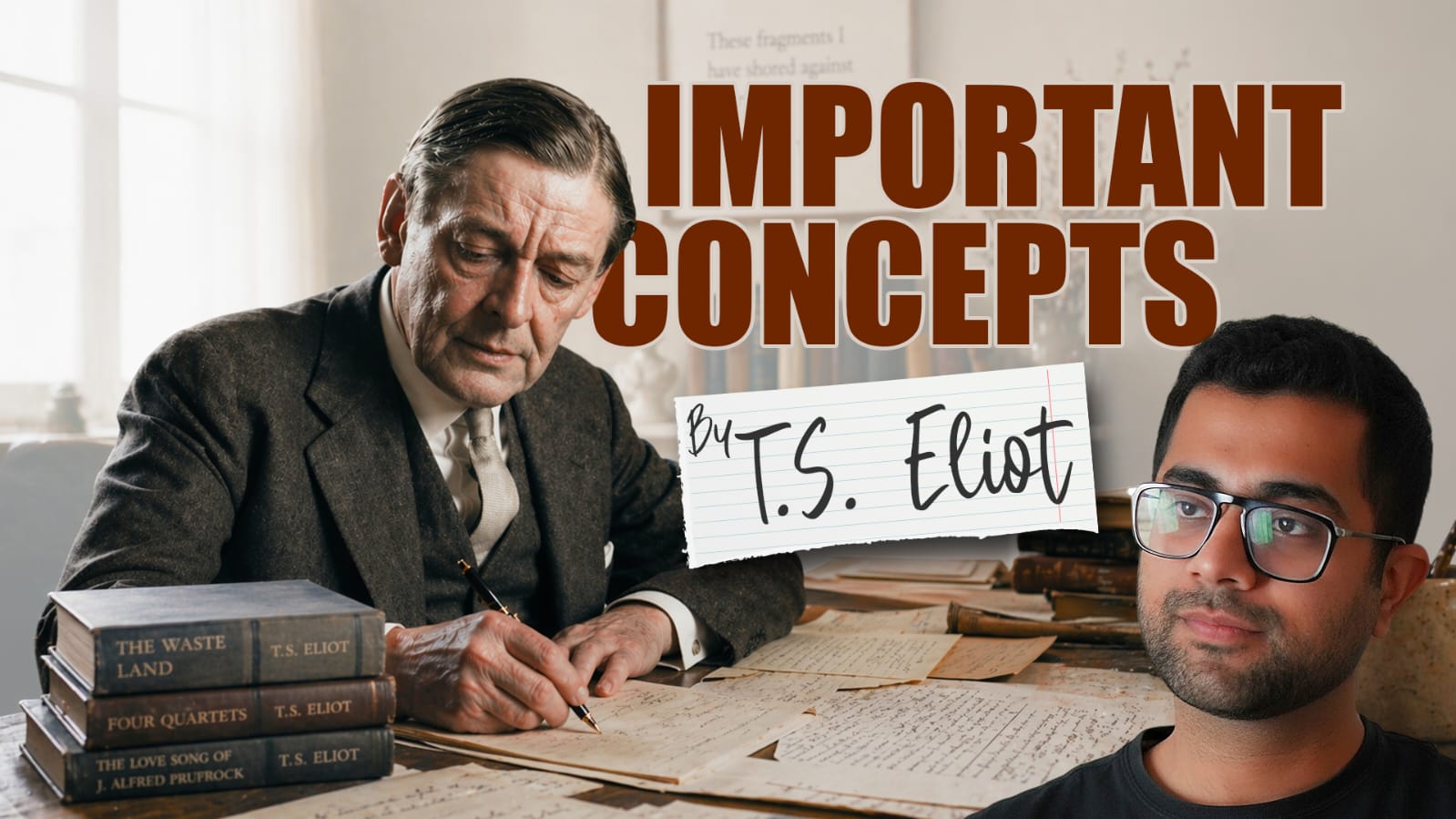
If you’re preparing for UGC NET English Literature, T.S. Eliot is one writer you simply cannot skip. Questions on Eliot appear with remarkable consistency across NET, SET, and GATE English Literature papers — sometimes 3 to 5 questions in a single exam. He shows up in the poetry section, the criticism section, and sometimes even in the cultural studies questions.
This guide covers everything you need: his major works with dates, his critical essays and concepts, the themes that get tested repeatedly, and the specific areas where students lose marks because they studied the wrong things. You can also practice T.S. Eliot previous year questions alongside this guide.
Why T.S. Eliot is so heavily tested in UGC NET
Eliot sits at the intersection of two high-weightage units in the UGC NET syllabus — Unit 2 (British Poetry) and Unit 5 (Literary Criticism and Theory). Most writers only appear in one unit. Eliot appears in both. That alone makes him one of the highest-ROI topics you can study.
He won the Nobel Prize in Literature in 1948. He changed the direction of English poetry in the 20th century. And his critical essays — particularly “Tradition and the Individual Talent” — are practically guaranteed to show up in some form every exam cycle.
The NTA has historically tested Eliot in three ways: direct questions about his poems, questions about his critical concepts, and passage-based questions where you need to identify his writing style.
Major works you must know (with dates)
Getting the dates right matters. NTA loves chronology-based questions, and mixing up whether The Waste Land came before or after Ash Wednesday has cost many students marks.
Poetry:
Prufrock and Other Observations (1917) — his first published collection, which includes “The Love Song of J. Alfred Prufrock.”
This poem established Eliot as a modern poet. The opening line (“Let us go then, you and I”) is one of the most frequently quoted in UGC NET papers.
The Waste Land (1922) — the single most important modernist poem for your exam. It has five sections: “The Burial of the Dead,” “A Game of Chess,” “The Fire Sermon,” “Death by Water,” and “What the Thunder Said.”
The poem was dedicated to Ezra Pound, who edited it heavily. NTA has asked about the dedication, the epigraph (from Petronius’s Satyricon), and the Sanskrit words “Datta, Dayadhvam, Damyata” from the Brihadaranyaka Upanishad.
The Hollow Men (1925) — “This is the way the world ends / Not with a bang but a whimper.” This line gets quoted in MCQs regularly.
Ash Wednesday (1930) — marks Eliot’s turn toward Christianity after his conversion to Anglicanism in 1927. Expect questions about the shift from despair to spiritual seeking.
Four Quartets (1943) — four interconnected poems: “Burnt Norton” (1936), “East Coker” (1940), “The Dry Salvages” (1941), and “Little Gidding” (1942). These explore time, memory, and spiritual redemption. NTA has asked students to match each Quartet with its associated element (air, earth, water, fire).
Drama:
Murder in the Cathedral (1935) — about the assassination of Thomas Becket, Archbishop of Canterbury. This play is Eliot’s most frequently tested drama.
The Family Reunion (1939) — uses Greek dramatic devices (the Eumenides) in a modern English country house setting.
The Cocktail Party (1949) — won the Tony Award for Best Play in 1950. Based loosely on Euripides’ Alcestis.
Critical works:
The Sacred Wood (1920) — essay collection containing “Tradition and the Individual Talent” and “Hamlet and His Problems.” Both essays are central to literary criticism questions in UGC NET.
The Use of Poetry and the Use of Criticism (1933) — based on his Charles Eliot Norton Lectures at Harvard.
Notes Towards the Definition of Culture (1948) — Eliot’s exploration of culture, religion, and education.
Five critical concepts NTA tests repeatedly
These are the concepts that generate the most questions. If you learn nothing else about Eliot’s criticism, learn these five.
1. Objective correlative
This comes from the essay “Hamlet and His Problems” (1919), published in The Sacred Wood. Eliot argued that the only way to express emotion in art is through “a set of objects, a situation, a chain of events which shall be the formula of that particular emotion.”
He used this concept to criticize Shakespeare’s Hamlet, arguing that Hamlet’s emotion exceeds the facts of the play — the emotion is “in excess of the facts as they appear.”
Exam trap: Students sometimes attribute this concept to “Tradition and the Individual Talent.” It’s from “Hamlet and His Problems.” NTA has tested this distinction.
2. Impersonal theory of poetry
From “Tradition and the Individual Talent” (1919). Eliot’s central argument: “Poetry is not a turning loose of emotion, but an escape from emotion; it is not the expression of personality, but an escape from personality.”
He compared the poet’s mind to a catalyst — it facilitates a chemical reaction (the poem) without itself being changed.
The platinum filament analogy is frequently tested: just as platinum enables sulphuric acid to form when sulphur dioxide and oxygen are combined, without the platinum itself being affected, the poet’s mind combines experiences into poetry without the poet’s personal emotions entering the work.
3. Dissociation of sensibility
From “The Metaphysical Poets” (1921). Eliot argued that a “dissociation of sensibility” occurred in English poetry after the metaphysical poets (Donne, Herbert, etc.) — poets could no longer think and feel simultaneously.
Before the dissociation, thought was “an experience” that modified sensibility. After it, thought and feeling split apart.
NTA has asked when this dissociation supposedly occurred (after Donne and Herbert, roughly mid-17th century) and which poets Eliot considered examples of unified sensibility. For more on this, see our metaphysical poets PYQ collection.
4. Tradition and the historical sense
Eliot’s concept of tradition is not about following rules blindly. He argued that tradition requires “the historical sense,” which involves “a perception, not only of the pastness of the past, but of its presence.”
Every new work of art alters the entire existing order of art. When a new masterpiece is created, all existing masterpieces are slightly readjusted in relation to it.
This is one of Eliot’s most original ideas and NTA loves testing it because it’s easy to frame as an MCQ with subtle wrong options.
5. The auditory imagination
From The Use of Poetry and the Use of Criticism. Eliot described this as “the feeling for syllable and rhythm, penetrating far below the conscious levels of thought and feeling, invigorating every word.”
It’s a less famous concept but has appeared in recent NET papers, particularly in 2023 and 2024. This ties into New Criticism’s emphasis on close reading of the text itself.
The Waste Land: section-by-section breakdown for exam
Since The Waste Land generates the most questions of any single Eliot work, here’s what you need to know about each section.
Section I — “The Burial of the Dead” Opens with “April is the cruellest month” — an inversion of Chaucer’s optimistic April in The Canterbury Tales. Features Madame Sosostris (a fortune teller with a tarot deck) and the “Unreal City” passage (echoing Baudelaire’s Paris). The section establishes themes of spiritual death, memory, and the failure of modern civilization.
Section II — “A Game of Chess” Juxtaposes two scenes: an upper-class woman at her dressing table (echoing Shakespeare’s Cleopatra) and a working-class pub conversation about Lil and Albert. Both scenes show relationships emptied of genuine connection.
Section III — “The Fire Sermon” The title refers to the Buddha’s Fire Sermon. Features Tiresias, whom Eliot called “the most important personage in the poem.” The Thames-daughters appear here, paralleling Wagner’s Rhine-daughters. The typist and the clerk scene is the poem’s most explicit depiction of loveless mechanical sexuality.
Section IV — “Death by Water” The shortest section — just 10 lines about the drowned Phoenician sailor Phlebas. NTA has asked about the length and the name Phlebas specifically.
Section V — “What the Thunder Said” The journey to Emmaus, the approach to the Chapel Perilous (Grail legend), and the voice of the thunder. The Sanskrit words appear here: “Datta” (give), “Dayadhvam” (sympathize), “Damyata” (control) — from the Brihadaranyaka Upanishad. The poem ends with “Shantih shantih shantih.”
Eliot’s own notes to the poem reference Jessie L. Weston’s From Ritual to Romance and James Frazer’s The Golden Bough as his two primary sources. Both titles have appeared in NTA questions.
Common exam traps and how to avoid them
Trap 1: Confusing the essays. “Objective correlative” is from “Hamlet and His Problems,” not from “Tradition and the Individual Talent.” “Dissociation of sensibility” is from “The Metaphysical Poets,” not from “The Sacred Wood” (though the essay was later collected there). Know which concept belongs to which essay.
Trap 2: Getting the dedication wrong. The Waste Land is dedicated to Ezra Pound (“il miglior fabbro” — the better craftsman), a phrase borrowed from Dante’s Purgatorio where it refers to Arnaut Daniel. NTA has asked about both the dedication and where the Italian phrase originally comes from.
Trap 3: Mixing up Four Quartets. Each Quartet is associated with a season, an element, and a place. “Burnt Norton” — air, a Gloucestershire manor; “East Coker” — earth, a Somerset village (where Eliot’s ancestors came from); “The Dry Salvages” — water, rocks off the Massachusetts coast; “Little Gidding” — fire, a 17th-century Anglican community in Huntingdonshire.
Trap 4: Overlooking Eliot’s American roots. Students forget that Eliot was born in St. Louis, Missouri in 1888 and only moved to England in 1914. He became a British citizen in 1927. NTA has tested his nationality and birthplace.
How to study Eliot in 5 days (exam strategy)
If you’re short on time, here’s the priority order:
Day 1: Read “Tradition and the Individual Talent” in full. It’s only about 3,000 words. Understand the catalyst analogy, the concept of tradition, and the impersonal theory.
Day 2: Read The Waste Land section by section. Don’t try to understand everything — focus on the opening lines of each section, the major allusions (Chaucer, Shakespeare, Baudelaire, Buddha, Upanishads), and the key characters (Tiresias, Madame Sosostris, Phlebas). Use our study material for guided notes.
Day 3: Study “Hamlet and His Problems” for the objective correlative, and “The Metaphysical Poets” for the dissociation of sensibility. Our literary theory booklet covers both essays with exam-ready summaries.
Day 4: Learn the dates and sequence of all major works. Practice 30-40 MCQs on Eliot from previous year papers — you’ll see the pattern of what NTA asks. Our PYQ booklet has these sorted topic-wise.
Day 5: Revise the exam traps listed above. Do one final round of MCQs.
Previous year question patterns
Based on analysis of UGC NET papers from 2019 to 2025, Eliot questions typically fall into these categories:
Matching questions (match works to dates, concepts to essays, Quartets to elements) account for roughly 40% of Eliot questions.
Direct factual questions (who edited The Waste Land? what prize did Eliot win?) make up about 30%. Conceptual questions (explain impersonal theory, identify objective correlative) cover the remaining 30%.
If you want to practice with actual previous year questions sorted by topic, check our subject-wise PYQ collection — it includes every Eliot question from the last 10 years of NET papers. You can also go directly to the T.S. Eliot PYQ page for poet-specific questions, or browse British poetry PYQs and literary criticism PYQs for the broader units where Eliot appears.
Preparing for UGC NET English Literature upcoming UGC NET attempt? Our complete course covers Eliot and 50+ other high-weightage authors with video lectures, topic-wise MCQs, and 13 physical booklets delivered to your door — including a dedicated literary theory booklet and a previous year questions booklet. Browse all our study material here.