If you are preparing for UGC NET English Literature, Salman Rushdie is one writer that’s important for the exam.
He appears across multiple syllabus units — Indian Writing in English, Postcolonial Literature, and sometimes even British Fiction — which means NTA can test him from different angles in the same paper.
Rushdie questions have appeared consistently in previous year papers, and the pattern suggests NTA favours his narrative techniques and thematic concerns over biographical details.
This guide breaks down everything you need to know about Salman Rushdie for UGC NET English Literature: his major works with dates, the specific themes NTA tests, common exam traps, and a focused 5-day study plan.
If you want to solve subject-wise previous year questions on Indian Literature alongside this guide, that combination alone will cover most of what NTA throws at you.
Why Salman Rushdie is important for UGC NET
Rushdie sits at the intersection of three high-weightage syllabus areas. Under Unit IX (Indian Writing in English), he is a core novelist.
Under Postcolonial Studies, his work illustrates hybridity, diaspora identity, and the politics of representation. And because he spent decades living in Britain, some questions frame him within British fiction traditions too.
NTA typically asks about 2 questions per paper that either directly name Rushdie or test concepts his novels exemplify.
The June 2025 question paper and the December 2025 paper both featured questions where Rushdie was either the answer or a distractor option. You should expect at least one direct question on him in any given attempt.
To understand how NTA distributes questions across units, check this detailed exam breakdown.
Major works you must know (with dates)
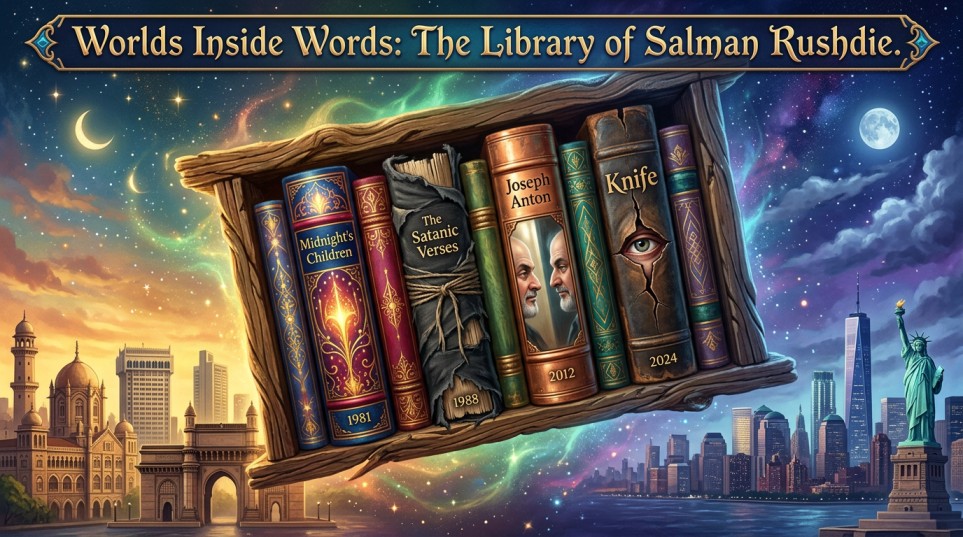
NTA tests chronology heavily. Get these dates wrong, and you lose easy marks. Here is the list in order of publication:
Grimus (1975) — His debut novel. A fantasy-science fiction hybrid. Almost never tested, but know it exists so you don’t confuse it with another writer’s work.
Midnight’s Children (1981) — Won the Booker Prize. Also won the Booker of Bookers (1993) and the Best of the Booker (2008), making it the most decorated novel in the prize’s history. This is the single most important Rushdie text for UGC NET.
Shame (1983) — Shortlisted for the Booker. A political allegory based loosely on Pakistan’s history. Know the connection to Zia-ul-Haq and Zulfikar Ali Bhutto.
The Satanic Verses (1988) — Shortlisted for the Booker. Led to the fatwa issued by Ayatollah Khomeini in 1989. NTA asks about the controversy as much as the text itself.
Haroun and the Sea of Stories (1990) — A children’s novel, but also an allegory about censorship and storytelling. Written partly as a response to the fatwa. Know the Ocean of the Streams of Story (Kathasaritsagara connection).
The Moor’s Last Sigh (1995) — Shortlisted for the Booker. Set in Cochin and Bombay. Explores the Moor family across generations. Won the Whitbread Novel Award.
The Ground Beneath Her Feet (1999) — A retelling of the Orpheus myth. Less frequently tested.
Shalimar the Clown (2005) — Set partly in Kashmir. Deals with terrorism, betrayal, and the destruction of Kashmiri culture.
The Enchantress of Florence (2008) — Historical fiction connecting Mughal Emperor Akbar’s court with Renaissance Florence.
Quichotte (2019) — Shortlisted for the Booker. A modern reworking of Cervantes’ Don Quixote. Recent enough that NTA may start including it.
Knife: Meditations After an Attempted Murder (2024) — Non-fiction memoir about the 2022 stabbing attack. Not likely to be tested directly, but worth knowing for general awareness questions.
For exam purposes, focus 80% of your energy on Midnight’s Children and The Satanic Verses. These two novels generate the overwhelming majority of Rushdie questions.
Key themes and concepts tested in UGC NET
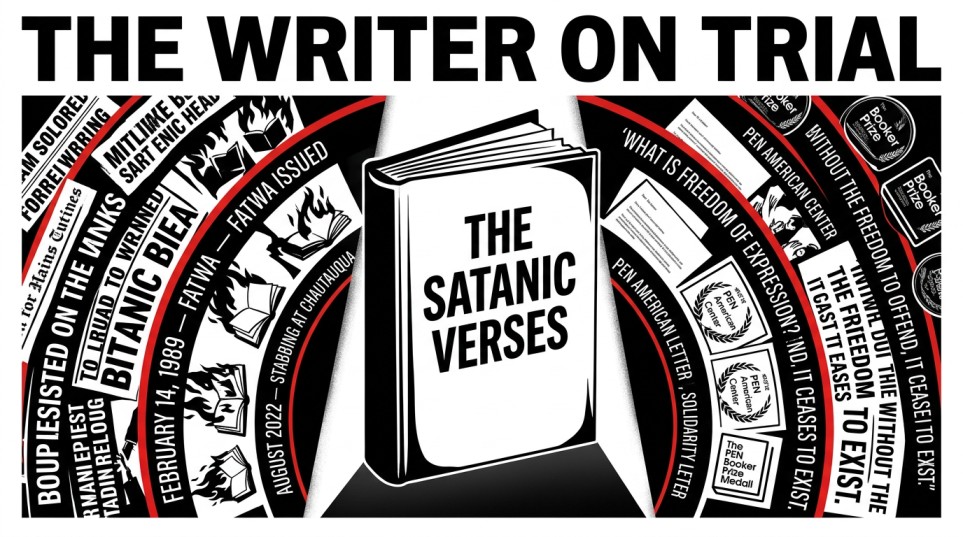
NTA does not ask vague questions like “What are Rushdie’s themes?” They test specific concepts with specific terminology. Here is what you need to know:
Magical realism — Rushdie’s most tested technique. Midnight’s Children blends supernatural elements (Saleem Sinai’s telepathy, the Midnight’s Children Conference) with real historical events (Partition, Emergency, Bangladesh War). NTA often asks you to identify which technique Rushdie employs, and magical realism is almost always the answer.
Postcolonial identity and hybridity — The Satanic Verses explores what happens to identity when immigrants move between cultures. The characters Gibreel Farishta and Saladin Chamcha represent two responses to cultural displacement. Homi Bhabha’s concept of hybridity is directly applicable here.
Unreliable narration — Saleem Sinai in Midnight’s Children is a famously unreliable narrator. He admits to factual errors and questions his own memory. NTA tests this by asking about narrative technique or the function of unreliability in postcolonial fiction.
Nation as narrative — Rushdie treats the nation itself as a story that gets told and retold. Saleem’s body literally maps onto India’s history. This idea connects to Benedict Anderson’s “imagined communities” concept, which NTA pairs with Rushdie in matching questions.
Censorship and free speech — Haroun and the Sea of Stories is an allegory about the suppression of storytelling. The Satanic Verses controversy itself becomes a case study in questions about literature and censorship.
Historiographic metafiction — A term from Linda Hutcheon. Rushdie’s novels are fiction that simultaneously comment on how history gets written. If NTA asks you to connect a theorist with a primary text, Hutcheon + Midnight’s Children is a tested combination.
You can practise MCQs on these themes in our Indian Literature previous year questions collection.
Novel-by-novel breakdown: what NTA actually asks
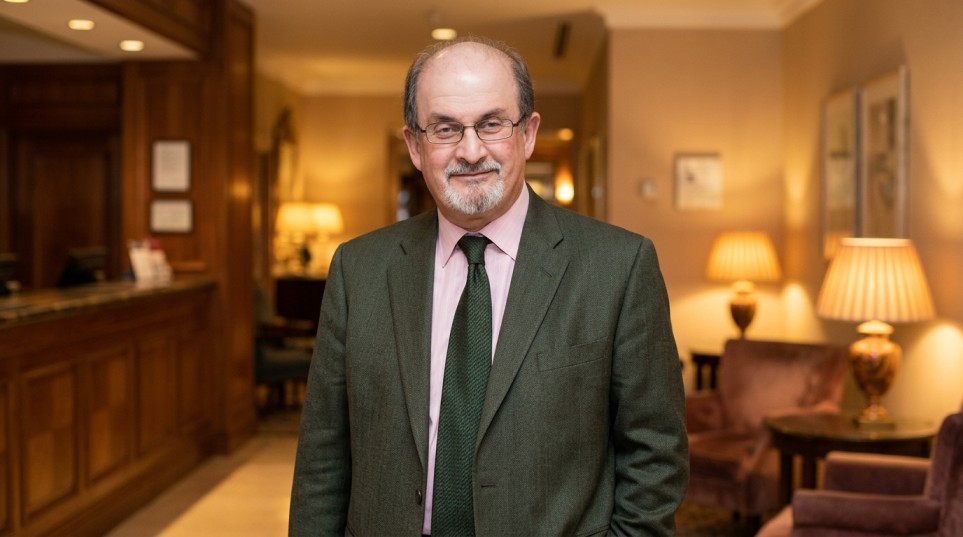
Midnight’s Children (1981)
This novel carries the heaviest exam weight. Here are the facts NTA tests:
The protagonist Saleem Sinai is born at midnight on August 15, 1947 — the exact moment of Indian independence. He discovers he has telepathic powers and connects with 1,001 other children born in that midnight hour (the Midnight’s Children Conference). The novel spans three generations of the Sinai family and covers Indian history from the Jallianwala Bagh massacre through the Emergency.
Key characters to know: Saleem Sinai (narrator), Shiva (Saleem’s rival, born at the same moment), Padma (Saleem’s listener/audience), the Widow (Indira Gandhi). The pickling factory where Saleem writes his memoir is a metaphor for preserving memory and history.
The novel’s structure mirrors India itself — fragmented, contradictory, bursting with competing narratives. NTA asks about this structural choice in questions about postmodern narrative technique.
The Satanic Verses (1988)
Two Indian actors, Gibreel Farishta and Saladin Chamcha, survive a plane explosion over the English Channel. Gibreel grows a halo; Saladin grows horns and hooves. The novel alternates between their stories in contemporary London and dream sequences set in early Islamic history.
NTA focuses on: the metamorphosis motif (transformation as metaphor for immigrant experience), the tension between sacred and profane, and the novel’s challenge to fixed religious and national identities. The fatwa by Ayatollah Khomeini (February 14, 1989) is a factual detail that appears in questions about literary controversy.
Shame (1983)
An allegorical novel about Pakistan. The characters Omar Khayyam Shakil, Sufiya Zinobia, and Raza Hyder map loosely onto real Pakistani political figures. The concept of “shame” (sharam) as a cultural force — particularly its gendered dimensions — is the central theme NTA tests.
Common exam traps and how to avoid them
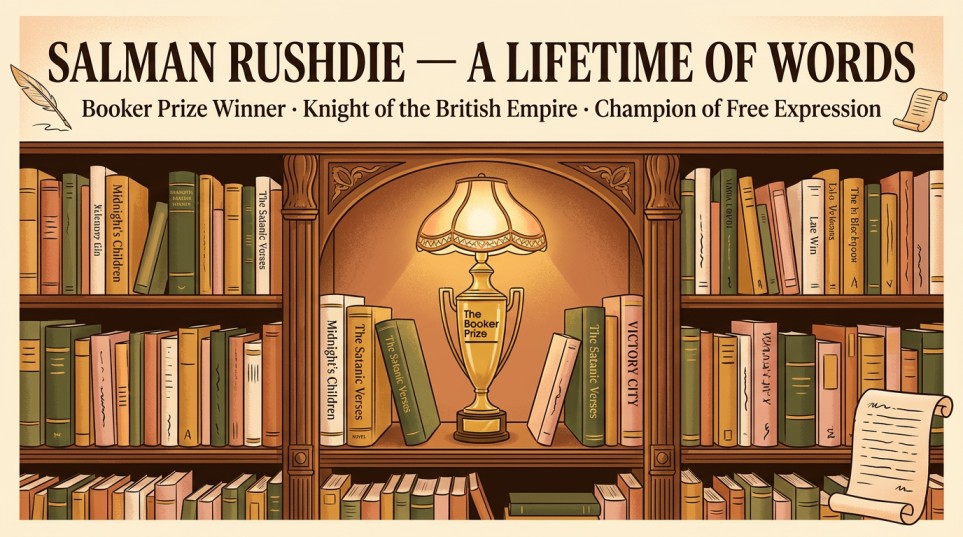
Trap 1: Confusing Booker Prize years. Students often write that Midnight’s Children won the Booker in 1980 or 1982. It won in 1981. The Booker of Bookers was awarded in 1993. The Best of the Booker was in 2008. These are three separate recognitions.
Trap 2: Attributing magical realism only to Latin American writers. NTA includes Rushdie as a distractor in questions about Gabriel Garcia Marquez, and vice versa. Both use magical realism, but their contexts are different. If the question mentions postcolonial South Asian identity + magical realism, the answer is Rushdie, not Marquez.
Trap 3: Mixing up Gibreel and Saladin. In The Satanic Verses, Gibreel Farishta gets the angelic transformation (halo) and Saladin Chamcha gets the demonic one (horns). Students frequently reverse this. Remember: Gibreel = Gabriel = angel.
Trap 4: Forgetting Haroun and the Sea of Stories is by Rushdie. Because it’s a children’s novel, students sometimes attribute it to someone else or skip it entirely. NTA has asked about the Kathasaritsagara connection (Ocean of the Streams of Story by Somadeva), which Rushdie references directly.
Trap 5: Ignoring the theorist connections. NTA matches Rushdie with Homi Bhabha (hybridity), Linda Hutcheon (historiographic metafiction), and Edward Said (Orientalism/counter-narrative). If a question asks you to match a novelist with a critical concept, these pairings are high-probability answers.
How to study Salman Rushdie for upcoming UGC NET Exam (exam strategy)
If you are running short on time, here is how to cover Rushdie efficiently. This plan assumes you have 2-3 hours per day.
Day 1: Midnight’s Children deep dive. Read a detailed chapter-by-chapter summary. Focus on the timeline of historical events the novel covers. Make flashcards for characters, their roles, and what they symbolise. Don’t read the full novel — it’s 650 pages. A good summary plus critical notes is enough for MCQs.
Day 2: The Satanic Verses + the controversy. Read a summary of the novel’s plot and dream sequences. Memorise the Gibreel/Saladin distinction. Learn the fatwa timeline (publication in September 1988, fatwa in February 1989). Read one short critical essay on the novel’s treatment of immigration and identity.
Day 3: Shame + other novels. Read plot summaries of Shame, Haroun, and The Moor’s Last Sigh. For each, write down one sentence about its central theme and one fact NTA might test. This day is about breadth, not depth.
Day 4: Theory connections. Study Homi Bhabha’s hybridity, Linda Hutcheon’s historiographic metafiction, and the concept of unreliable narration. Connect each concept back to a specific Rushdie novel. This is where you score marks on the theory-application questions that NTA increasingly favours.
Day 5: PYQ practice + revision. Solve all available previous year question papers that include Rushdie questions. Revise your flashcards. Focus on the facts you kept getting wrong. Check our exam prep guide for broader last-minute strategies.
Previous year question patterns
NTA frames Rushdie questions in a few predictable formats. The most common is the simple publication years or plot summary.
The second format is the matching question, where you pair novels with themes, techniques, or theorists. Rushdie + magical realism, Rushdie + historiographic metafiction, Rushdie + postcolonial hybridity — these pairings repeat across papers.
You can find a comprehensive collection of Indian Literature PYQs sorted by topic on our site. Solving these alongside the full question papers from recent exams will show you exactly how NTA tests Rushdie.
For a broader understanding of the UGC NET English Literature exam structure and how different authors are distributed across the paper, refer to our complete study material which covers Rushdie and 50+ other high-weightage writers with video lectures, topic-wise MCQs, and 13 physical booklets delivered to your door.