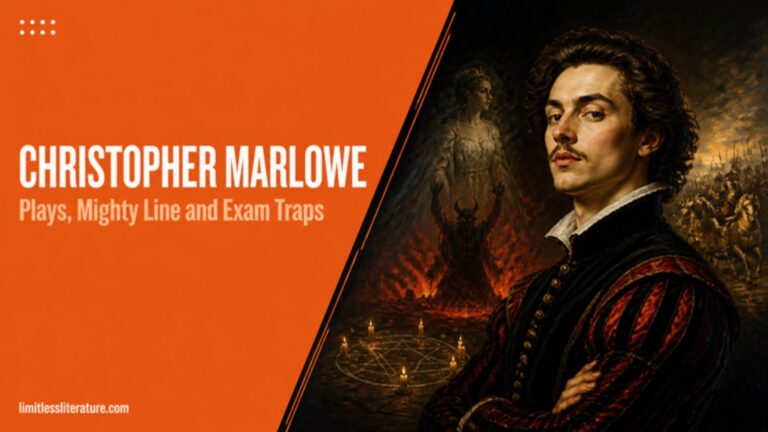
“Was this the face that launched a thousand ships / And burnt the topless towers of Ilium?” Most students can recite the line. Far fewer can say who speaks it, to whom, and what is actually standing on the stage when it is spoken. Faustus says it to Helen of Troy, but the Helen he kisses is a spirit raised by Mephistopheles, and the kiss is the moment he gives up his last chance to repent. That gap between the famous sound of a line and its place in the play is exactly where exam questions on Christopher Marlowe live.
Marlowe wrote for barely six years and died at twenty-nine, yet he left four plays that question setters return to again and again: Tamburlaine, Doctor Faustus, The Jew of Malta and Edward II. This guide gives you the dates, the characters, the lines and the traps, built around the questions already asked on this site.
Quick answer: Christopher Marlowe (baptised 1564, died 1593) was the Elizabethan playwright who turned blank verse into the main voice of English tragedy, the “mighty line” Ben Jonson praised. For exams, know his four big plays and their heroes (Tamburlaine, Faustus, Barabas, Edward), the Prologue and Epilogue of Doctor Faustus, and his narrative poem Hero and Leander.
Born: baptised 26 February 1564, Canterbury, son of a shoemaker
Education: King’s School, Canterbury; Corpus Christi College, Cambridge (BA 1584; MA granted after a Privy Council letter in 1587)
Died: 30 May 1593, Deptford, stabbed by Ingram Frizer; buried at St Nicholas, Deptford, 1 June 1593
Group: University Wits
Best known for: Doctor Faustus, Tamburlaine the Great, The Jew of Malta, Edward II, Hero and Leander
Asked in: UGC NET, State SET, GATE, KVS and State PGT/TGT, Assistant Professor exams
Why Marlowe keeps turning up in papers
Three reasons. First, he sits at a turning point. Before him, English tragedy was either stiff Senecan imitation or the leftover machinery of the morality play. After Tamburlaine, the London stage spoke in confident, swelling blank verse, and Shakespeare grew up on it. Any question about the development of Elizabethan drama will name him.
Second, his heroes are easy to test. Each play is built around one overreaching figure with one ruling desire: Tamburlaine wants power, Faustus wants knowledge, Barabas wants wealth, Edward wants his favourite. Setters love “match the hero to the passion” items, and the site’s own papers ask exactly that.
Third, Doctor Faustus is short, quotable and framed by a Chorus. The Prologue and Epilogue alone have produced at least four questions on this site. If you only have one evening for Marlowe, read those two speeches and the final soliloquy.
My advice on priority: Doctor Faustus first, then The Jew of Malta and Tamburlaine together (they are the two “Machiavellian” and “epic” items), then Edward II. Dido and The Massacre at Paris need only a title and date.
Plays and poems with dates
Elizabethan dates are slippery. Many plays were acted years before they were printed, so learn both columns and expect setters to use the printing date when they give a single year.
| Work | Type | Written or acted | First printed |
|---|---|---|---|
| Dido, Queen of Carthage | Tragedy (with Thomas Nashe) | Cambridge years, mid-1580s | 1594 |
| Tamburlaine the Great, Parts 1 and 2 | Heroic tragedy | Both parts acted by the end of 1587 | 1590 (anonymous) |
| Doctor Faustus | Tragedy with morality elements | Disputed: soon after Tamburlaine, or as late as 1592 | 1604 (A-text); 1616 (B-text) |
| The Jew of Malta | Tragedy / black farce | 1589 or 1590 | 1633 |
| Edward II | History play | Acted 1592 (Pembroke’s Men) | 1594 |
| The Massacre at Paris | History / political tragedy | Acted January 1593 | Undated octavo |
| Hero and Leander | Narrative poem (epyllion) | Left unfinished at his death | 1598; completed by George Chapman |
| “The Passionate Shepherd to His Love” | Pastoral lyric | Before 1593 | 1599 |
| Ovid’s Amores and Lucan’s Pharsalia, Book I | Translations from Latin | Almost certainly at Cambridge | Posthumously |
Two things worth fixing in memory: the two Faustus texts (1604 shorter A-text, 1616 longer B-text) and the late printing of The Jew of Malta (1633, forty years after Marlowe’s death).
The plays one by one
Tamburlaine the Great (Parts 1 and 2)
A Scythian shepherd rises to conquer kingdoms from Persia to Babylon by force of will and rhetoric. Part 1 ends in triumph and marriage to Zenocrate; Part 2 brings her death, more cruelty and finally Tamburlaine’s own death, the one enemy he cannot beat. The site asks three things here: he was born a shepherd, his defining traits are ambition and cruelty, and the play has epic features (huge geography, catalogues of kings, a hero above ordinary morality). Its Prologue announces the break from “jigging” rhymed drama, which is why Tamburlaine is the usual answer for “the play that established blank verse on the public stage”.
Doctor Faustus
A Wittenberg scholar exhausts logic, medicine, law and divinity, turns to magic, and signs his soul to Lucifer in his own blood for twenty-four years of power with Mephistopheles as his servant. The middle of the play is a run of tricks (the Pope, the Emperor, the horse-courser) that critics have long called thin. The end is the great final soliloquy as the clock strikes. The source is the English translation, often called the English Faust Book, of the German Historia von D. Johann Fausten (1587), which is why the site’s answer to “immediate source” points to the German story.
Morality-play traces are a standard question: the soliloquising hero, the Good and Bad Angels, the pageant of the Seven Deadly Sins, the Old Man, and the closing moral. Valdes and Cornelius are the two magicians who tempt Faustus; Valdes tells him to bring “Bacon’s and Albanus’ works, / The Hebrew Psalter, and New Testament” (some editions print Albertus for Albanus). Mephistopheles’ answer to Faustus’s question about why he is out of hell, “Why, this is hell, nor am I out of it”, is the line most often quoted for Marlowe’s idea of damnation as a state of mind.
The Jew of Malta
Barabas, a rich merchant of Malta, has his wealth seized by the Christian governor Ferneze to pay Turkish tribute. His revenge grows into a chain of murders: his daughter Abigail’s suitors Lodowick and Mathias, a nunnery full of nuns including Abigail herself, and finally his own fall into the boiling cauldron he prepared for others. His slave Ithamore is his accomplice. The Prologue is spoken by Machiavel, the stage Machiavelli, which is why the site keys this as the play with a “Machiavellian hero” and the one with a “play on the name of Machiavelli” in the prologue. If a question asks which Marlovian hero is consumed by greed, the answer is Barabas.
Edward II
A history play drawn from the chronicles. King Edward’s devotion to his favourite Piers Gaveston alienates the barons and his queen Isabella; Mortimer the Younger and Isabella take power; Edward is imprisoned and murdered at Berkeley Castle by the hired killer Lightborn; the young Edward III punishes Mortimer at the end. Critics often call it Marlowe’s most controlled play, and it is the one the site names for an openly homosexual sensibility. One small trap: the king’s later favourite Spencer is not Edmund Spenser the poet.
Dido and The Massacre at Paris
Dido, Queen of Carthage draws on Virgil’s Aeneid and was printed in 1594 as a joint work with Thomas Nashe. The Massacre at Paris stages the St Bartholomew’s Day massacre of 1572 and survives only in a short, damaged text. One line of each is enough.
Characters and lines to match
| Character or line | Play | What to remember |
|---|---|---|
| Zenocrate, Bajazeth | Tamburlaine | Tamburlaine’s wife; the Turkish emperor he humiliates |
| Mephistopheles, Valdes, Cornelius, Wagner | Doctor Faustus | Devil-servant; the two magicians; Faustus’s student-servant |
| Good Angel, Bad Angel, Old Man | Doctor Faustus | Morality-play figures pulling Faustus both ways |
| Barabas, Abigail, Ithamore, Ferneze | The Jew of Malta | Merchant, his daughter, his slave, the governor |
| Gaveston, Isabella, Mortimer, Lightborn | Edward II | Favourite, queen, rebel lord, murderer |
| “His waxen wings did mount above his reach” | Doctor Faustus, Prologue | Chorus compares Faustus to Icarus |
| “Why, this is hell, nor am I out of it” | Doctor Faustus | Mephistopheles, not Faustus |
| “Was this the face that launched a thousand ships” | Doctor Faustus | Faustus to the spirit of Helen |
| “Cut is the branch that might have grown full straight” | Doctor Faustus, Epilogue | Chorus, after Faustus is taken |
| “To practise more than heavenly power permits” | Doctor Faustus, Epilogue | The closing warning to “forward wits” |
| “Who ever loved that loved not at first sight?” | Hero and Leander | Quoted in Shakespeare’s As You Like It with “Dead shepherd” |
Mind maps on the site: Doctor Faustus mind map and The Jew of Malta mind map. Use them for a ten-minute revision of plot order and minor characters.
The mighty line: form and metre notes
Ben Jonson’s phrase “Marlowe’s mighty line”, from his poem to Shakespeare in the 1623 First Folio, is the one critical tag on Marlowe that every exam expects you to know. It refers to his blank verse: unrhymed iambic pentameter, but driven by long sentences, place names, hyperbole and sound.
- Not the first, but the one that stuck. Blank verse entered English with Surrey’s translation of the Aeneid, and Gorboduc (1561) was the first English play written in it. Marlowe’s achievement was making it flexible and popular on the public stage.
- The line as a unit. Early Marlowe tends to end sense with the line (end-stopped verse) and builds by piling line on line. Later Shakespeare runs sense across lines far more.
- Hyperbole and catalogue. Tamburlaine’s speeches list kingdoms and conquests; the effect is epic size, one reason the site keys Tamburlaine for “epic features”.
- Prose for low scenes. In Doctor Faustus the comic servants (Wagner, Robin) usually speak prose, which marks them off from the verse of the main action.
- The final soliloquy. Faustus’s last hour breaks the regular line apart with short cries and a Latin line borrowed from Ovid’s Amores. It is the standard example of Marlowe bending his own metre for dramatic effect.
“The Passionate Shepherd to His Love” (“Come live with me and be my love”) is in rhymed tetrameter couplets, not blank verse. Walter Ralegh answered it with “The Nymph’s Reply to the Shepherd”, a pairing that often appears in match-the-poem items.
Marlowe among the University Wits
The University Wits were the group of Oxford- and Cambridge-educated writers who dominated the London stage in the 1580s and early 1590s. The usual list: John Lyly, George Peele, Robert Greene, Thomas Lodge, Thomas Nashe, Christopher Marlowe, with Thomas Kyd often added even though he did not attend university.
| Wit | Remember for | Link to Marlowe |
|---|---|---|
| John Lyly | Court comedies, Euphues | Wrote no tragedy (the site’s “who did not write tragedies” item) |
| Thomas Kyd | The Spanish Tragedy | Wrote the other founding tragedy of the period; a frequent distractor in Marlowe items |
| Thomas Nashe | The Unfortunate Traveller | Co-author of Dido |
| Robert Greene | Friar Bacon and Friar Bungay | His magician comedy is often set beside Faustus |
| George Peele | The Old Wives’ Tale | Fellow Wit, pastoral and comic |
Marlowe’s life also sits inside the period’s politics. The Privy Council’s 1587 intervention over his degree, and the company at Deptford on the day he died, keep the spy theory alive. Exams rarely test it; do not spend time on it.
Asked in exams: Marlowe questions from the site
These come from the site’s Christopher Marlowe previous year questions page unless marked otherwise. The source page does not print exam and year for each item, so they are listed as previous year questions.
| Question (short) | Answer | Source |
|---|---|---|
| Which play has a Machiavellian hero? | The Jew of Malta | Marlowe PYQs, Q2 |
| Faustus Prologue: the chorus proposes the theme should be… | “cursed necromancy” and “self-conceit” | Marlowe PYQs, Q3 |
| Features of Marlowe’s portrait of Tamburlaine | Ambition and cruelty | Marlowe PYQs, Q5 |
| “Cut is the branch that might have grown full straight” occurs in… | Doctor Faustus | Marlowe PYQs, Q6 |
| Tamburlaine was born as a… | Shepherd | Marlowe PYQs, Q7 |
| Which is not a revenge tragedy? | Doctor Faustus | Marlowe PYQs, Q8 |
| Marlovian character consumed by greed | Barabas | Marlowe PYQs, Q10 |
| Odd one out among early plays imitating Greek and Latin models | Tamburlaine | Marlowe PYQs, Q12 |
| Where is the king murdered in Edward II, Act V? | A room in Berkeley Castle | Marlowe PYQs, Q14 |
| Hero warned not “to practise more than heavenly power permits” | Doctor Faustus | Marlowe PYQs, Q17 |
| Play on Machiavelli’s name in the prologue | The Jew of Malta | Marlowe PYQs, Q18 |
| Mythological figure Faustus is compared to in the Prologue | Icarus | Marlowe PYQs, Q20 |
| Morality-play traces in Doctor Faustus | Soliloquising hero, Good and Bad Angels, final moral | Marlowe PYQs, Q21 |
| Shakespeare’s contemporary who did not write tragedies (Kyd, Lyly, Marlowe, Jonson) | John Lyly | Shakespeare PYQs |
For more drama items from the same period, work through the British drama previous year questions and the Ben Jonson questions; full papers are in the previous year question papers section, and every topic is collected in the subject-wise English literature PYQs.
Exam traps
- “Tamburlaine was the first English play in blank verse.” No. Gorboduc (1561) was. Tamburlaine made blank verse the voice of the popular stage. Read the question wording: “first” and “established” are different answers.
- The Faustus Prologue lists the play’s subject. Half true. The Chorus first lists what the play is not about: marching “in fields of Thrasimene”, “the dalliance of love”, “proud audacious deeds”. The actual subject is Faustus’s “self-conceit” and “cursed necromancy”. The site’s Q3 is built on this.
- The Spanish Tragedy is Marlowe’s. It is Thomas Kyd’s. It appears as a distractor in Marlowe questions because both writers shaped early Elizabethan tragedy.
- Hero and Leander is a play. It is a narrative poem, an epyllion, left unfinished and completed by George Chapman. It turns up as a wrong option in “which play” questions.
- Every famous Faustus line is spoken by Faustus. “Why, this is hell, nor am I out of it” belongs to Mephistopheles; “Cut is the branch…” belongs to the Chorus in the Epilogue.
- Spencer in Edward II is the poet. Spencer (the Younger Spencer, Edward’s later favourite) is a historical baron. Edmund Spenser the poet has nothing to do with the play.
For how these Elizabethan tragedies fit the classical idea of tragedy, see the Aristotle guide. For Marlowe’s great successor, see the William Shakespeare guide, and for the other giant of the 1590s, the Edmund Spenser guide.
Self-test: five questions
1. Who speaks “Why, this is hell, nor am I out of it”?
(A) Mephistopheles (B) Doctor Faustus (C) The Good Angel (D) The Bad Angel
Answer: A. Mephistopheles says it when Faustus asks how he can be out of hell.
2. When was the shorter A-text of Doctor Faustus printed?
(A) 1590 (B) 1594 (C) 1604 (D) 1616
Answer: C. The A-text is the 1604 quarto; the longer B-text came in 1616.
3. Who completed Marlowe’s unfinished Hero and Leander?
(A) Thomas Nashe (B) George Chapman (C) Michael Drayton (D) Robert Greene
Answer: B. Chapman finished the poem; the 1598 printings include his continuation.
4. Which character murders the king in Edward II?
(A) Gaveston (B) Mortimer (C) Ithamore (D) Lightborn
Answer: D. Lightborn is hired to kill Edward at Berkeley Castle; Ithamore belongs to The Jew of Malta.
5. Who wrote of “Marlowe’s mighty line”?
(A) John Dryden (B) Ben Jonson (C) Philip Sidney (D) Samuel Johnson
Answer: B. Ben Jonson, in his poem to Shakespeare in the 1623 First Folio.
FAQ
Which Marlowe play should I read first?
Doctor Faustus. It is short, it carries the most questions, and its Prologue, Epilogue and final soliloquy cover most of what is asked.
How did Christopher Marlowe die?
He was stabbed by Ingram Frizer at a house in Deptford on 30 May 1593 and buried at St Nicholas, Deptford, on 1 June 1593.
What does “Marlowe’s mighty line” mean?
It is Ben Jonson’s phrase for Marlowe’s powerful blank verse, the unrhymed iambic pentameter that became the standard voice of Elizabethan tragedy.
Was Marlowe one of the University Wits?
Yes. He was a Cambridge graduate who wrote for the London stage alongside Lyly, Peele, Greene, Lodge and Nashe.
Further reading: Christopher Marlowe on Britannica.
Keep going
One author down. Here is where to go next.
- English Literature Authors A–Z: every author guide, mind map and question set on this site
- 5,000+ topic-wise previous year questions from UGC NET, GATE and SET
- UGC NET English guide: syllabus, exam pattern and preparation plan
Preparing for UGC NET English December 2026?
The Crash Course UGC NET English Literature: Zero to Hero covers the core authors and the topics that keep coming back, with 150+ video lectures and mock tests, before the exam starts on 14 December.
Diwali offer: ₹300 off with coupon code LIMITLESS for the next 10 days (till 16 November).
See the Crash Course → or WhatsApp us on 7891410858
