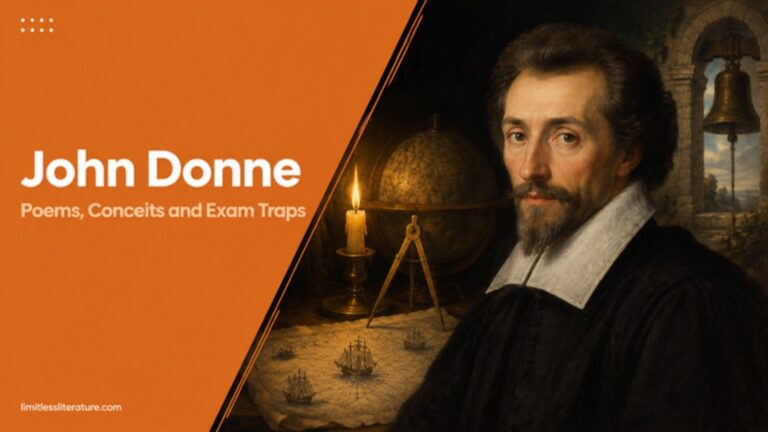
Ask a class who wrote “Easter Wings” and a few hands will go up for John Donne. Ask who wrote Steps to the Temple and someone will say George Herbert. Both answers are wrong, and question setters know it. Donne and Herbert are the two names students mix up most in the metaphysical chapter: both were clergymen, both wrote devotional verse, and both use surprising images. But Donne is the poet of the argued love lyric and the Holy Sonnets; Herbert is the poet of The Temple and the shape poems. Keep that line clear and half the traps in this chapter disappear.
This guide is built from the Donne questions already on this site: the poems that get asked, the dates you need, and the wrong options that keep catching students.
Quick answer: John Donne (1572–1631) was the leading metaphysical poet: love lyrics in Songs and Sonnets, religious verse in the Holy Sonnets, and later the sermons he preached as Dean of St Paul’s. For exams, know his famous conceits (the compass, the flea), the opening lines of his best-known poems, the 1633 posthumous Poems, and who coined and who criticised the label “metaphysical”.
Born: 1572 (between January and June), London, into a Roman Catholic family
Career: sailed with Essex to Cadiz (1596) and the Azores (1597); secretary to Sir Thomas Egerton from 1597; dismissed and briefly imprisoned after secretly marrying Anne More in December 1601
Church: ordained in the Church of England, January 1615; Dean of St Paul’s, 1621
Died: 31 March 1631, London
Best known for: Songs and Sonnets, Holy Sonnets, the two Anniversaries, Devotions upon Emergent Occasions, the sermons
Asked in: UGC NET, State SET, GATE, KVS and State PGT/TGT, Assistant Professor exams
Donne in our own question bank
How often he is asked: John Donne or one of his works is named in at least 21 questions in our solved previous year questions. The ones with a paper label come from the June 2024 (cancelled) paper, the December 2024 paper and the June 2026 paper; the rest sit on our topic-wise PYQ pages, which do not print a year for each item. Only questions we found and checked on the site are counted.
The exam trap: the options are usually all real Donne titles or all real metaphysical poets, so recognition is not enough. In the December 2024 paper, all four options for “the elegy on Donne’s wife” were Holy Sonnets; the answer is Holy Sonnet 17, not the far more famous “Death, be not proud”. And when T. S. Eliot’s “dissociation of sensibility” is asked, “John Donne and Andrew Marvell” sits among the options as bait. Eliot blamed Milton and Dryden.
In Nakul’s words (from his video Why the metaphysical poet John Donne used a compass to describe love):
“In the 17th century, many experiments and innovations were taking place in science, astronomy and navigation. So Donne thought that if science could show the world a new way, then why couldn’t literature show a new way of understanding life?”
“When we say, ‘You are my WiFi, without you my life is stale,’ that’s a modern conceit. He did the same thing 400 years ago with maps, alchemy and telescopes.”
Why setters keep coming back to Donne
He is the easiest way to test a whole movement with one name. A question on Donne can check whether you know what a conceit is, what “metaphysical” meant to Dryden and Johnson, why Eliot revived these poets in 1921, and how the seventeenth century ordered its poets by birth. That is four syllabus areas in one author.
His lines are also memorable, which makes them perfect for “identify the poet” items. “For God’s sake hold your tongue, and let me love.” “Busy old fool, unruly sun.” “Mark but this flea.” Once you have heard Donne’s voice, the abrupt, arguing opening is hard to mistake for anyone else. That is exactly why setters put Herbert, Vaughan and Marvell beside him as options.
My advice on priority: learn eight poems by their first lines, learn the prose works with dates, and learn the critics’ tags (Jonson, Dryden, Johnson, Eliot). Skip the long verse letters and the Latin epigrams unless you have spare weeks.
Works with dates
Most of Donne’s poems circulated in manuscript during his life and were printed only after his death. That is the single biggest dating trap: a poem can be “early” in composition and still carry 1633 as its first printed date.
| Work | Type | Date |
|---|---|---|
| Satires and Elegies | Verse satire; love elegies | 1590s, in manuscript; printed after his death |
| Metempsychosis | Satirical poem, unfinished | Dated 16 August 1601 |
| Biathanatos | Prose treatise on suicide | Written c. 1608; published 1647 |
| Pseudo-Martyr | Anti-Catholic prose polemic | 1610 |
| Ignatius His Conclave | Prose satire on the Jesuits | 1611 |
| An Anatomy of the World (The First Anniversary) | Elegiac poem for Elizabeth Drury | 1611 |
| Of the Progress of the Soul (The Second Anniversary) | Elegiac poem for Elizabeth Drury | 1612 |
| Devotions upon Emergent Occasions | Prose meditations written during a serious illness of 1623 | 1624 |
| Death’s Duell | His last sermon, preached at court before Charles I | Preached 25 February 1631; printed after his death |
| Poems, by J. D. | First collected poems | 1633 (posthumous); from 1635 the poems were grouped as Songs and Sonnets and Divine Poems |
Two easy confusions sit inside this table. Of the Progress of the Soul (1612) is the Second Anniversary; the 1601 satire is Metempsychosis, a different poem. And both Anniversaries were written for Elizabeth Drury, the young daughter of his patron Sir Robert Drury, not for Donne’s wife.
The poems that get asked
“The Good-Morrow”
Two lovers wake into a new life: “I wonder, by my troth, what thou and I / Did, till we loved?” The third stanza opens with the lines the site has asked about: “Let sea-discoverers to new worlds have gone, / Let maps to other, worlds on worlds have shown, / Let us possess one world, each hath one, and is one.” Voyages and maps against the private world of two people: the typical Donne move.
“The Sun Rising”
“Busy old fool, unruly sun”: the speaker scolds the sun for waking the lovers and ends by making their bed the centre of the universe. Learn the opening; it is the fastest identification in the chapter.
“The Canonization”
“For God’s sake hold your tongue, and let me love.” The lovers become saints of love, and the poem gives us “the well-wrought urn”, the phrase Cleanth Brooks later used as a book title. It appears as a distractor in dramatic-monologue questions (December 2024 paper), so remember that it is a dramatic lyric, not Browning’s kind of monologue.
“The Flea”
“Mark but this flea, and mark in this, / How little that which thou deniest me is.” A seduction argument built on a flea that has bitten both lovers. It is the textbook example of a far-fetched conceit, and it sat beside “The Canonization” as a wrong option in the same dramatic-monologue question.
“A Valediction: Forbidding Mourning”
The parting poem with the compass: the lovers’ souls are “two so / As stiff twin compasses are two”, one foot fixed, the other roaming, until “thy firmness makes my circle just, / And makes me end where I begun.” Earlier comes the image of love stretched “like gold to airy thinness beat”. This is the conceit Nakul’s video explains, and it is the one you should be able to describe in two sentences for any descriptive paper.
“Twicknam Garden”
A bitter garden poem in which the speaker invites lovers to collect his tears “which are love’s wine”. The site has asked which poet compared tears to love’s wine; Ben Jonson, Marvell and Suckling were the distractors.
Holy Sonnets
“Death, be not proud” ends “And death shall be no more; Death, thou shalt die.” “Batter my heart, three-personed God” asks God to break and remake the speaker. “At the round earth’s imagined corners” imagines the Last Judgement. “Since she whom I loved hath paid her last debt” (Holy Sonnet 17) mourns his wife Anne, who died on 15 August 1617 after giving birth to their twelfth child.
“Song” and “A Hymn to God the Father”
“Go and catch a falling star” is the cynical song about women’s constancy. “A Hymn to God the Father” plays on his own name: “When thou hast done, thou hast not done, / For I have more.” Pun questions on “done/Donne” are rare, but the hymn is a good example of his wit in a religious poem.
Asked in exams: Donne questions from the site
All of these are real questions from our pages. Where the source page prints the paper, it is named; otherwise the item is listed as a previous year question.
| Question (short) | Answer | Source |
|---|---|---|
| Elegy on Donne’s wife, who died in 1617 | Holy Sonnet 17 | December 2024 paper, Q102 |
| Which is a dramatic monologue? (“The Canonization”, “Tintern Abbey”, “Andrea del Sarto”, “The Flea”) | “Andrea del Sarto” (Browning) | December 2024 cycle paper, Q105 |
| Birth order: Marvell, Milton, Donne, Lovelace, Carew | Donne, Carew, Milton, Lovelace, Marvell | June 2024 (cancelled) paper, Q74 |
| Match: Anniversaries, The Temple, The Rehearsal Transpros’d, Pindarique Odes | Donne, Herbert, Marvell, Cowley | Metaphysical poets PYQs, Q1 |
| “A Valediction Forbidding Mourning” is written by (Donne, Milton, Adrienne Rich, Plath, Frost) | Donne and Adrienne Rich | Metaphysical poets PYQs, Q2 |
| Birth order: Herbert, Spenser, Sidney, Donne, Goldsmith | Spenser, Sidney, Donne, Herbert, Goldsmith | Metaphysical poets PYQs, Q4 |
| Who wrote “Here lies a king, that ruled as he thought fit / The universal monarch of wit” on Donne’s death? | Thomas Carew | British poetry PYQs, Q45 |
| “Let sea-discoverers to new worlds have gone…” Identify the author | John Donne | British poetry PYQs, Q70 |
| Poet who compared human tears to “love’s wine” | John Donne | British poetry PYQs, Q116 |
| Source of the title of Dylan Thomas’s Deaths and Entrances | Donne’s “Death’s Duell” | British poetry PYQs, Q152 |
| Eliot’s “Whispers of Immortality”: the dramatist “much possessed by death” and the poet who “knew the anguish of the marrow” | John Webster and John Donne | T. S. Eliot poetry PYQs, Q2 |
| Eliot: dissociation of sensibility aggravated by which two poets? | Milton and Dryden (not Donne and Marvell) | Literary criticism PYQs, Q41 |
The full metaphysical set is on the metaphysical poets previous year questions page, and the wider period is covered in the British poetry PYQs. Complete papers are in the previous year question papers section, and every topic is collected in the subject-wise English literature PYQs.
Exam traps
- “Death, be not proud” is the poem for his wife. No. The elegy for Anne is Holy Sonnet 17, “Since she whom I loved hath paid her last debt”. “Death, be not proud” is a defiant address to Death. The December 2024 paper set all four options from the Holy Sonnets to catch exactly this.
- Eliot blamed Donne for the dissociation of sensibility. The reverse. In “The Metaphysical Poets” (1921) Eliot praises Donne’s generation for feeling thought “as immediately as the odour of a rose”; the dissociation was “aggravated” by Milton and Dryden.
- Dryden or Eliot coined “metaphysical poets”. Dryden (1693) said Donne “affects the metaphysics”. The phrase “the metaphysical poets” comes from Samuel Johnson’s Life of Cowley in the Lives of the Poets, and he used it disapprovingly. Eliot revived the poets, not the term.
- Herbert’s titles given to Donne. The Temple and the shape poems “Easter Wings” and “The Altar” are George Herbert’s; Steps to the Temple is Richard Crashaw’s. Donne is a regular distractor in all three questions.
- Only Donne wrote “A Valediction Forbidding Mourning”. Adrienne Rich wrote a modern poem with the same title, and the site’s question keys both. Read “is written by” questions to the end before picking a single name.
- The elegy “Here lies a king…” is by Herbert or Henry King. It is Thomas Carew’s elegy on Donne, which calls him “the universal monarch of wit”. Learn it with Ben Jonson’s harsher remark that Donne “for not keeping of accent, deserved hanging”.
For the critic behind trap 3, see the Samuel Johnson guide; for the critic behind trap 2, the T. S. Eliot guide.
Donne’s afterlife: who borrowed from him
Donne’s reputation has had more ups and downs than almost any English poet’s, and each turn has produced exam questions.
| Writer | What they did with Donne |
|---|---|
| Ben Jonson | Admired him but said he “for not keeping of accent, deserved hanging”: the first famous complaint about his rough metre |
| Thomas Carew | Elegy on his death, crowning him “monarch of wit” |
| John Dryden | 1693: Donne “affects the metaphysics” even in his love poems |
| Samuel Johnson | Named the “metaphysical poets” in the Life of Cowley and attacked their conceits as heterogeneous ideas “yoked by violence together” |
| T. S. Eliot | “The Metaphysical Poets” (1921), a review of Herbert Grierson’s anthology, and the poem “Whispers of Immortality” |
| Ernest Hemingway | For Whom the Bell Tolls (1940) takes its title and epigraph from Meditation XVII of the Devotions (“No man is an island”) |
| Dylan Thomas | Took the title Deaths and Entrances from Donne’s last sermon, Death’s Duell |
| Cleanth Brooks | The Well Wrought Urn borrows its title from “The Canonization” |
The Hemingway line is a favourite cross-period item; if you have read the Ernest Hemingway guide, you already know half of it.
Read these first
If you have one evening for Donne, read in this order. Each one is short.
- “A Valediction: Forbidding Mourning”: the compass conceit, the most explained image in the chapter.
- “The Good-Morrow” and “The Sun Rising”: two openings you must recognise instantly.
- “The Canonization” and “The Flea”: the argued love poem at its most daring.
- “Death, be not proud” and “Batter my heart”: the two Holy Sonnets most quoted in papers.
- Meditation XVII from the Devotions: one page of prose that answers the Hemingway question for you.
Then read the critics in one sitting: Johnson’s paragraph on the metaphysical poets and Eliot’s 1921 essay. Together they explain why Donne fell out of fashion and why he came back. To place him in time, read the Edmund Spenser guide (the generation before) and the John Milton guide (the generation after).
Self-test: five questions
1. Who coined the phrase “the metaphysical poets”?
(A) John Dryden (B) T. S. Eliot (C) Samuel Johnson (D) Ben Jonson
Answer: C. Johnson used it in his Life of Cowley; Dryden only said Donne “affects the metaphysics”.
2. In which year were Donne’s collected Poems first printed?
(A) 1633 (B) 1611 (C) 1624 (D) 1647
Answer: A. Poems, by J. D. appeared in 1633, two years after his death.
3. For whom were the two Anniversaries written?
(A) Anne More (B) Lucy Harington (C) Magdalen Herbert (D) Elizabeth Drury
Answer: D. They mourn Elizabeth Drury, daughter of Donne’s patron Sir Robert Drury.
4. Which work contains “No man is an island”?
(A) Pseudo-Martyr (B) Devotions upon Emergent Occasions (C) Death’s Duell (D) Biathanatos
Answer: B. It is in Meditation XVII of the Devotions (1624).
5. Which image does “A Valediction: Forbidding Mourning” use for the lovers?
(A) A flea (B) A map (C) A compass (D) A sundial
Answer: C. Twin compass legs: one fixed, one roaming, joined at the top.
FAQ
Why is John Donne called a metaphysical poet?
Dryden said Donne “affects the metaphysics”, and Samuel Johnson later grouped him and his followers as “the metaphysical poets” for their learned, far-fetched conceits. The label began as criticism.
What is Donne’s most famous conceit?
The compass in “A Valediction: Forbidding Mourning”, where two parted lovers are like the legs of a drawing compass that stay joined however far one moves.
When did John Donne become Dean of St Paul’s?
In 1621, six years after his ordination in January 1615. He held the post until his death on 31 March 1631.
Which Donne poem mourns his wife?
Holy Sonnet 17, “Since she whom I loved hath paid her last debt”, written after Anne Donne died in August 1617.
Further reading: John Donne on Britannica.
Keep going
One author down. Here is where to go next.
- English Literature Authors A–Z: every author guide, mind map and question set on this site
- 5,000+ topic-wise previous year questions from UGC NET, GATE and SET
- UGC NET English guide: syllabus, exam pattern and preparation plan
Preparing for UGC NET English December 2026?
The Crash Course UGC NET English Literature: Zero to Hero covers the core authors and the topics that keep coming back, with 150+ video lectures and mock tests, before the exam starts on 14 December.
Diwali offer: ₹300 off with coupon code LIMITLESS for the next 10 days (till 16 November).
See the Crash Course → or WhatsApp us on 7891410858