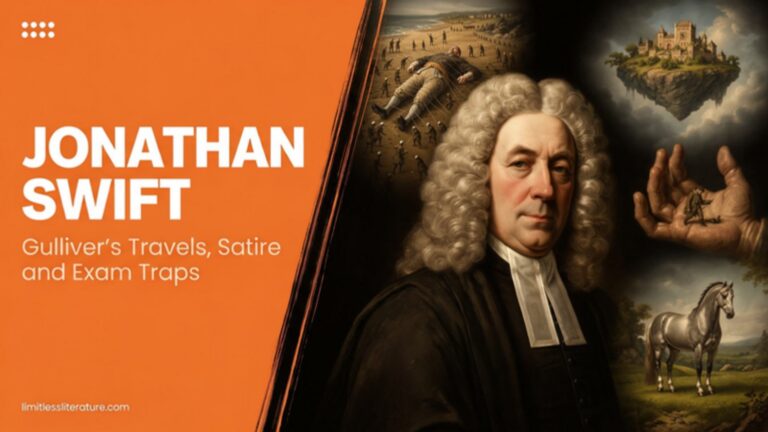
Open our Jonathan Swift question page and count. Of the 23 questions there, 11 are about Gulliver’s Travels, and almost all of them ask the same thing in different clothes: which voyage, which land, which name. Who calls Gulliver “Grildrig”? Where do the Struldbruggs live? Whose verdict is “the most pernicious race of little odious vermin”? If you can place every name in the right part of the book, you have already answered half of what examiners ask about Swift.
The other half is small and repeats just as often: what A Tale of a Tub is about, who the Ancients and Moderns were in The Battle of the Books, what tone A Modest Proposal takes, and who “Stella” was. This guide is built around those questions.
Quick answer: Jonathan Swift (1667–1745) was an Anglo-Irish satirist, Dean of St Patrick’s Cathedral, Dublin, from 1713. For exams, know A Tale of a Tub and The Battle of the Books (1704), the Drapier’s Letters (1724), Gulliver’s Travels (1726, four voyages) and A Modest Proposal (1729), plus Stella, Vanessa and his pen names.
Born: 30 November 1667, Dublin
Died: 19 October 1745, Dublin
Education: Kilkenny College; Trinity College, Dublin
Post: Dean of St Patrick’s, Dublin (from 1713)
Age: Augustan (Neoclassical) satire, with Pope, Gay and Arbuthnot
Group: Scriblerus Club (1713)
Asked in: UGC NET English, State SET, GATE English, KVS and State PGT/TGT, Assistant Professor exams and CUET PG English.
What our own question bank says about Swift
How often he is asked: Swift or his works appear in at least 34 questions in our solved previous year questions. In 28 of them Swift is the subject; in the other 6 he is an option set to catch you (for example, as a wrong author for The Tale of La Roche in June 2026). Two of these questions carry exam labels, June 2024 and June 2026; the rest sit on our topic-wise pages (the Swift question page, the British poetry PYQs and the British literature PYQs) without year labels.
The trap the options are built on: name confusion. “Stella” in a question can mean Swift’s Esther Johnson or Sidney’s Astrophel and Stella; “Johnson” can mean Esther Johnson or Samuel Johnson (June 2024 put The Journal to Stella in a list of Samuel Johnson’s works); “Swift” can mean Jonathan or Graham Swift, author of Waterland. Read the whole name before you mark.
Nakul Sir on A Modest Proposal: “Obviously, Jonathan Swift wasn’t talking about eating children. He was actually attacking the British government, saying that the current situation in Ireland is solely due to the British government.” And on the kind of satire it is: “In Juvenalian satire, you’re not being funny, but you’re being furious, you’re angry.” Watch the short: A Modest Proposal | Why Jonathan Swift Wanted British Government to EAT Irish Babies?
Why examiners keep coming back to Swift
Swift gives an examiner everything a good multiple-choice question needs. His main book has four lands, each with its own made-up names, so one chapter can become a match-the-following item. His pamphlets have exact years and real targets (a merchant called William Wood, the Ancients and Moderns quarrel). And his best-known essay works by saying the opposite of what it means, which makes it perfect for “what is the tone” questions.
My advice on priorities: read Parts I, II and IV of Gulliver’s Travels closely and Part III for its names; know the argument of A Modest Proposal paragraph by paragraph; and learn one line each on A Tale of a Tub, The Battle of the Books, the Drapier’s Letters and the Journal to Stella. Skip the minor church pamphlets unless you have time to spare. Swift’s poetry gets fewer questions, but “Verses on the Death of Dr. Swift” has been asked more than once.
Swift’s works with dates
| Year | Work | Form | What to remember |
|---|---|---|---|
| 1704 | A Tale of a Tub | Prose satire | Religious allegory: three brothers Peter, Martin and Jack |
| 1704 | The Battle of the Books | Mock-heroic prose | Ancients vs Moderns; the spider and the bee; “sweetness and light” |
| 1708–09 | Bickerstaff Papers | Hoax pamphlets | As “Isaac Bickerstaff”, he predicted the death of the almanac maker John Partridge |
| 1710 | A Description of a City Shower | Poem (The Tatler) | Mock-georgic London; ends in “dung, guts, and blood” |
| 1710–13 | Journal to Stella | Letters | To Esther Johnson and Rebecca Dingley; printed after his death |
| 1711 | The Conduct of the Allies | Tory pamphlet | Argued for ending the War of the Spanish Succession |
| 1713 | Cadenus and Vanessa | Poem | On Esther Vanhomrigh; “Cadenus” is an anagram of decanus (dean) |
| 1724 | The Drapier’s Letters | Pamphlets | As “M. B. Drapier”, against William Wood’s copper coins for Ireland |
| 1726 | Gulliver’s Travels | Satirical prose fiction | Published 28 October 1726; four voyages |
| 1729 | A Modest Proposal | Satirical pamphlet | Irony: the poor of Ireland should sell their children as food |
| 1731 / 1739 | Verses on the Death of Dr. Swift | Poem | Written 1731, published 1739; built on a maxim of La Rochefoucauld |
| 1738 | Polite Conversation | Satirical dialogues | Mocks the clichés of fashionable talk |
| 1745 | Directions to Servants | Ironic manual | Published in the year of his death |
Gulliver’s Travels, voyage by voyage
The full title is Travels into Several Remote Nations of the World, “by Lemuel Gulliver, first a surgeon, and then a captain of several ships”. Learn the book as four boxes. Every name an examiner can throw at you belongs in one of them.
| Part | Land | Names to know | The satire |
|---|---|---|---|
| I | Lilliput (and Blefuscu) | Quinbus Flestrin (the “Man-Mountain”), Big-Endians and Little-Endians, Tramecksan and Slamecksan (high and low heels) | Party politics and religious quarrels made tiny and silly |
| II | Brobdingnag | Grildrig (Gulliver’s name there), Glumdalclitch (the farmer’s daughter who looks after him), Splacknuck (the creature he is compared to) | A wise giant king hears Gulliver praise England and calls humans “the most pernicious race of little odious vermin” |
| III | Laputa, Balnibarbi, Glubbdubdrib, Luggnagg, Japan | The flying island, the Academy of Lagado, the Struldbruggs (people who never die but go on ageing) | Useless science, abstract learning and the wish to live forever |
| IV | Land of the Houyhnhnms | Houyhnhnms (rational horses), Yahoos (brutish humans), Don Pedro de Mendez (the kind Portuguese captain) | Reason against human nature; Gulliver comes home unable to bear his own family |
Details that have been asked from our question page: the Houyhnhnms have few words because they have fewer wants and passions; back in England, Gulliver will not let his wife and children touch his bread or drink from his cup; and at the end he says he wrote to inform and instruct mankind. He also calls the real voyager William Dampier his “cousin”. Part II supplies one line examiners love: “nothing is great or little otherwise than by comparison”, which the June 2026 paper asked as a who-said-it item.
See the whole book on one page in our Gulliver’s Travels mind map.
The other works, in one line each
A Tale of a Tub (1704). A father leaves three sons a coat each and a will. Peter (the Roman Catholic Church), Martin (the Church of England) and Jack (Calvinists and Dissenters) twist the will to suit themselves. The coats stand for faith and the will for scripture. Exams ask one thing: it is about contending religious parties, not political factions.
The Battle of the Books (1704). Printed with A Tale of a Tub. Books in the King’s Library fight over whether ancient or modern learning is better. The bee, who gathers from nature, brings “sweetness and light”; the spider spins only from itself. Matthew Arnold later borrowed “sweetness and light” for Culture and Anarchy (see our Matthew Arnold guide).
The Drapier’s Letters (1724). Writing as a Dublin draper, M. B. Drapier, Swift attacked the patent given to the English merchant William Wood to mint copper halfpence for Ireland. The campaign worked; the patent was later withdrawn.
A Modest Proposal (1729). The narrator calmly proposes that poor Irish parents sell their year-old children as food for the rich. The tone is irony, the form a mock economic project. At the close he says he has no personal interest: his youngest child is past the age to be useful, and his wife is past childbearing.
Journal to Stella. Letters written in London from 1710 to 1713 to Esther Johnson (“Stella”) and her companion Rebecca Dingley. Do not mix Stella with Vanessa (Esther Vanhomrigh), the subject of Cadenus and Vanessa.
Verses on the Death of Dr. Swift. Swift imagines how friends and enemies will react to his death. He took the idea from a maxim of La Rochefoucauld: in the misfortunes of our best friends we find something that does not displease us.
Timeline strip
- 1667 Born in Dublin, after his father’s death.
- 1689 Joins Sir William Temple at Moor Park, Surrey, as secretary; meets the young Esther Johnson there.
- 1704 A Tale of a Tub and The Battle of the Books appear together.
- 1710 In London, writing for the new Tory ministry; the Journal to Stella begins.
- 1713 Made Dean of St Patrick’s, Dublin; the Scriblerus Club forms with Pope, Gay, Arbuthnot, Parnell and Oxford.
- 1724 The Drapier’s Letters make him a hero in Ireland.
- 1726 Gulliver’s Travels published on 28 October.
- 1728 Stella dies.
- 1729 A Modest Proposal.
- 1745 Dies in Dublin on 19 October; buried in St Patrick’s beside Stella.
For the Scriblerus side of the story, read our Alexander Pope guide; for the Tory and Whig pamphlet wars that came before, the John Dryden guide.
Famous first lines
Opening lines turn up as “identify the work” questions. These four are worth knowing by heart.
| Opening | Work |
|---|---|
| “My father had a small estate in Nottinghamshire; I was the third of five sons.” | Gulliver’s Travels |
| “It is a melancholy object to those who walk through this great town, or travel in the country…” | A Modest Proposal |
| “Careful observers may foretell the hour / (By sure prognostics) when to dread a shower” | A Description of a City Shower |
| “As Rochefoucault his maxims drew / From nature, I believe ’em true” | Verses on the Death of Dr. Swift |
Asked in exams: real questions from our site
| Question (short) | Answer | Source |
|---|---|---|
| The merchant whose copper-coin patent the Drapier’s Letters attacked | William Wood | Previous year question |
| Gulliver’s name in Brobdingnag | Grildrig | Previous year question |
| Who calls humans “the most pernicious race of little odious vermin”? | The King of Brobdingnag | Previous year question |
| Which Swift book is a religious allegory? | A Tale of a Tub | Previous year question |
| The “Battle of Books” was between which two groups? | Champions of ancient and modern learning | Previous year question |
| The Struldbruggs are… | People exempt from natural death | Previous year question |
| The Journal to Stella was addressed to… | Esther Johnson and Rebecca Dingley | Previous year question |
| Source of the idea for “Verses on the Death of Dr. Swift” | A maxim of La Rochefoucauld | Previous year question |
| Predominant tone and thrust of A Modest Proposal | Irony | Previous year question |
| Match the essayist: Orwell, Montaigne, Lamb, Swift | Swift: A Modest Proposal; Orwell: Why I Write; Lamb: On the Artificial Comedy; Montaigne: On the Cannibals | Previous year question |
| True about Swift (Dublin-born, Kilkenny and Trinity; ordained in the Church of Ireland) | Yes; not a Kit-Cat member, did not write Lady Audley’s Secret | Previous year question |
| “Nothing is great or little otherwise than by comparison”: who said it? | Jonathan Swift | UGC NET June 2026, Q80 |
| Which is not a work of Samuel Johnson? | The Journal to Stella (it is Swift’s) | UGC NET June 2024 (cancelled), Q69 |
| Who wrote “Verses on the Death of Dr. Swift”? | Jonathan Swift himself | Previous year question |
More practice: the topic-wise PYQ collection and all our previous year question papers.
Exam traps and the right answers
- Stella is two people. Swift’s Stella is Esther Johnson. Sidney’s Astrophel and Stella (the first English sonnet sequence in our British poetry PYQs) is a different Stella altogether.
- Stella is not Vanessa. One code question lists Hester Vanhomrigh beside Esther Johnson. Vanhomrigh is Vanessa; the Journal went to Esther Johnson and Rebecca Dingley.
- The wrong Johnson. The Journal to Stella was offered as a Samuel Johnson work in June 2024. It is Swift’s. Johnson wrote The Rambler and The Idler (see our Samuel Johnson guide).
- The wrong Swift. Waterland (1983) is by Graham Swift, a postmodern novelist. Several of our British literature PYQs name him; do not hand his novel to Jonathan.
- Religion, not politics. A Tale of a Tub is about contending religious parties. “Warring political factions” is the distractor. Likewise, The Battle of the Books is Ancients against Moderns, not Cavaliers against Roundheads, and it is not a Victorian novel (it was offered as one).
- Bickerstaff is Swift. In the Drapier question, “Isaac Bickerstaff” is an option, but that was Swift’s own pen name from 1708. The merchant was William Wood. And The Tale of La Roche (June 2026) is Henry Mackenzie’s, not Swift’s.
Self-test: five questions
1. Who is Glumdalclitch in Gulliver’s Travels?
(A) Gulliver’s name among the giants
(B) The farmer’s daughter who nurses him
(C) A maid to the Lilliputian queen
(D) A servant of the Houyhnhnm master
Answer: B. Glumdalclitch is the girl who looks after him in Brobdingnag; his own name there is Grildrig.
2. The Battle of the Books first appeared in print with…
(A) The Tatler, 1709
(B) The Examiner, 1710
(C) Miscellanies, 1727
(D) A Tale of a Tub, 1704
Answer: D. The two satires came out together in the 1704 volume.
3. Which persona signed the 1724 letters against Wood’s halfpence?
(A) M. B. Drapier
(B) Isaac Bickerstaff
(C) Lemuel Gulliver
(D) Martinus Scriblerus
Answer: A. Swift wrote as a Dublin draper; Bickerstaff belongs to the 1708 almanac hoax.
4. Where does Gulliver meet the Struldbruggs?
(A) Lilliput
(B) Brobdingnag
(C) Luggnagg
(D) Houyhnhnm land
Answer: C. They appear in Part III, in Luggnagg, as people who never die but keep ageing.
5. Matthew Arnold took “sweetness and light” from…
(A) A Modest Proposal
(B) Gulliver’s Travels
(C) Journal to Stella
(D) The Battle of the Books
Answer: D. It is the bee’s gift in Swift’s fable of the spider and the bee.
FAQ
What is Jonathan Swift most famous for?
Gulliver’s Travels (1726) and A Modest Proposal (1729). For exams, add A Tale of a Tub and The Battle of the Books (both 1704) and the Drapier’s Letters (1724).
What are the four voyages in Gulliver’s Travels?
Lilliput, Brobdingnag, Laputa (with Balnibarbi, Glubbdubdrib, Luggnagg and Japan) and the land of the Houyhnhnms, in that order.
Who was Stella in Swift’s life?
Esther Johnson, whom Swift first met at Sir William Temple’s house. The Journal to Stella is his letters to her and Rebecca Dingley from London, 1710 to 1713.
What kind of satire is A Modest Proposal?
It is ironic satire written as a mock economic project. Nakul Sir calls it Juvenalian: angry rather than funny, aimed at English neglect of Ireland.
Read more on Swift’s life at Britannica.
Keep going
One author down. Here is where to go next.
- English Literature Authors A–Z: every author guide, mind map and question set on this site
- 5,000+ topic-wise previous year questions from UGC NET, GATE and SET
- UGC NET English guide: syllabus, exam pattern and preparation plan
Preparing for UGC NET English June 2027?
Eklavya Batch | UGC NET June 2027. From foundation to final: printed booklets for the full syllabus, 300+ video lectures and every-day Google Meet sessions with Nakul Sir.
See the Eklavya Batch → 💬 WhatsApp Nakul Sir: 78914 10858