If you’re preparing for UGC NET English Literature, Charles Dickens is compulsory to study.
He appears across multiple units of the syllabus, NTA has asked questions on him in almost every session for the past decade, and the questions cover everything from character identification to novel chronology to opening lines.
This guide breaks down exactly what you need to know, what to skip, and how to study Dickens efficiently for your exam.
Why Charles Dickens is important for UGC NET English Literature
Dickens falls under Unit 5 (Victorian Literature) in the UGC NET English Literature syllabus.
But his reach extends beyond that single unit. Questions on Dickens also appear in the British Novel section, and occasionally in questions about social realism, serialized fiction, and 19th-century literary movements.
On average, you can expect 2-4 questions directly or indirectly related to Dickens in any given NET paper.
That might not sound like much, but in an exam where 2 marks can separate JRF from NET, or NET from nothing, those questions matter. Check the December 2025 topic-wise breakdown to see how Victorian literature questions were distributed in the most recent exam.
Dickens is also a safe topic. Unlike some postcolonial or theoretical writers where NTA can frame ambiguous questions, Dickens questions tend to be factual. If you know your dates, characters, and opening lines, you score. Simple as that.
Major works you must know (with dates)
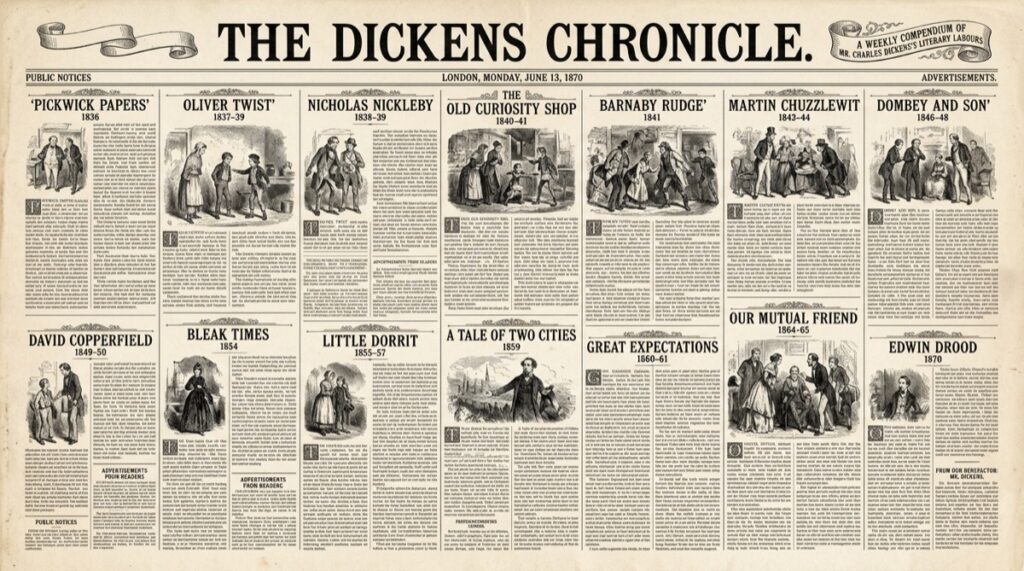
NTA tests chronology heavily. They will give you four novels and ask you to arrange them in order of publication. Memorize these dates:
Novels (in chronological order):
- The Pickwick Papers (1836-37) — his first novel, serialized in monthly parts
- Oliver Twist (1837-39) — subtitled “The Parish Boy’s Progress”
- Nicholas Nickleby (1838-39)
- The Old Curiosity Shop (1840-41)
- Barnaby Rudge (1841) — his first historical novel, set during the Gordon Riots of 1780
- Martin Chuzzlewit (1843-44)
- A Christmas Carol (1843) — a novella, not a novel, but frequently tested
- Dombey and Son (1846-48)
- David Copperfield (1849-50) — Dickens’s own favourite, semi-autobiographical
- Bleak House (1852-53) — the fog opening, Court of Chancery
- Hard Times (1854) — his shortest novel, set in the industrial town of Coketown
- Little Dorrit (1855-57)
- A Tale of Two Cities (1859) — set during the French Revolution
- Great Expectations (1860-61)
- Our Mutual Friend (1864-65) — his last completed novel
- The Mystery of Edwin Drood (1870) — unfinished at his death
Priority tip: Focus hardest on Oliver Twist, David Copperfield, Bleak House, Hard Times, Great Expectations, and A Tale of Two Cities. These six account for roughly 80% of all Dickens questions in previous year papers.
Key themes and concepts tested in UGC NET English Literature
NTA doesn’t ask you to write essays on Dickens. They test specific, identifiable concepts. Here’s what keeps coming up:
Social criticism and reform: Dickens attacked the Poor Law system (Oliver Twist), the factory system (Hard Times), the legal system (Bleak House), debtors’ prisons (Little Dorrit, David Copperfield), and class hypocrisy (Great Expectations). Know which novel targets which institution.
Serialization: Dickens published almost all his novels in serial form, either in weekly or monthly instalments. This affected his narrative structure. Cliffhangers at chapter ends, multiple subplots running simultaneously, and episodic plotting are all features of serialized fiction. NTA has asked about the relationship between serialization and Victorian novel form.
The Bildungsroman: David Copperfield and Great Expectations are both coming-of-age novels. Know the German term and be able to identify which Dickens novels fit this category.
Dickens and illustration: His novels were published with illustrations by artists like Hablot Knight Browne (pen name “Phiz”) and George Cruikshank. NTA has asked which illustrator worked with Dickens on specific novels. Cruikshank illustrated Oliver Twist. Phiz illustrated most of the others from Pickwick Papers through A Tale of Two Cities.
Autobiographical elements: Dickens worked in a blacking factory as a child when his father was imprisoned for debt. This experience directly shaped David Copperfield (the blacking warehouse scene) and Little Dorrit (the Marshalsea prison). Questions about autobiographical elements in Dickens come up regularly.
Novel-by-novel breakdown for UGC NET
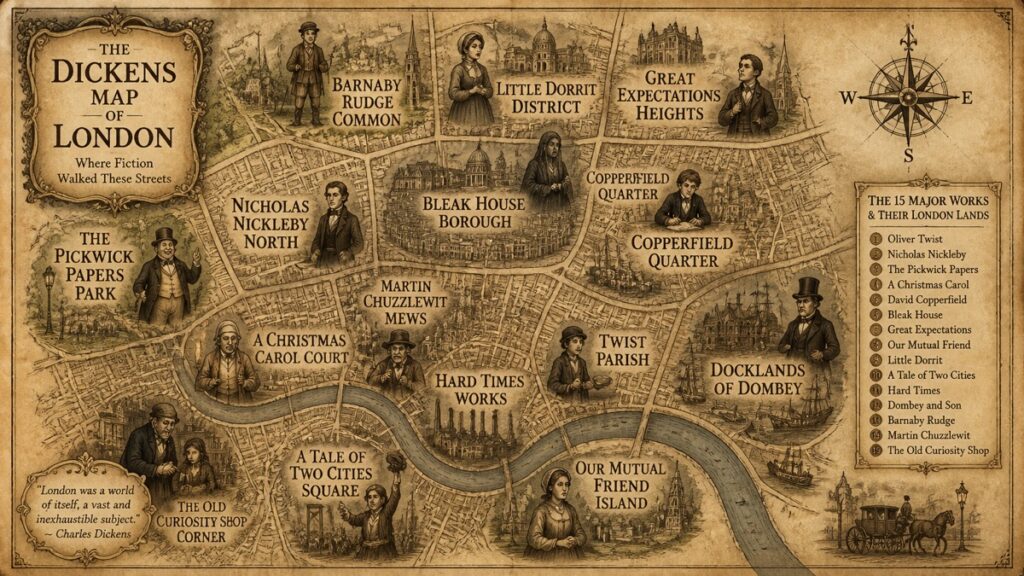
Rather than trying to read all sixteen novels, focus on these high-frequency texts and know them well:
Oliver Twist (1837-39): Subtitle is “The Parish Boy’s Progress.” Set in London’s criminal underworld. Key characters: Oliver, Fagin, the Artful Dodger, Bill Sikes, Nancy, Mr. Bumble. The famous line “Please, sir, I want some more” is from the workhouse scene. Attacks the Poor Law Amendment Act of 1834. Illustrated by George Cruikshank.
David Copperfield (1849-50): Opens with “Whether I shall turn out to be the hero of my own life.” First-person narration. Semi-autobiographical. Key characters: Steerforth, Uriah Heep, Mr. Micawber (based on Dickens’s father), Agnes Wickfield, Betsey Trotwood. Dickens called it his “favourite child.” You can practice questions on this novel in our subject-wise PYQ collection.
Bleak House (1852-53): Opens with the famous fog passage describing London and the Court of Chancery. Uses dual narration — third-person present tense and Esther Summerson’s first-person past tense. This narrative technique is frequently tested. The case of Jarndyce v. Jarndyce satirizes the legal system. Key characters: Lady Dedlock, Esther Summerson, Mr. Tulkinghorn, Inspector Bucket (one of the first detective figures in English fiction).
Hard Times (1854): Set in the fictional industrial town of Coketown. Dedicated to Thomas Carlyle. Opens with Mr. Gradgrind’s speech: “Now, what I want is, Facts.” Attacks utilitarianism and the factory system. Shortest of Dickens’s novels. Key characters: Thomas Gradgrind, Josiah Bounderby, Louisa Gradgrind, Stephen Blackpool, Sissy Jupe. F.R. Leavis included it in The Great Tradition (1948) — this connection between Leavis and Dickens is a popular exam question.
A Tale of Two Cities (1859): Set during the French Revolution. The two cities are London and Paris. Famous opening: “It was the best of times, it was the worst of times.” Key characters: Sydney Carton, Charles Darnay, Lucie Manette, Madame Defarge. Carton’s final sacrifice and his line “It is a far, far better thing that I do” are frequently quoted in questions.
Great Expectations (1860-61): A Bildungsroman. Key characters: Pip, Miss Havisham, Estella, Abel Magwitch, Joe Gargery, Mr. Jaggers. Miss Havisham sitting in her decayed wedding dress in Satis House is one of the most iconic images in English fiction. Dickens wrote two endings — the original dark ending and a revised happier one, influenced by Bulwer-Lytton. NTA has asked about this.
For a broader view of how British novels and prose appear in NET exams, check our category-wise PYQ page.
Common exam traps and how to avoid them
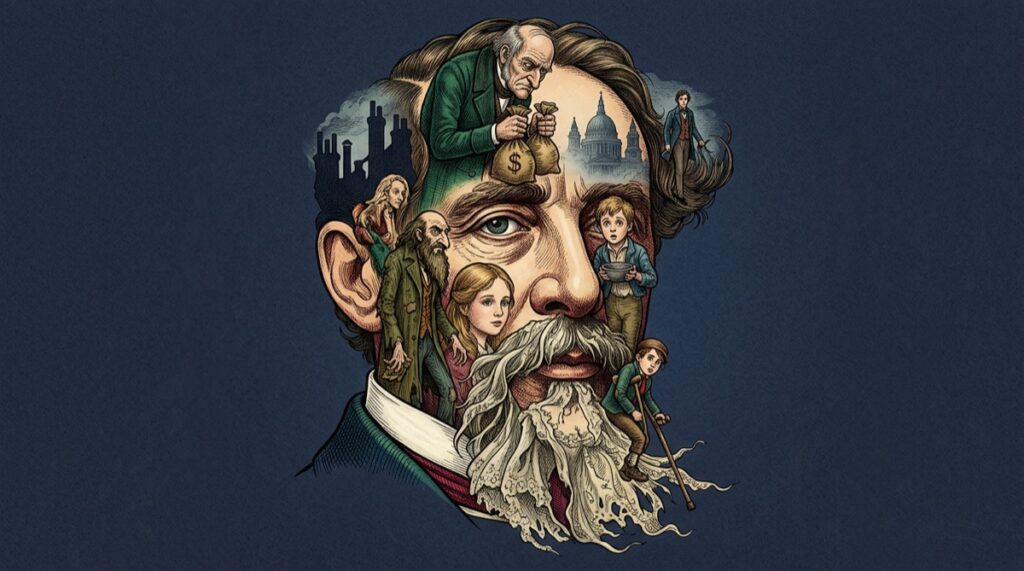
Trap 1: Confusing the illustrators. Students mix up George Cruikshank and Phiz. Remember: Cruikshank = Oliver Twist. Phiz (Hablot Knight Browne) = most other novels from Pickwick to A Tale of Two Cities.
Trap 2: Getting the chronology wrong. A Tale of Two Cities (1859) comes before Great Expectations (1860-61). Students often reverse these. Also, Hard Times (1854) is before Little Dorrit (1855-57), not after.
Trap 3: Attributing the wrong subtitle. Oliver Twist is subtitled “The Parish Boy’s Progress.” Students sometimes confuse this with The Pilgrim’s Progress by Bunyan. The subtitle echoes Bunyan, but it is Dickens’s novel.
Trap 4: Mixing up the opening lines. “It was the best of times” = A Tale of Two Cities. “Whether I shall turn out to be the hero of my own life” = David Copperfield. “Now, what I want is, Facts” = Hard Times (this is Gradgrind’s dialogue, not the narrator). The fog opening = Bleak House. Keep these four straight.
Trap 5: The Leavis connection. F.R. Leavis famously excluded Dickens from The Great Tradition but made an exception for Hard Times, which he praised in an appendix. NTA asks whether Leavis included or excluded Dickens. The answer is nuanced: he excluded Dickens generally but included Hard Times specifically.
How to study Charles Dickens in 5 days (exam strategy)
If you’re short on time, here’s a focused plan. For a more comprehensive approach, see our 40-day exam preparation guide.
Day 1: Memorize the chronology of all major works. Write them down by hand three times. Focus on the six priority novels listed above.
Day 2: Read detailed summaries of Great Expectations, Bleak House, and Hard Times. Note all major characters and their relationships. Know the opening lines.
Day 3: Read detailed summaries of Oliver Twist, David Copperfield, and A Tale of Two Cities. Note subtitles, dedications, and illustrators.
Day 4: Study the thematic connections: which novel attacks which institution, the Bildungsroman question, serialization and its effects, the Leavis connection. Also study autobiographical elements in Dickens.
Day 5: Solve all available Charles Dickens previous year questions. Then solve mixed questions from the previous year question papers to test yourself under exam conditions.
This plan won’t make you a Dickens scholar, but it will get you those 2-4 marks in the exam. And in NET, that’s what matters.
Previous year question patterns for Charles Dickens in UGC NET
Based on analysis of past exam papers, NTA frames Dickens questions in five predictable ways:
Pattern 1 — Character identification: “Which character appears in which novel?” This is the most common type. Know your characters cold, especially minor ones like Quilp (The Old Curiosity Shop), Uriah Heep (David Copperfield), and Inspector Bucket (Bleak House).
Pattern 2 — Chronological ordering: “Arrange the following novels in order of publication.” They pick four novels and ask you to sequence them. Your chronology memorization on Day 1 handles this.
Pattern 3 — Opening lines and famous quotes: They give you a line and ask which novel it belongs to. The four key openings listed above cover most of these.
Pattern 4 — Thematic matching: “Which Dickens novel critiques the legal system?” (Bleak House). “Which novel is set during the French Revolution?” (A Tale of Two Cities). “Which novel is dedicated to Thomas Carlyle?” (Hard Times).
Pattern 5 — Literary connections: Questions linking Dickens to other writers or critics. The Leavis-Hard Times connection is the most tested. Occasionally they ask about Dickens’s influence on later writers or his relationship with Wilkie Collins.
For the complete collection of questions NTA has asked about Dickens, visit our Charles Dickens UGC NET PYQ page. You can also find Dickens questions mixed into our British Literature PYQ section.
According to Britannica’s profile of Dickens, he remains the most widely read Victorian novelist — and NTA’s question frequency reflects that.
Preparing for UGC NET English Literature? Our course covers Charles Dickens and 50+ other high-weightage authors with video lectures, topic-wise MCQs, and 13 physical booklets delivered to your door. Learn more about the course here.