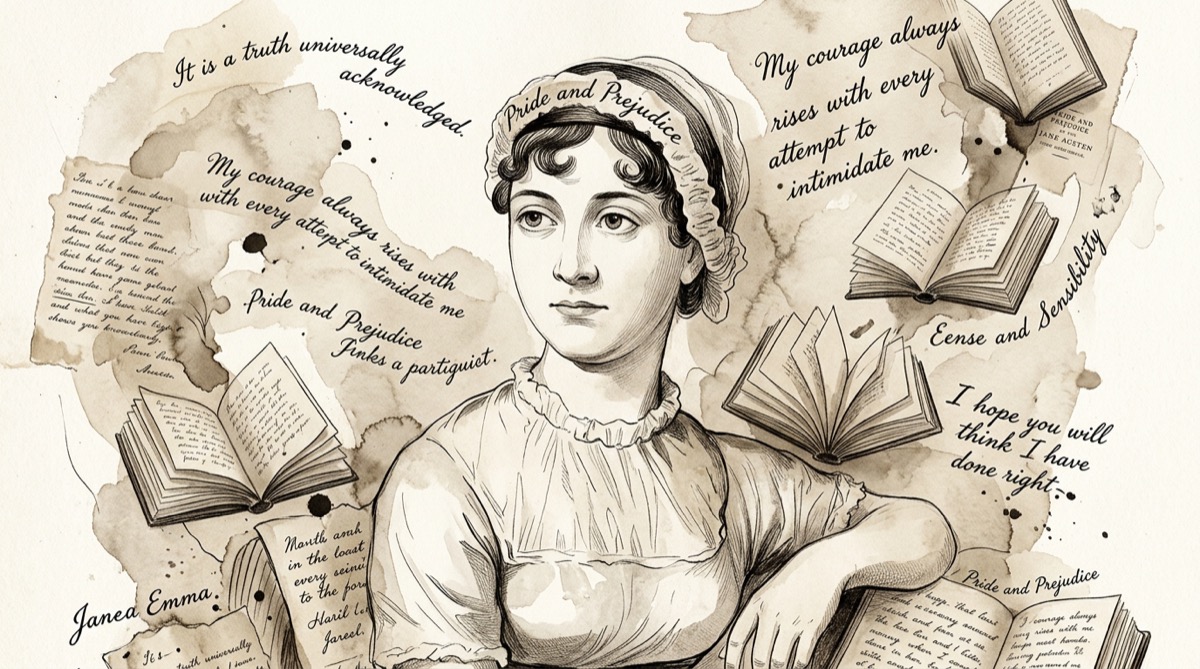
Jane Austen is one of the important writers and appears across multiple units in the NTA syllabus, and questions on her novels have shown up in almost every exam cycle over the past decade.
This guide breaks down everything you need to know about Jane Austen for UGC NET English Literature — her six novels, the literary techniques NTA loves to test, common exam traps, and a practical day-by-day study plan.
Austen wrote only six completed novels, which sounds manageable until you realize NTA can pull questions from any of them.
The good news? Most questions follow predictable patterns, and once you understand Austen’s core techniques and themes, you can handle almost anything the exam throws at you.
Why Jane Austen is important for UGC NET
Looking at the June 2025 UGC NET English question paper, Austen questions tend to fall into three categories: character identification (matching characters to novels), thematic questions (irony, marriage, class), and factual recall (publication dates, first lines, dedicatees).
If you have practiced with subject-wise previous year questions, you will notice that Austen questions rarely go deep into theory. They test whether you have actually read the novels or just memorized summaries.
Major works you must know (with dates)
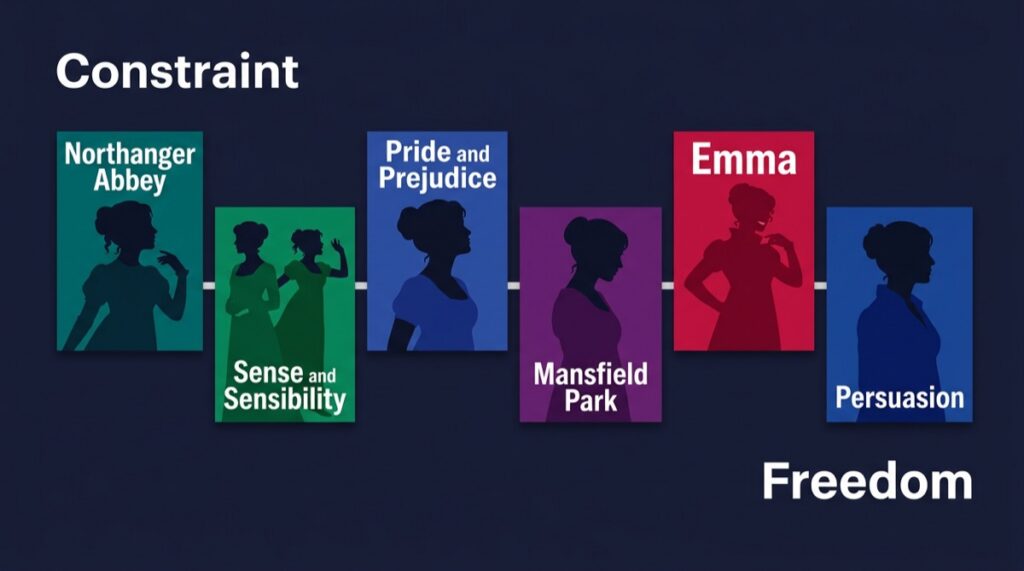
Jane Austen (1775–1817) completed six novels during her short life. NTA tests chronology heavily, so memorize these dates:
Sense and Sensibility (1811) — Austen’s first published novel. Originally drafted as an epistolary novel titled Elinor and Marianne (c. 1795). Published under the pseudonym “By a Lady.” Follows the Dashwood sisters — Elinor (sense) and Marianne (sensibility) — after their father’s death leaves them financially dependent. The central tension is between reason and emotion.
Pride and Prejudice (1813) — Austen’s most famous novel. Originally titled First Impressions (drafted 1796–97). Elizabeth Bennet and Mr. Darcy navigate misunderstandings rooted in pride and social prejudice. Contains perhaps the most quoted opening line in English fiction. This is the novel NTA questions most frequently.
Mansfield Park (1814) — The most debated of Austen’s novels among critics. Fanny Price, a poor relation raised by wealthy relatives, watches moral corruption unfold in a household obsessed with theatricals and status. More serious in tone than the earlier novels. The Lovers’ Vows episode (a play within the novel) is frequently tested.
Emma (1816) — Dedicated to the Prince Regent. Emma Woodhouse is Austen’s most complex heroine — “handsome, clever, and rich” — who fancies herself a matchmaker but consistently misreads people. This novel is the best example of Austen’s use of free indirect discourse. The Box Hill scene is a key turning point that examiners love.
Northanger Abbey (1817, posthumous) — Written around 1798–99 but published after Austen’s death alongside Persuasion. A parody of the Gothic novel tradition, especially Ann Radcliffe’s The Mysteries of Udolpho. Catherine Morland’s overactive imagination, fed by Gothic fiction, leads her to suspect dark secrets at Northanger Abbey. This is NTA’s go-to text for questions about Austen and the Gothic.
Persuasion (1817, posthumous) — Austen’s last completed novel and her most mature work. Anne Elliot, at 27, is Austen’s oldest heroine. She was persuaded to break off an engagement with Captain Wentworth years earlier and gets a second chance. The most autumnal and emotionally direct of Austen’s novels.
Minor works to be aware of: Lady Susan (epistolary novella, written c. 1794, published 1871), The Watsons (unfinished), and Sanditon (unfinished, written in 1817 before her death). These rarely appear in UGC NET but have shown up in one-off questions.
For a full breakdown of how NTA structures its paper around authors like Austen, check the 2025 UGC NET English detailed breakdown.
Key themes and concepts tested in UGC NET

NTA frames Austen questions around specific literary concepts. Here are the ones that appear most often:
Free Indirect Discourse — This is the single most tested concept connected to Jane Austen for UGC NET English Literature. Free indirect discourse blends the narrator’s voice with a character’s thoughts without quotation marks or reporting verbs. Austen did not invent it, but she perfected it. In Emma, the reader often cannot tell where the narrator ends and Emma’s own self-deception begins. If an NTA question asks “Which author is most associated with free indirect discourse?”, the answer is Austen.
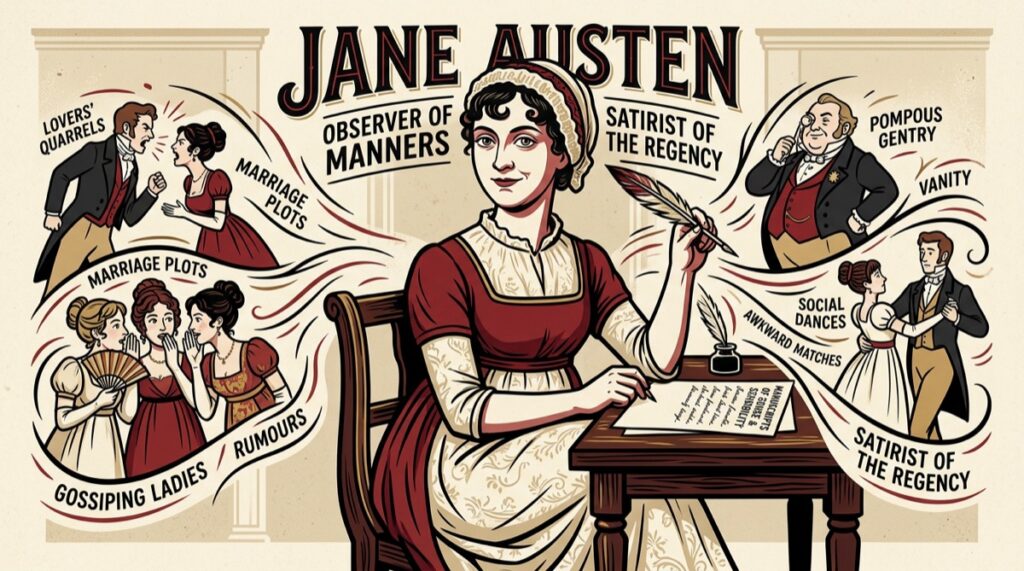
Novel of Manners — Austen’s novels are the textbook definition of this genre. A novel of manners focuses on the social customs, behaviours, and moral codes of a particular class (in Austen’s case, the English gentry). Questions may ask you to identify the genre or to distinguish it from the Gothic novel, the picaresque, or the Bildungsroman.
Irony and Satire — Austen’s irony operates at every level: dramatic irony (the reader knows more than the characters), verbal irony (characters say the opposite of what they mean), and situational irony. The opening of Pride and Prejudice is pure verbal irony. Mr. Collins’s proposal to Elizabeth is dramatic irony at its sharpest. NTA frequently tests students’ ability to identify the type of irony in a given passage.
Marriage and Class — Every Austen novel revolves around marriage, but not in the romantic sense alone. Marriage in Austen is an economic institution, a mechanism for class mobility, and often the only avenue of financial security available to women. Questions about Austen and marriage tend to test whether you understand the social realities underneath the love stories.
Gothic Parody — Specifically in Northanger Abbey. NTA likes to ask which Austen novel parodies the Gothic tradition, or which Gothic novelist is referenced in the text. The answer is Ann Radcliffe, specifically The Mysteries of Udolpho.
Novel-by-novel exam focus areas

Here is what to prioritize in each novel if you are studying Jane Austen for UGC NET English Literature:
Pride and Prejudice — Know the opening line verbatim. Know the five Bennet sisters by name. Understand Mr. Collins as a figure of satire. Understand the Darcy–Wickham contrast. Know that the novel was originally titled First Impressions. Questions about Austen’s treatment of pride and social prejudice almost always reference this novel.
Emma — Focus on the Box Hill scene (Emma insults Miss Bates and Mr. Knightley rebukes her). Understand Emma as an unreliable focalizer — the reader sees events through Emma’s flawed perception. Know the Harriet Smith subplot. This novel is the standard reference for questions on free indirect discourse in Austen.
Sense and Sensibility — Know which sister represents “sense” (Elinor) and which represents “sensibility” (Marianne). The Willoughby–Marianne plot vs. the Edward Ferrars–Elinor plot. Understand the binary structure of the novel.
Mansfield Park — The Lovers’ Vows episode is critical. Know that the play performed is Elizabeth Inchbald’s adaptation of Kotzebue’s Das Kind der Liebe. Fanny Price is Austen’s most controversial heroine — passive, moralistic, and judged differently by every generation of critics. Sir Thomas Bertram’s colonial holdings in Antigua have generated significant postcolonial readings (Edward Said discusses this in Culture and Imperialism).
Northanger Abbey — Gothic parody. Catherine Morland as a naive reader. The direct reference to Ann Radcliffe. The famous “defence of the novel” passage in Chapter 5, where Austen argues for the novel as a serious literary form. This passage has appeared as a comprehension question in previous NET papers.
Persuasion — Anne Elliot’s age (27). Captain Wentworth’s letter (“You pierce my soul. I am half agony, half hope.”). The theme of constancy vs. persuasion. The autumnal mood connecting to Romantic sensibility.
You can practice questions from all these novels in the Jane Austen previous year UGC NET questions collection, or browse the wider British Literature PYQ bank.
Common exam traps and how to avoid them
Trap 1: Confusing publication order with writing order. Northanger Abbey was published in 1817 but written in the 1790s, making it one of Austen’s earliest works. NTA sometimes asks about “Austen’s first novel” — the answer depends on whether they mean first published (Sense and Sensibility, 1811) or first drafted (Northanger Abbey / Susan, c. 1798-99). Read the question carefully.
Trap 2: Mixing up characters across novels. Austen has a large cast across six novels. NTA loves matching questions: “Which novel features these characters?” Know that Anne Elliot belongs to Persuasion, Fanny Price to Mansfield Park, Catherine Morland to Northanger Abbey, and the Dashwood sisters to Sense and Sensibility. Students who have not read the novels often confuse Elinor Dashwood with Fanny Price.
Trap 3: Assuming Northanger Abbey is a Gothic novel. It is a parody of Gothic novels. If NTA asks “Which of the following is a Gothic novel?” and lists Northanger Abbey as an option, it is a wrong answer. The correct classification is Gothic parody or anti-Gothic satire.
Trap 4: Forgetting the dedicatee of Emma. Emma was dedicated to the Prince Regent (later George IV). This is a factual recall question that has appeared more than once. Students often guess it was dedicated to a literary figure.
Trap 5: Not knowing Austen’s original titles. Pride and Prejudice was originally First Impressions. Sense and Sensibility was originally Elinor and Marianne. Northanger Abbey was originally Susan. These alternate titles are tested as matching questions.
How to study Jane Austen for UGC NET

If the exam is close and you need a focused plan for Jane Austen for UGC NET English Literature, here is what to do:
Day 1: Pride and Prejudice + Emma. These two novels generate the most questions. Read detailed summaries with character lists. Memorize the opening line of Pride and Prejudice. Understand the Box Hill scene in Emma. Study free indirect discourse using Emma as your primary example.
Day 2: Sense and Sensibility + Persuasion. Focus on the binary structure of Sense and Sensibility (Elinor vs. Marianne) and the theme of constancy in Persuasion. Note Anne Elliot’s age and the Wentworth letter. These two novels are simpler to prepare than Mansfield Park.
Day 3: Northanger Abbey + Mansfield Park. Study Northanger Abbey as Gothic parody — know Ann Radcliffe and The Mysteries of Udolpho. Read the Chapter 5 defence of the novel passage. For Mansfield Park, focus on the Lovers’ Vows episode and the Edward Said postcolonial reading.
Day 4: Themes, techniques, and critical reception. Study free indirect discourse, novel of manners, irony (verbal, dramatic, situational), marriage as economic institution, and class structure. Read one good critical essay — D.W. Harding’s “Regulated Hatred” (1940) is short and frequently referenced in exam questions about Austen criticism.
Day 5: PYQs and revision. Solve all available previous year question papers that include Austen questions. Focus on the pattern: character identification, chronology, and thematic matching. If you are using our study material for UGC NET English Literature, go through the Austen section’s MCQs twice.
For broader preparation advice beyond single authors, read this guide on 5 things to do 40 days before UGC NET English Literature exam.
Previous year question patterns
Based on analysis of UGC NET English papers from 2017 to 2025, Austen questions follow these patterns:
Character identification (most common): “Which of the following characters appears in [novel]?” or “Match the characters with the correct novels.” These are pure recall questions. If you know your character lists, these are free marks.
Factual recall: Publication dates, original titles, dedications, opening lines. NTA treats Austen as a factual gold mine because her bibliography is compact and memorizable.
Literary technique: Questions about free indirect discourse, irony, or the novel of manners almost always reference Austen. Sometimes the question does not name Austen directly but describes a technique and asks you to identify the author.
Thematic analysis: “Which of the following best describes Austen’s treatment of marriage?” or “What is the primary target of Austen’s satire?” These need conceptual understanding, not just factual recall.
Gothic parody: At least one question about Northanger Abbey and the Gothic tradition appears in most exam cycles.
You can see these patterns in action across the December 2025 topic-wise UGC NET paper. For a broader view of how British prose writers are tested, explore the full British Literature previous year questions collection.
For a reliable external reference on Austen’s life and works, the Jane Austen Society of North America (JASNA) maintains well-sourced summaries and critical discussions.
Preparing for UGC NET English Literature? Our course covers Jane Austen and 50+ other high-weightage authors with video lectures, topic-wise MCQs, and 13 physical booklets delivered to your door. Learn more about the course here.