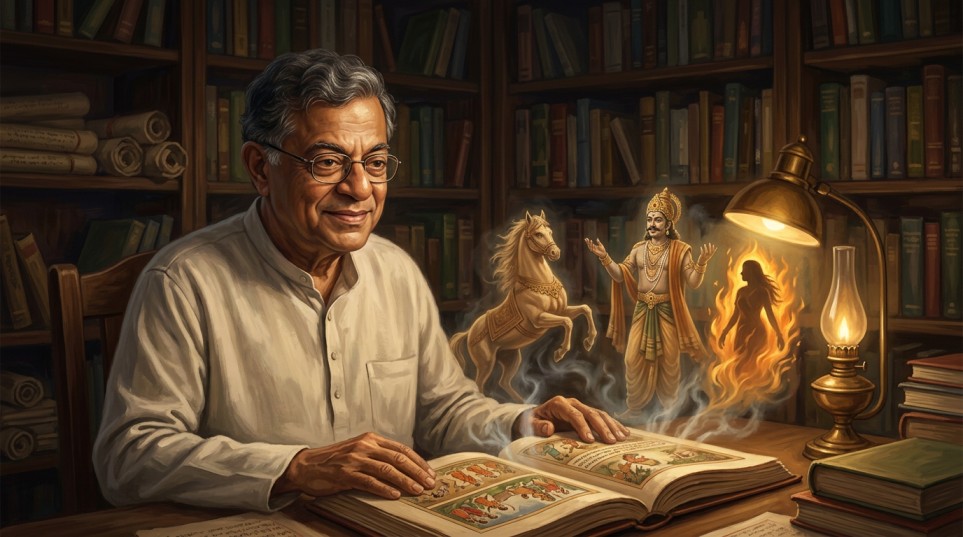
If you are preparing for UGC NET English Literature, Girish Karnad is one playwright which was in a lot of UGC NET past exams.
He appears in the Indian Writing in English and Indian Drama sections of the syllabus, and NTA has asked questions on his plays repeatedly across exam cycles.
From Tughlaq’s political allegory to Hayavadana’s body-swap crisis, Karnad’s work draws on myth, folklore, and history in ways that generate sharp, tricky MCQs.
This guide breaks down everything you need to know — his major works, the themes NTA loves to test, common exam traps, and a realistic day study plan.
Why Girish Karnad is important for UGC NET English Literature
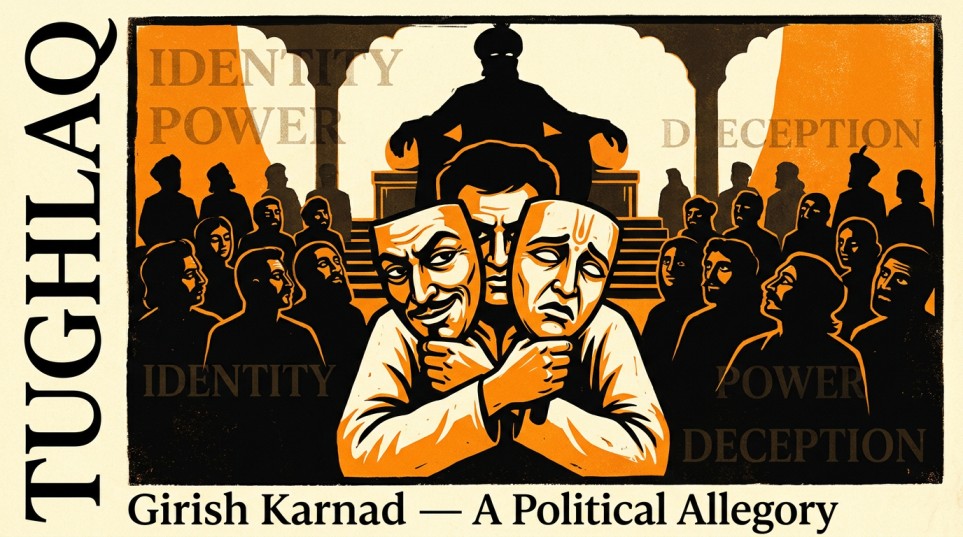
Girish Karnad (1938–2019) falls under Unit IX (Indian Writing in English) and is specifically relevant to Indian drama questions in the UGC NET English Literature syllabus. NTA treats him as a high-weightage dramatist alongside Badal Sircar, Vijay Tendulkar, and Mahesh Dattani.
Here’s why he keeps showing up in exams. First, he won the Jnanpith Award (1998), India’s highest literary honour, which makes him a favourite for factual recall questions.
Second, his plays bridge mythology and modernity, giving NTA room to frame analytical questions about his use of folk forms.
Third, he wrote in Kannada and translated his own work into English, which raises questions about translation, bilingualism, and the politics of Indian English theatre.
If you look at the 2025 UGC NET English exam breakdown, Indian Writing in English consistently carries 15–20 questions.
Karnad’s plays make up a reliable chunk of that. You can also check Indian Modern Theatre previous year UGC NET questions to see how frequently his name appears.
Major works you must know (with dates)
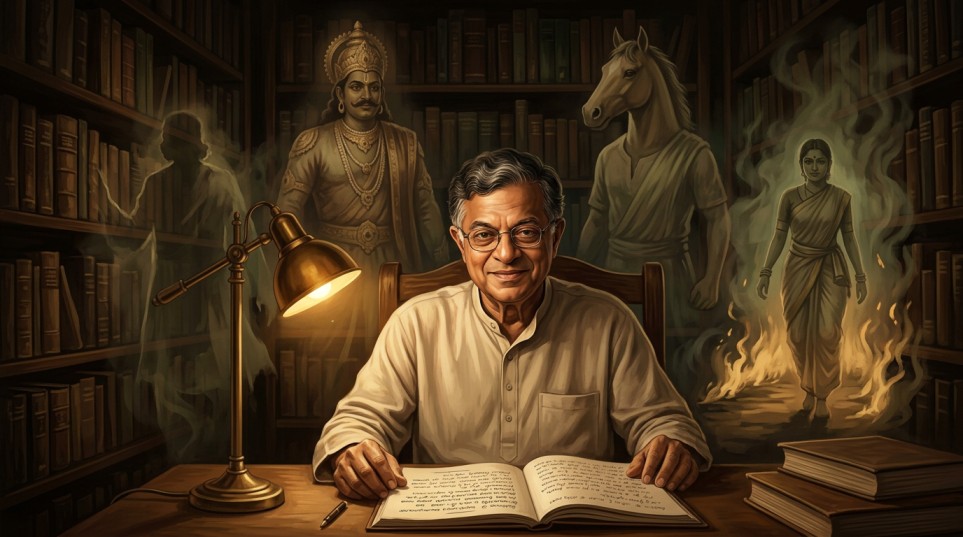
NTA tests chronology heavily, so memorise these dates. Karnad wrote all his plays originally in Kannada and later translated them into English himself.
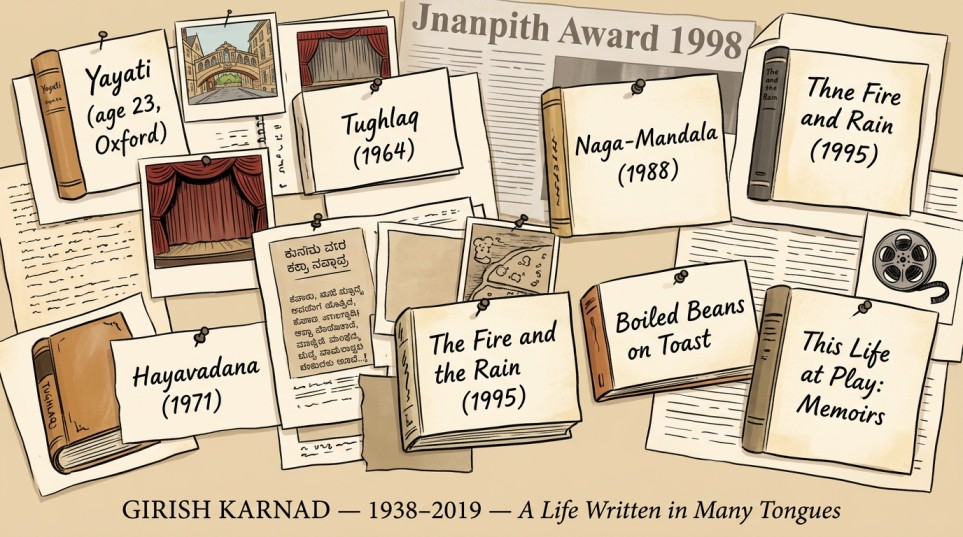
Yayati (1961) — His debut play, written while he was a Rhodes Scholar at Oxford. Based on the story of King Yayati from the Mahabharata. Yayati asks his son Puru to exchange his youth for Yayati’s old age. The play questions the ethics of a father exploiting his child. This is the only play Karnad did not translate into English himself.
Tughlaq (1964) — His most politically significant play. Based on the historical figure Muhammad bin Tughlaq, the 14th-century Sultan of Delhi known for brilliant but disastrous decisions. Written as an allegory for the Nehruvian era — idealism giving way to disillusionment. Structured in 13 scenes. This is the play NTA asks about most often.
Hayavadana (1971) — Based on a story from the 11th-century Sanskrit text Kathasaritsagara, filtered through Thomas Mann’s novella The Transposed Heads (1940). Uses the Yakshagana folk theatre form. The central question: is identity located in the head or the body? Won the Kamaladevi Chattopadhyay Award.
Hittina Hunja / Bali: The Sacrifice (1980) — Explores the conflict between Vedic Brahminism and folk religion. A rooster sacrifice becomes the site of ideological battle between a husband and wife.
Nagamandala (1988) — Drawn from Kannada folk tales. Rani is trapped in a loveless marriage; a magical cobra (Naga) visits her at night disguised as her husband. Questions the nature of truth, fidelity, and patriarchal authority. The frame narrative uses the device of oral storytelling — flames that have escaped from houses gather to share tales.
Taledanda / Death by Beheading (1990) — Set in 12th-century Karnataka during the Veerashaiva (Lingayat) movement led by Basavanna. Deals with caste violence, religious reform, and the limits of social revolution. Written in the context of the Mandal Commission agitation. Won the Sahitya Akademi Award in 1994.
The Dreams of Tipu Sultan (1997) — A BBC commission. Historical play about Tipu Sultan of Mysore, using his actual dream diary as source material.
Agni Mattu Male / The Fire and the Rain (1998) — Based on the story of Yavakri from the Mahabharata. A fire sacrifice becomes the backdrop for themes of jealousy, artistic rivalry, and sexual desire.
Benda Kalu on Toast / Boiled Beans on Toast (2012) — His most contemporary play, set in modern Bangalore. Deals with communalism, land grabbing, and urban politics.
For a full collection of Indian Literature previous year questions that include Karnad, check our subject-wise question bank.
Key themes and concepts tested in UGC NET English Literature
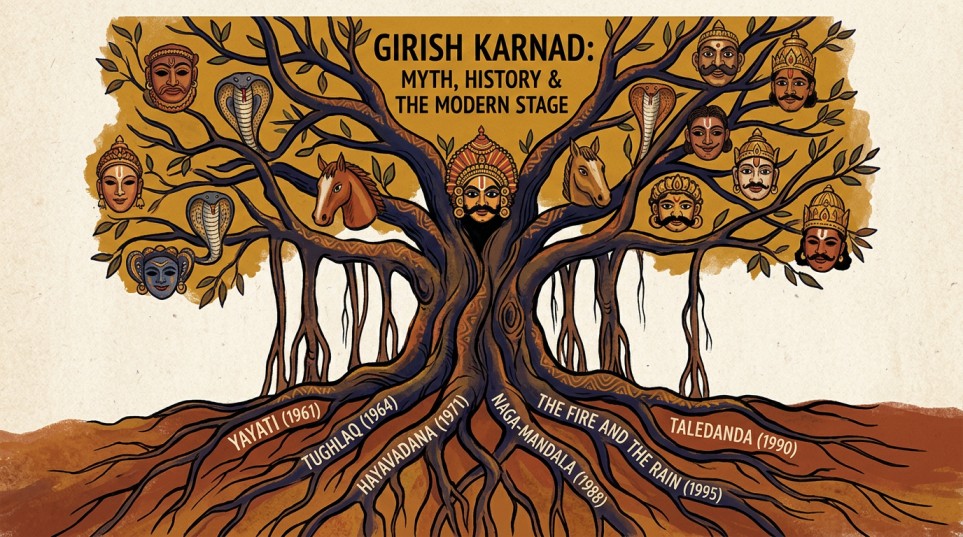
NTA doesn’t just ask “who wrote what.” They test whether you understand the deeper patterns across Girish Karnad’s plays. Here are the recurring themes:
Myth and history as political allegory. Tughlaq uses a medieval sultan to comment on Nehru’s India. Taledanda uses 12th-century Karnataka to comment on caste politics in the 1990s. NTA frequently asks you to identify which historical period a play allegorises.
The crisis of identity. Hayavadana is the most obvious example — two friends swap heads, and neither their wives nor they themselves can figure out who is who. But identity questions run through Nagamandala (Rani’s split between her “real” husband and the Naga), Yayati (the exchanged youth), and even Tughlaq (the gap between the sultan’s self-image and his actual tyranny).
Folk and classical theatre forms. Karnad was one of the first modern Indian playwrights to use traditional performance conventions — Yakshagana in Hayavadana, the Sutradhar (narrator) figure, masks, the play-within-a-play structure, and animal characters. NTA loves asking which folk form is used in which play.
Gender and patriarchy. Nagamandala is a strong feminist text — Rani’s trial by ordeal (holding a cobra to prove her chastity) is an ironic rewriting of Sita’s Agni Pariksha. Padmini in Hayavadana makes an independent choice about desire. Bali: The Sacrifice pits a woman’s folk beliefs against her husband’s Brahminical rationalism.
Violence and the failure of idealism. Tughlaq’s reforms collapse into bloodshed. Basavanna’s egalitarian movement in Taledanda ends in mass killing. Karnad’s recurring message: good intentions are not enough when power structures resist change.
Play-by-play breakdown: what NTA actually asks
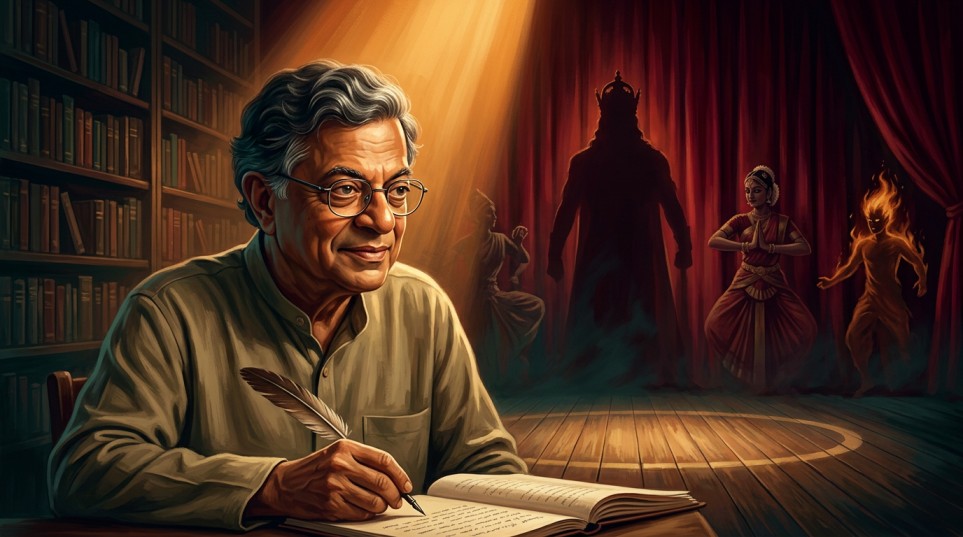
Let me go deeper into the three plays NTA tests most. If you’re short on time, focus here.
Tughlaq
This is Karnad’s most examined play in UGC NET English Literature. Know these facts cold:
The play has 13 scenes (not acts). The opening scene takes place in front of a mosque in Delhi. Tughlaq’s two most controversial decisions are shifting the capital from Delhi to Daulatabad and introducing copper currency.
The character Aziz represents the common opportunist who thrives in political chaos. The play ends with Tughlaq alone, praying — a broken idealist turned tyrant.
The Nehruvian allegory angle is a guaranteed exam question. Tughlaq’s rational reforms (separating religion from state, attempting Hindu-Muslim unity) mirror Nehru’s secular modernism. Both began with grand visions and ended in crisis.
Hayavadana
Based on a story from Kathasaritsagara and Thomas Mann’s The Transposed Heads. The three central characters are Devadatta (intellectual, poet), Kapila (physical, strong-bodied), and Padmini (who desires both).
After a head-swap, Padmini must decide: is her husband the one with her husband’s head on another man’s body, or the one with another man’s head on her husband’s body?
The title character Hayavadana (“horse-head”) has a horse’s head on a human body and wants to become fully human. Ironically, he becomes fully horse instead. The play uses a Bhagavata (narrator) figure drawn from Yakshagana tradition.
Key exam point: the play questions the Cartesian mind-body split. NTA has asked which Western text inspired Hayavadana — the answer is Thomas Mann’s The Transposed Heads, not the Kathasaritsagara (though both are sources).
Nagamandala
The frame story involves flames (escaped from sleeping households) gathering to hear a tale. Rani’s husband Appanna ignores her completely.
A Naga (cobra king) takes Appanna’s form and visits Rani at night, treating her with love. When Rani becomes pregnant, Appanna accuses her of infidelity. She undergoes a trial by ordeal — holding a cobra — and survives because the Naga protects her.
NTA tests the irony here: Rani “passes” the chastity test, but she technically did have a relationship with another being (the Naga). The play questions whether truth is about facts or social performance.
Common exam traps and how to avoid them
Trap 1: Confusing Karnad’s sources. Hayavadana’s source is both the Kathasaritsagara AND Thomas Mann. If the question asks for the “Western source,” the answer is Mann. If it asks for the “original source” or “Sanskrit source,” the answer is Kathasaritsagara. Read the question carefully.
Trap 2: Getting the Sahitya Akademi Award play wrong. Taledanda won the Sahitya Akademi Award in 1994, not Tughlaq and not Hayavadana. Students often assume Tughlaq won because it’s his most famous play.
Trap 3: Misidentifying the folk form. Hayavadana uses Yakshagana, not Nautanki or Tamasha. NTA has offered these as distractors.
Trap 4: Mixing up the Jnanpith year. Karnad received the Jnanpith Award in 1998, not 1994 (that’s the Sahitya Akademi). The two dates get swapped in students’ notes constantly.
Trap 5: Attributing plays to the wrong language. All of Karnad’s plays were originally written in Kannada, not English. He translated them into English himself (except Yayati, which was translated by others). NTA sometimes frames questions around this.
You can practise avoiding these traps by solving subject-wise previous year questions where Karnad appears regularly in the Indian Writing in English section.
How to study Girish Karnad for UGC NET in 5 days
If the exam is close and you haven’t touched Karnad yet, here’s a realistic plan:
Day 1: Tughlaq. Read a detailed summary. Focus on the 13-scene structure, the Nehruvian allegory, Aziz’s role, and the ending. Note the historical facts about Muhammad bin Tughlaq.
Day 2: Hayavadana. Understand the head-swap plot, the Yakshagana connection, the Thomas Mann source, and the mind-body identity question. Know the characters Devadatta, Kapila, Padmini, and Hayavadana.
Day 3: Nagamandala + Taledanda. These are your next-priority plays. For Nagamandala, focus on the frame narrative, the Naga’s role, and the irony of the chastity trial. For Taledanda, know the Basavanna context, the caste theme, and the Sahitya Akademi Award (1994).
Day 4: Remaining plays + biography. Quick notes on Yayati, Bali: The Sacrifice, The Fire and the Rain, and The Dreams of Tipu Sultan. Memorise key dates: born 1938 (Matheran), died 2019 (Bengaluru), Padma Shri 1974, Padma Bhushan 1992, Jnanpith 1998. Rhodes Scholar at Oxford.
Day 5: Previous year questions. Solve every Karnad PYQ you can find. Check our previous year question papers hub and the December 2025 topic-wise paper for the latest patterns. Also read the exam preparation strategy guide if you want a broader study framework.
Previous year question patterns
NTA frames Girish Karnad questions in a few predictable ways. Matching type questions (“Match the play with its source”) are common — you’ll see Hayavadana paired with Thomas Mann, Yayati with the Mahabharata, Tughlaq with Muhammad bin Tughlaq.
Factual recall questions test awards, dates, and folk form names. Analytical questions ask you to identify the central theme or the allegorical period of a specific play.
In recent years, NTA has also started asking comparative questions: pairing Karnad with other Indian dramatists like Vijay Tendulkar, Badal Sircar, or Mahesh Dattani and asking what distinguishes their dramatic approach.
Karnad’s distinguishing feature is his use of myth and folk forms — Tendulkar is known for realistic social drama, Sircar for Third Theatre, and Dattani for contemporary urban issues.
For more practice with Indian drama and other high-weightage writers like Kamala Das and Salman Rushdie, check our full Indian Literature question bank.
Preparing for UGC NET English Literature? Our complete course covers Girish Karnad and 50+ other high-weightage authors with video lectures, topic-wise MCQs, and 13 physical booklets delivered to your door.