If you are preparing for UGC NET English Literature, Samuel Beckett is one writer from where you will definitely find a couple of questions.
NTA has tested him repeatedly across multiple cycles, and questions on Beckett tend to be tricky because they test specific details rather than broad ideas.
Most students read a summary of Waiting for Godot and assume they are covered. They are not.
Beckett’s presence in the syllabus goes well beyond a single play, and the exam regularly pulls questions from his lesser-known works, his philosophical connections, and the structural details of his drama.
This guide breaks down everything you need to know about Samuel Beckett for UGC NET English Literature: his major works with exact dates, the concepts NTA loves to test, common exam traps, and a practical study plan you can start today.
Why Samuel Beckett is important for UGC NET
Samuel Beckett appears in the UGC NET English Literature syllabus — British Drama, alongside Ben Jonson, Harold Pinter, and Bertolt Brecht.
He also shows up indirectly under literary criticism and theory sections when questions touch on the Theatre of the Absurd, existentialism, or postmodern drama.
In recent exam cycles, NTA has asked 2 to 4 questions directly or indirectly related to Beckett.
Sometimes the question names him outright. Other times, you will see a passage from Waiting for Godot or a question about absurdist theatre that requires knowledge of Beckett’s techniques.
If you look at the June 2025 UGC NET English Literature question paper, you will notice that drama questions consistently appear and Beckett is a favourite source.
The UGC NET English syllabus breakdown confirms that British Drama carries significant weightage. Skipping Beckett means leaving easy marks on the table.
Major works you must know (with dates)
NTA tests chronology heavily. Get these dates wrong and you lose marks on straightforward matching questions. Here is the list you need to memorize:
Plays:
- Waiting for Godot (written 1948–49, first performed January 1953 in Paris, published 1952 in French as En attendant Godot)
- Endgame (Fin de partie, 1957)
- Krapp’s Last Tape (1958, written in English)
- Happy Days (1961, written in English)
- Play (1963)
- Not I (1972)
- Footfalls (1976)
- Rockaby (1981)
Novels (the Trilogy):
- Molloy (1951, French; 1955, English translation)
- Malone Dies (Malone meurt, 1951)
- The Unnamable (L’innommable, 1953)
Other prose:
- Murphy (1938, his first published novel)
- Watt (written 1942–44, published 1953)
- How It Is (Comment c’est, 1961)
- Worstward Ho (1983)
Critical work:
- Proust (1931, a critical essay on Marcel Proust)
Nobel Prize: 1969, for Literature.
Pay special attention to the trilogy (Molloy, Malone Dies, The Unnamable). NTA has asked matching questions where you need to arrange these in order or identify which came first.
Also note that Waiting for Godot was written in French originally. This fact appears in MCQs.
For practice on chronology-based questions, work through the subject-wise previous year questions collection where drama questions are sorted by topic.
Key themes and concepts tested in UGC NET

Beckett questions in UGC NET English Literature fall into a few predictable categories. Here is what NTA tends to focus on:
Theatre of the Absurd. Martin Esslin coined this term in his 1960 essay (published as a book in 1961). Beckett is considered the central figure of this movement, though Beckett himself never used the label. NTA will test whether you know that the Theatre of the Absurd was not a formal movement with manifestos. It was a critical label applied after the fact. Other playwrights grouped under this term include Eugène Ionesco, Jean Genet, and Arthur Adamov.
Existentialism and the absurd. Beckett’s work draws on Albert Camus’s concept of the absurd (from The Myth of Sisyphus, 1942) and Sartre’s existentialism, but Beckett was not a card-carrying existentialist. His characters exist in a world stripped of meaning, waiting for something that never arrives. The philosophical underpinning matters for theory-based questions.
Minimalism and reduction. Beckett’s career shows a consistent movement toward less. His early novels are dense; his late plays (Not I, Breath) strip theatre down to a mouth, a breath, a few seconds. NTA sometimes asks about this trajectory.
Language and silence. In Beckett’s world, language fails to communicate. Characters talk to fill silence, but their words carry no real information. The gap between what is said and what is meant is a recurring exam topic.
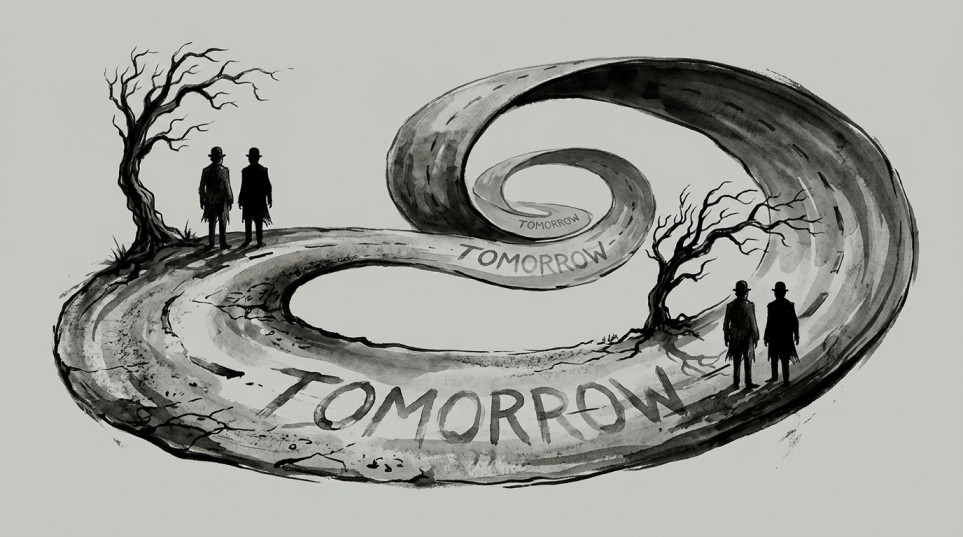
Circular structure. Waiting for Godot ends where it begins. Act II mirrors Act I. Nothing progresses. This structural choice is itself a thematic statement, and NTA tests whether you understand that the repetition is intentional, not lazy writing.
Tragicomedy. Beckett subtitled Waiting for Godot “a tragicomedy in two acts.” Expect questions that ask you to identify this subtitle or explain why the play blends comedy with despair.
Play-by-play breakdown for UGC NET
Waiting for Godot (1953)
This is the most tested Beckett work in UGC NET English Literature, so know it inside out.
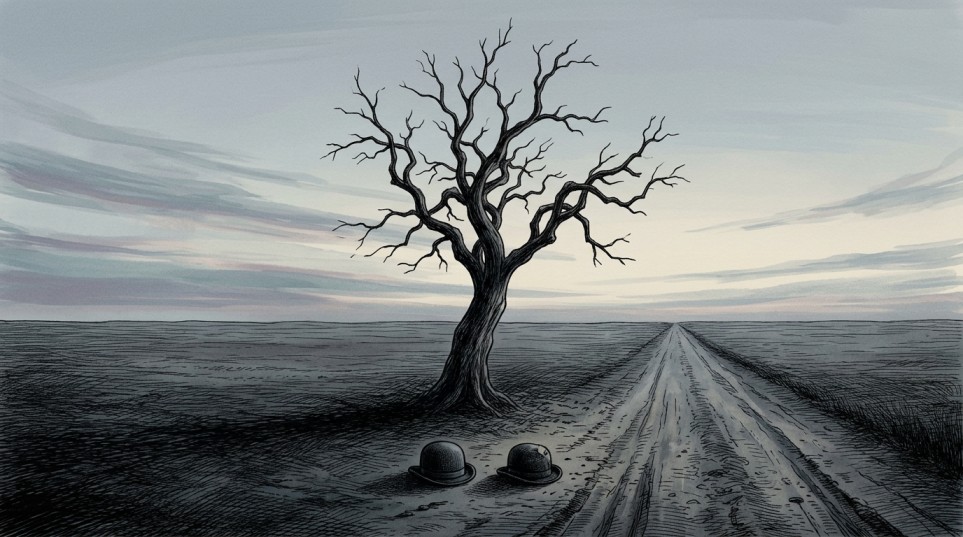
Structure: Two acts. The setting is “A country road. A tree.” (NTA has tested this exact stage direction.) Act II is almost identical to Act I, reinforcing the theme of repetition and stasis.
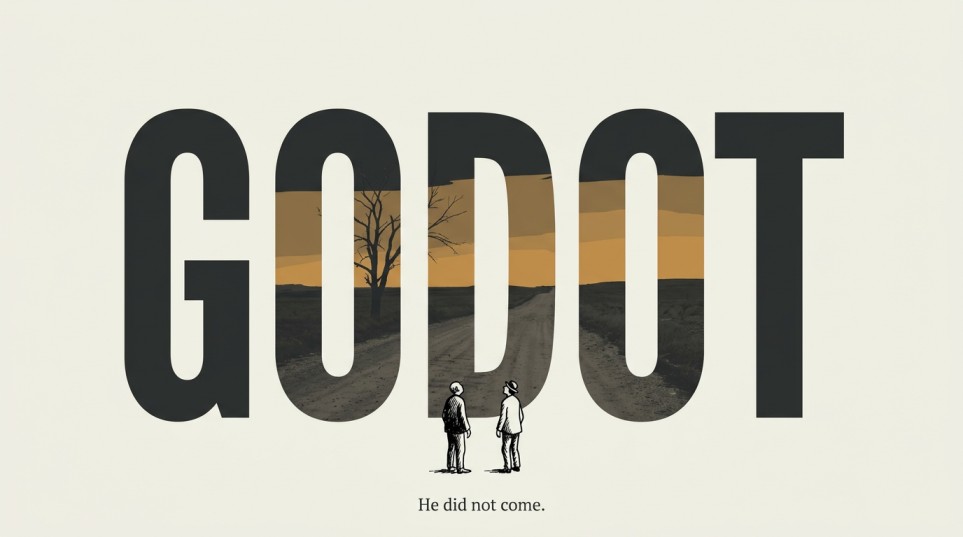
Characters: Vladimir (called Didi) and Estragon (called Gogo) wait for someone named Godot, who never comes. Pozzo and Lucky appear in both acts. Lucky delivers a famous monologue in Act I (the “thinking” speech) that is a stream of broken academic and theological language. A Boy appears at the end of each act to say Godot will come tomorrow.
Key details NTA tests:
- The tree has leaves in Act II but was bare in Act I (only change between acts)
- Vladimir is the more intellectual of the two; Estragon is more physical
- Lucky’s speech parodies academic discourse
- The play was originally written in French
- Beckett dedicated no specific allegorical meaning to Godot; he refused to say who or what Godot represents
- The famous speech about being born “astride of a grave” belongs to Vladimir, not Estragon
For Beckett-specific previous year questions from NET and GATE, check the dedicated PYQ page where questions are organized by playwright.
Endgame (1957)
Structure: One act. Set in a bare room with two small windows. Four characters: Hamm (blind, cannot stand, sits in a wheelchair at the centre), Clov (cannot sit, the only one who can move), Nagg and Nell (Hamm’s parents, live in dustbins on stage).
Key points: The chess metaphor is built into the title. The play is about endings that never quite end. Hamm’s opening line, “Me to play,” signals the game structure. The relationship between Hamm and Clov mirrors master-servant dynamics, but neither can survive without the other. NTA has asked about the setting and the dustbin detail specifically.
Happy Days (1961)
Structure: Two acts. Winnie is buried up to her waist in a mound of earth in Act I, and up to her neck in Act II. Her husband Willie is barely visible behind the mound.
Key points: Despite her physical entrapment, Winnie maintains relentless optimism, filling her days with routines and chatter. The play is about the human capacity to endure by refusing to acknowledge reality. The physical image of burial is the exam-ready detail here.
Krapp’s Last Tape (1958)
Structure: One act, one character. An old man (Krapp) listens to tape recordings he made decades earlier. The play creates a dialogue between Krapp’s past and present selves.
Key points: Written in English (unlike most earlier works). The use of technology (the tape recorder) as a dramatic device was innovative for 1958. NTA may test the year or the monologue format.
Common exam traps and how to avoid them

Trap 1: Confusing Beckett with Ionesco. Both are Theatre of the Absurd, but their styles differ. Ionesco wrote The Bald Soprano and Rhinoceros. Beckett wrote Waiting for Godot and Endgame. NTA sometimes lists works and asks you to match them to the correct playwright. Do not mix these up.
Trap 2: Saying Godot represents God. Beckett explicitly denied this interpretation. While the syllable “God” appears in the name, Beckett said if he knew who Godot was, he would have said so in the play. If a question offers “Godot represents God” as an option, be cautious. NTA tends to test awareness of Beckett’s own statements on this.
Trap 3: Wrong act count. Waiting for Godot has two acts. Endgame has one act. Happy Days has two acts. Students frequently reverse these under exam pressure. Drill this until it is automatic.
Trap 4: Forgetting the French originals. Beckett wrote most of his major works in French first, then translated them into English himself. Waiting for Godot was En attendant Godot. Endgame was Fin de partie. The Unnamable was L’innommable. NTA tests French titles in matching questions.
Trap 5: Attributing speeches to the wrong character. The “astride of a grave” speech in Waiting for Godot belongs to Vladimir. Lucky’s “thinking” speech is in Act I. Pozzo goes blind in Act II, not Act I. These character-specific details appear in assertion-reason and match-the-following formats.
You can test yourself on these patterns using previous year question papers to see how NTA frames Beckett questions across different exam cycles.
How to study Samuel Beckett in 5 days (exam strategy)
If you are short on time, here is a practical plan that covers what NTA actually tests. No fluff.
Day 1: Waiting for Godot deep read. Read a full summary with character analysis. Memorize the setting, act structure, character nicknames (Didi = Vladimir, Gogo = Estragon), the tree detail, and Lucky’s speech context. If you can, read the actual text of Act I.
Day 2: Endgame + Happy Days. Read detailed summaries of both. Focus on settings (bare room with dustbins; mound of earth), character names, and act count. Note the chess metaphor in Endgame and Winnie’s progressive burial in Happy Days.
Day 3: The Trilogy + other works. Read summaries of Molloy, Malone Dies, and The Unnamable. You do not need to read the full novels. Focus on the order, the narrative technique (each novel strips away more identity and narrative coherence), and the dates. Skim Murphy and Krapp’s Last Tape.
Day 4: Theory and context. Study Theatre of the Absurd as a concept. Know Martin Esslin’s name, the 1961 book, the key playwrights (Beckett, Ionesco, Genet, Adamov, Pinter). Understand how Beckett connects to Camus and existentialism without being an existentialist. Read about minimalism in Beckett’s later work.
Day 5: PYQs and revision. Solve every available Beckett question from previous year NET and GATE papers. Cross-check your answers. Revise dates, French titles, and character details. If you are also covering the broader British Literature section, do those PYQs on the same day to reinforce connections.
For a broader exam preparation strategy, read this guide on what to do 40 days before your UGC NET English exam.
Previous year question patterns
NTA frames Beckett questions in four main formats:
Match the following: You get a column of plays and a column of playwrights or settings. Waiting for Godot matched with “A country road. A tree.” or with “tragicomedy” is a classic setup.
Assertion-Reason: A statement about Beckett’s technique paired with a reason. For example, “Assertion: Waiting for Godot has a circular structure. Reason: Beckett believed in linear narrative progression.” You need to identify that the assertion is true but the reason is false.
Chronological ordering: Arrange these works in order of publication. This is where knowing exact dates saves you.
Character identification: Who says a specific line? Who is blind? Who cannot sit? These questions reward close reading.
The December 2025 topic-wise question analysis shows how drama questions were distributed in the most recent exam, which helps you gauge current weightage.
Preparing for UGC NET English Literature? Our study material covers Samuel Beckett for UGC NET English Literature and 50+ other high-weightage authors with video lectures, topic-wise MCQs, and 13 physical booklets delivered to your door.