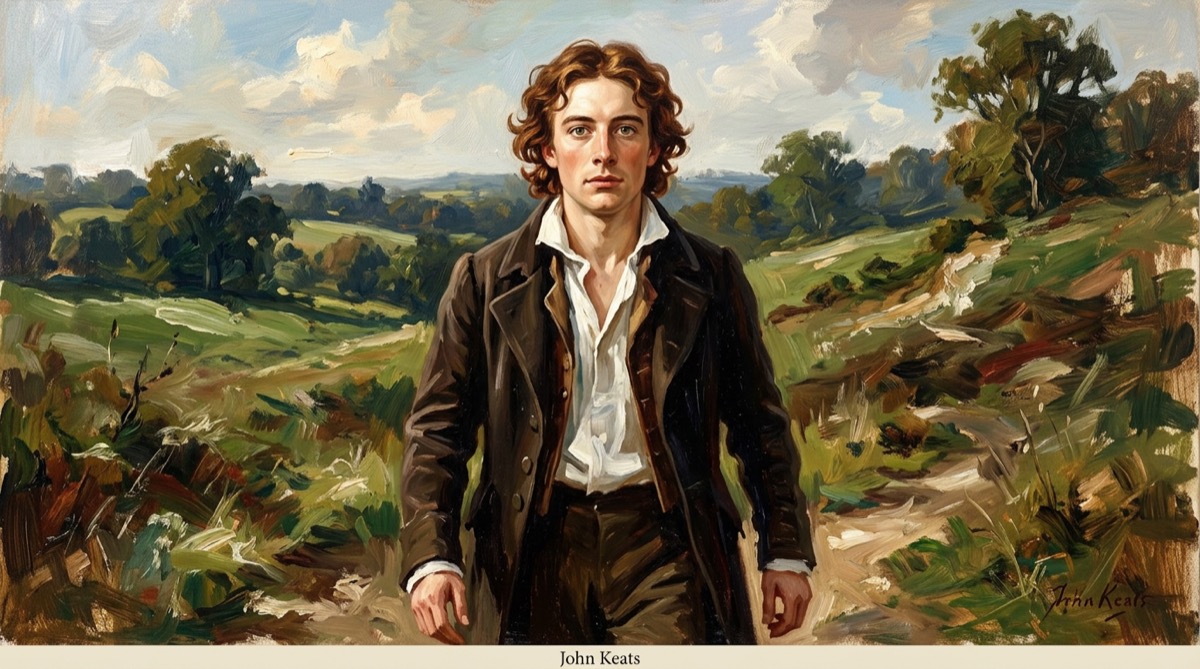
Let’s discuss John Keats considered to be one of the important romantic poets for UGC NET English Literature.
He appears under Unit III (Romantic Period, 1798–1830) of the NTA syllabus, and questions on his poems, letters, and critical ideas have shown up in almost every exam cycle for the past decade.
Despite dying at 25, Keats produced enough material to fill an entire section of your preparation.
This guide breaks down exactly what NTA asks, which poems to prioritise, and how to study Keats efficiently in the final weeks before your exam.
Why John Keats is important for UGC NET
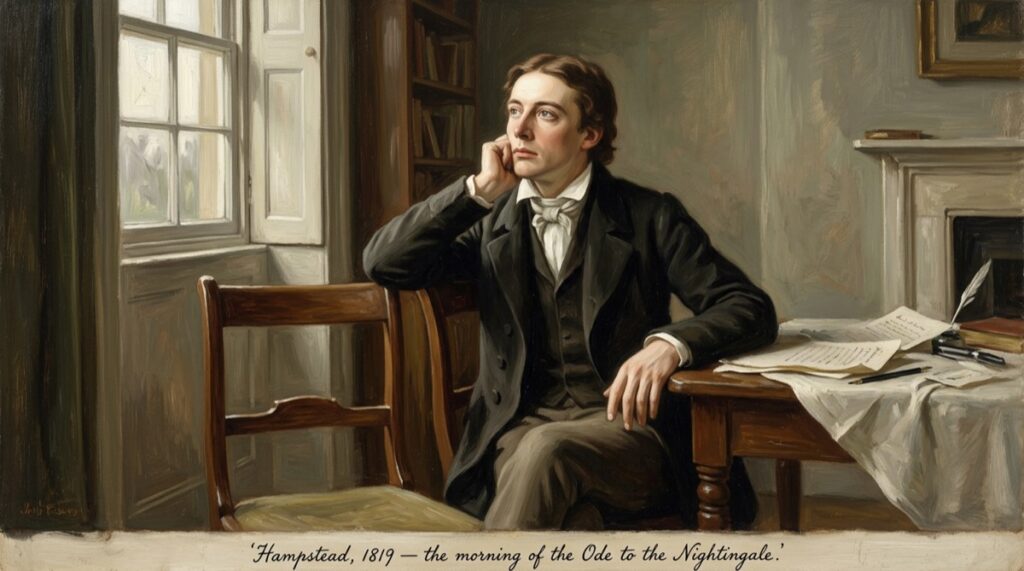
Keats sits alongside Wordsworth, Coleridge, Shelley, and Byron in the Romantic Poetry unit of the UGC NET English Literature syllabus.
But what makes Keats different from the other Romantics is the range of question types NTA pulls from his work.
You will face questions on his odes, his narrative poems, his letters (especially Negative Capability), his critical ideas about poetry, and even biographical details like his medical training and early death.
Looking at previous year questions on British Poetry, Keats typically accounts for 2–4 questions per paper.
That is a significant chunk from a single poet. If you check the June 2025 question paper, you will notice that Keats questions tested both factual recall (which poem contains a specific line) and conceptual understanding (what does Negative Capability mean). You need to be ready for both.
For a full set of Keats questions from past exams, visit the John Keats Previous Year UGC NET Questions page on our site.
Major works you must know (with dates)
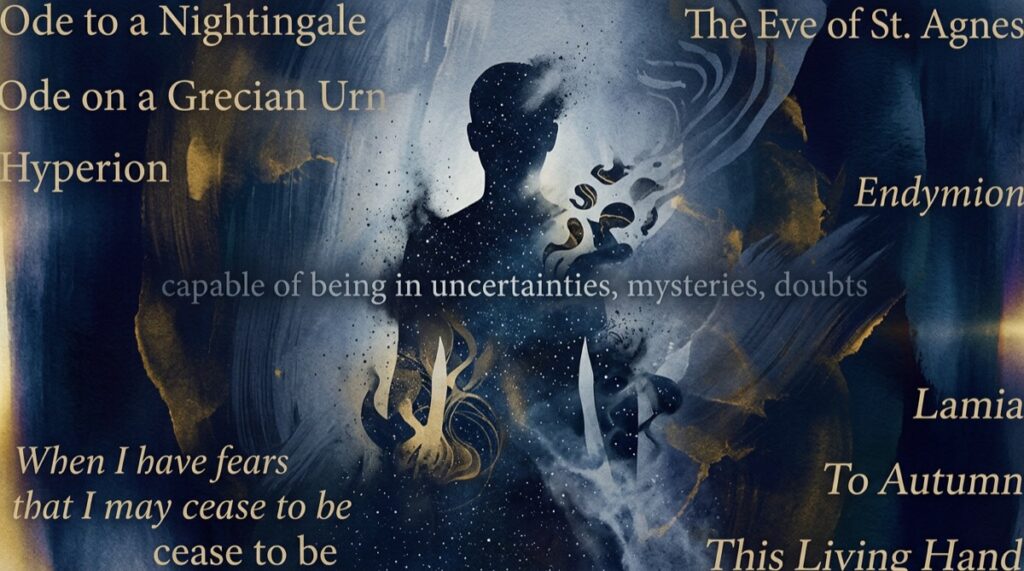
NTA loves testing chronology. They will give you four poems and ask which was written first, or they will attribute a line to the wrong poem to see if you notice. Here is the complete list you need to memorise:
Early poems (1814–1817):
- “Imitation of Spenser” (1814) — his earliest known poem
- “O Solitude, if I must with thee dwell” (1816) — first published poem, appeared in Leigh Hunt’s The Examiner
- “On First Looking into Chapman’s Homer” (October 1816) — his first great sonnet, written after reading George Chapman’s translation of Homer with Charles Cowden Clarke
- Poems (March 1817) — first published volume, includes “I Stood Tip-toe upon a Little Hill” and “Sleep and Poetry”
Major works (1818):
- Endymion: A Poetic Romance (1818) — his first long poem, opens with the famous line “A thing of beauty is a joy for ever.” This line is among the most frequently tested Keats quotations in UGC NET
- “Isabella, or the Pot of Basil” (1818) — based on a story from Boccaccio’s Decameron
The Great Year — 1819: This is the year that matters most. Between January and September 1819, Keats wrote nearly everything NTA cares about:
- “The Eve of St. Agnes” (January 1819)
- “La Belle Dame sans Merci” (April 1819)
- “Ode to Psyche” (April 1819)
- “Ode to a Nightingale” (May 1819)
- “Ode on a Grecian Urn” (May 1819)
- “Ode on Melancholy” (May 1819)
- “Ode on Indolence” (May 1819)
- “Lamia” (Summer 1819)
- “To Autumn” (September 1819)
- “The Fall of Hyperion: A Dream” (1819, unfinished revision of Hyperion)
Final volume (1820):
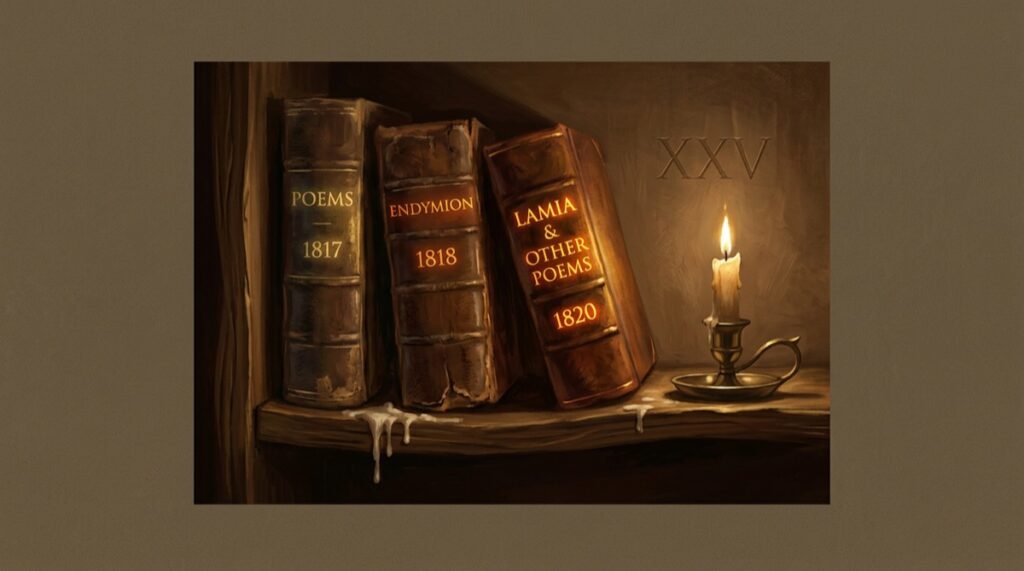
- Lamia, Isabella, The Eve of St Agnes, and Other Poems (July 1820) — published to strong reviews, unlike his earlier volumes
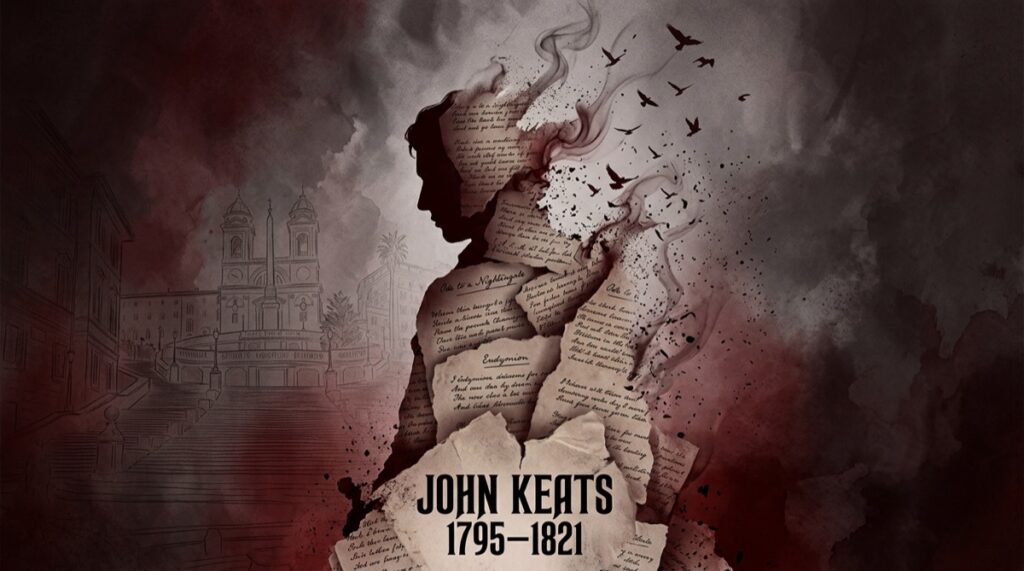
Keats died in Rome on 23 February 1821, aged 25.
Remember this: almost all the poems NTA tests come from 1819. If you know that one year thoroughly, you have covered roughly 80% of what they ask.
Key themes and concepts tested in UGC NET English Literature
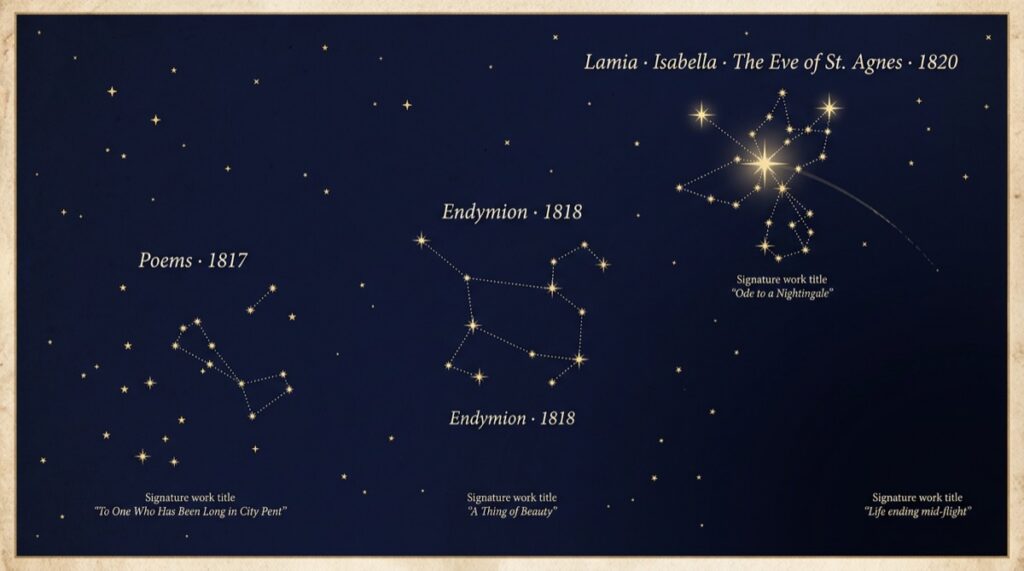
Negative Capability
This is the single most tested Keats concept in UGC NET. Keats defined it in a letter to his brothers George and Tom on 21 December 1817: “when man is capable of being in uncertainties, Mysteries, doubts without any irritable reaching after fact & reason.”
NTA has asked about this definition multiple times, sometimes giving you four definitions and asking which one belongs to Keats, sometimes asking you to identify the letter’s recipient.
What you need to know: Negative Capability is the ability to remain comfortable with ambiguity and mystery rather than forcing rational explanations onto experience.
Keats contrasted this quality with what he saw as Coleridge’s tendency to over-rationalise. It is the opposite of didactic poetry — Keats believed a poet should have no fixed identity or moral agenda.
Beauty and Truth
“Beauty is truth, truth beauty — that is all / Ye know on earth, and all ye need to know.” These closing lines of “Ode on a Grecian Urn” are tested relentlessly.
Know which poem they come from, know they are spoken by the urn itself, and know the philosophical debate around them — do they represent Keats’s own belief, or is the urn making a claim the poem itself questions?
Sensuous imagery
Keats is the most sensuous of the Romantic poets. His poetry appeals to all five senses simultaneously. NTA sometimes asks you to identify which poet prioritises sensory experience over philosophical argument — the answer is always Keats.
The Chameleon Poet
In a letter to Richard Woodhouse (27 October 1818), Keats described the “poetical Character” as having “no self — it is every thing and nothing.”
The poet, unlike the “wordsworthian or egotistical sublime,” has no fixed identity. This concept of the Chameleon Poet appears in match-the-following and direct-question formats.
Mortality and permanence
Keats’s odes constantly set up a tension between things that die (the poet, the listener, human life) and things that endure (the nightingale’s song, the urn, the season of autumn). Understanding this tension is the key to answering any analytical question about his odes.
Ode-by-ode breakdown for UGC NET
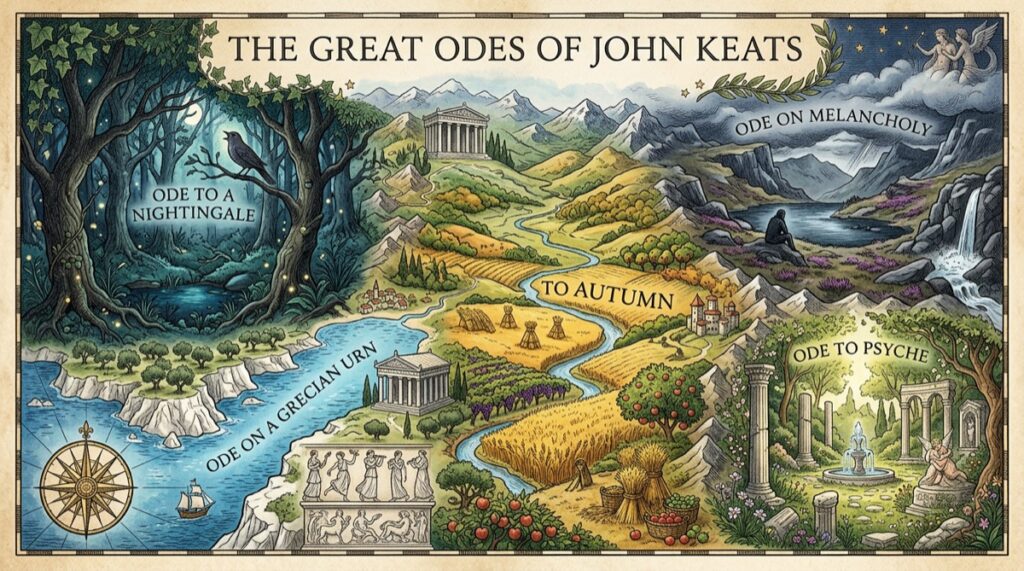
Since the six odes carry the heaviest exam weight, here is what to focus on in each:
Ode to a Nightingale (May 1819)
- 8 stanzas, written in Keats’s garden at Wentworth Place, Hampstead
- Central conflict: the poet wants to escape mortality by merging with the nightingale’s song, but realises imagination cannot sustain the escape
- The word “forlorn” in stanza 8 breaks the spell — “the fancy cannot cheat so well / As she is fam’d to do”
- Key line for exams: “Thou wast not born for death, immortal Bird!” — NTA asks whether the bird or the song is immortal
- Theme: mortality
Ode on a Grecian Urn (May 1819)
- 5 stanzas, addresses an ancient Greek urn with scenes of lovers and musicians frozen in time
- The figures on the urn exist in a state of permanent anticipation — the lovers never kiss, the musician never stops playing
- “Heard melodies are sweet, but those unheard / Are sweeter” — tests the idea that imagination surpasses reality
- Closing lines on beauty and truth are the most quoted lines in the entire UGC NET English Literature syllabus
- Theme: art’s permanence vs. human transience
Ode on Melancholy (May 1819)
- 3 stanzas; an original fourth stanza was deleted (NTA has asked about this)
- Argues that melancholy is inseparable from beauty and pleasure — you cannot have one without the other
- “She dwells with Beauty — Beauty that must die”
- No mythological figure addressed, unlike the other odes
To Autumn (September 1819)
- 3 stanzas, often considered Keats’s most perfect poem
- Written after a walk near Winchester on 19 September 1819
- No tension between mortality and immortality — instead, a calm acceptance of the natural cycle
- Personification of Autumn as a figure sitting on a granary floor, crossing a brook, watching a cider press
- Frequently asked: which Keats ode does not mention a mythological or symbolic figure? Answer: “To Autumn” (though “Ode on Melancholy” also fits this description — read the question carefully)
Ode to Psyche (April 1819)
- The first of the great odes, and the one Keats himself said he took most pains with
- Addresses Psyche, the last goddess admitted to Olympus
- Keats offers to build a temple to Psyche in his own mind — “a fane / In some untrodden region of my mind”
Ode on Indolence (May 1819)
- The least studied of the six, but NTA occasionally asks about it
- Three figures pass before the poet: Love, Ambition, and Poesy (Poetry)
- Keats ultimately rejects all three in favour of doing nothing
For practice with 4,000+ subject-wise previous year questions, including all Keats PYQs sorted by topic, check out our collection.
Common exam traps and how to avoid them
Trap 1: Confusing “Hyperion” with “The Fall of Hyperion” Hyperion: A Fragment (1818–1819) is written in Miltonic blank verse and tells the story of the Titans being overthrown by the Olympian gods.
The Fall of Hyperion: A Dream (1819) is a reworked version using a dream-vision framework. NTA sometimes lists both as options.
Know that the first is a fragment abandoned mid-sentence, the second is a reimagining. Both are unfinished.
Trap 2: “A thing of beauty is a joy for ever” is from Endymion, not the Odes Students often attribute this line to “Ode on a Grecian Urn” because both deal with beauty. It is the opening line of Endymion (1818). Do not confuse it with “Beauty is truth, truth beauty” from the Urn ode.
Trap 3: The Negative Capability letter was written to his brothers, not to Shelley The letter dated 21 December 1817 was addressed to George and Tom Keats. NTA sometimes puts “Fanny Brawne” or “Percy Bysshe Shelley” as distractors. Also remember: the Chameleon Poet letter (October 1818) went to Richard Woodhouse — a different recipient for a different concept.
Trap 4: Keats did not write “Kubla Khan” This sounds obvious, but in match-the-following questions where you are pairing poets with poems under time pressure, students do mix up Keats and Coleridge. “Kubla Khan” is Coleridge. Keats wrote “Lamia.”
Trap 5: “La Belle Dame sans Merci” is a ballad, not an ode NTA has tested this distinction. The poem uses a simple ABCB rhyme scheme and a medieval setting. It is a literary ballad, not one of the six great odes.
How to study John Keats in-depth for UGC NET English
If you are short on time, here is a focused plan. This assumes you have already covered the basics and need to sharpen your Keats preparation before your exam.
For a broader preparation framework, read our guide on 5 things to do 40 days before UGC NET English Literature.
Day 1: The Odes Read “Ode to a Nightingale” and “Ode on a Grecian Urn” line by line. Memorise the opening and closing lines of each. Understand the central conflict in each poem. Write down 5 key quotes from each.
Day 2: The remaining odes + “La Belle Dame sans Merci” Cover “Ode on Melancholy,” “To Autumn,” “Ode to Psyche,” and “Ode on Indolence.” Read “La Belle Dame sans Merci” and note how its form differs from the odes.
Day 3: Narrative poems and Endymion Read summaries of Endymion, “The Eve of St. Agnes,” “Isabella,” and “Lamia.” Focus on sources — which story comes from Boccaccio, which from Burton’s Anatomy of Melancholy, which from classical myth. Memorise the opening lines of Endymion.
Day 4: Letters and critical concepts Study the Negative Capability letter (December 1817), the Chameleon Poet letter (October 1818), and Keats’s views on the “egotistical sublime” (his phrase for Wordsworth’s poetic mode).
Know the recipients and dates. For more on how Wordsworth fits into the Romantic Poetry unit, see our separate guide.
Day 5: PYQs and revision Solve every available Keats question from previous year question papers. Focus on the pattern: which questions repeat, which distractors NTA reuses, which poems appear most often. Review your notes on chronology and quotes.
Previous year question patterns
Based on analysis of recent UGC NET papers, here is how NTA typically frames Keats questions:
Type 1 — Identify the source: “The line ‘________’ occurs in which poem by John Keats?” These require you to have memorised opening and closing lines of major poems. “A thing of beauty” (Endymion), “My heart aches” (Nightingale), “Thou still unravish’d bride” (Grecian Urn), “Season of mists” (To Autumn).
Type 2 — Match the following: Poet-poem pairs or concept-poet pairs. Keats is often paired with Negative Capability, Wordsworth with Egotistical Sublime, Coleridge with Imagination vs. Fancy.
Type 3 — Conceptual: “What does Keats mean by Negative Capability?” Four options given, usually one that describes Coleridge’s organicism, one that describes Eliot’s objective correlative, and one correct paraphrase of Keats’s idea.
Type 4 — Chronological ordering: Arrange these poems in order of composition. This is where knowing that the odes were all written in spring 1819 saves you.
Type 5 — Quotation completion: “If Poetry ________ as naturally as the leaves to a tree, it ________ at all.” (Answer: “comes not… had better not come”). This type tests whether you have actually read Keats’s letters.
To understand how NTA structures the overall paper, read our 2025 UGC NET English detailed breakdown.
For systematic practice, use our subject-wise previous year question bank — it includes all Keats questions tagged and sorted so you can drill them separately.
Preparing for UGC NET English Literature? Our complete course covers John Keats and 50+ other high-weightage authors with video lectures, topic-wise MCQs, and 13 physical booklets delivered to your door.