Literary Theory · Part 3 of 25 · 1950s–1960s
Structuralism II: Semiotics, Lévi-Strauss & Barthes
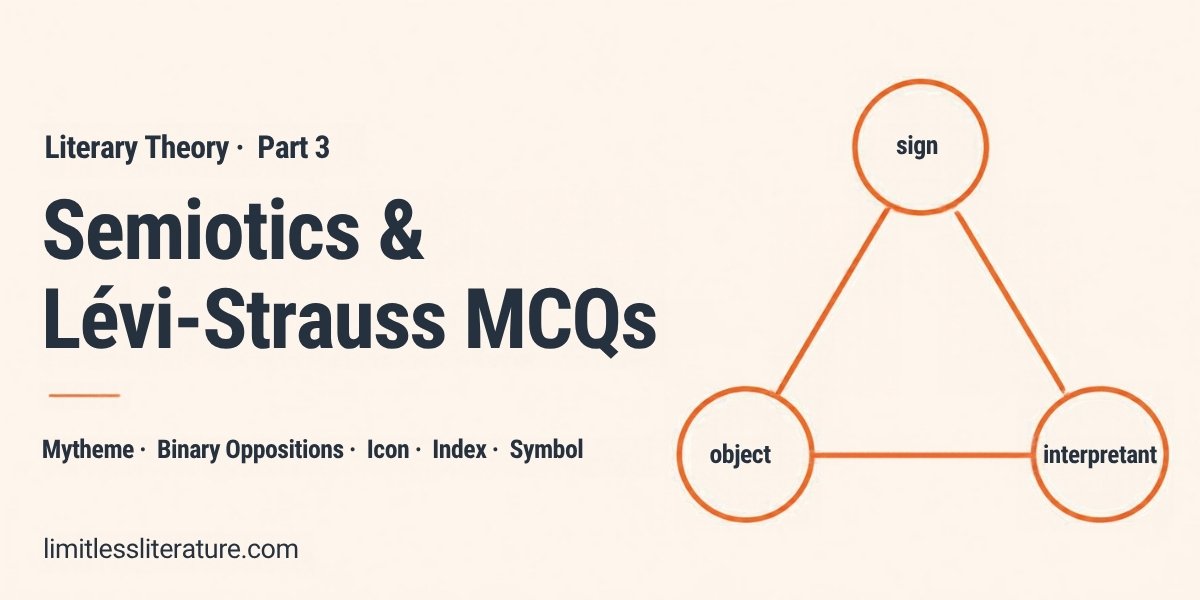
What is Semiotics & Lévi-Strauss? After Saussure, structuralism spread from linguistics to anthropology and culture. Claude Lévi-Strauss read myths as systems of binary oppositions built from “mythemes”, Roland Barthes decoded everyday “myths” in Mythologies (1957), and semiotics, after C.S. Peirce, classified signs as icon, index and symbol.
This part covers Claude Lévi-Strauss, the structuralist Roland Barthes, semiotics (Peirce, Eco, Greimas) and general questions on structuralism. The questions are drawn from previous UGC NET, SET, PhD entrance and Assistant Professor papers, and every answer comes with a short explanation. Tap an option to check your answer.
Claude Lévi-Strauss
1. The notion of the ________, posited by Lévi-Strauss, denoting the minimal units of narrative “sense”, is formed on the analogy of the morpheme, which, in linguistics, is the ________ unit of grammatical sense.
- Semantics / largest
- Bliss / largest
- Rhetoric / moderate
- Mytheme / smallest
2. Claude Lévi-Strauss, one of the founding figures of structuralism, was a/an __________ by profession.
- psychoanalyst
- novelist
- literary critic
- anthropologist
3. Pick out the wrong statement with regard to Claude Lévi-Strauss from the options below.
- Claude Lévi-Strauss was much influenced by Roman Jakobson.
- Claude Lévi-Strauss was a linguist.
- Claude Lévi-Strauss taught both in France and in America.
- Claude Lévi-Strauss fled continental Europe in the wake of WWII.
4. The constituent units of a myth are called ________.
- morphemes
- mythemes
- parole
- fables
5. ‘Mytheme’ is a word coined by
- Jacques Lacan
- Roland Barthes
- Jacques Derrida
- Claude Lévi-Strauss
6. The title of the fourth volume of Mythologiques, which came out in 1971, is:
- The Raw and the Cooked
- The Origin of Table Manners
- The Naked Man
- From Honey to Ashes
7. In the essay “The Structural Study of Myth”, which myth does Claude Lévi-Strauss primarily analyse?
- Agamemnon myth
- Trojan myth
- Oedipus myth
- Ulysses myth
Roland Barthes (Structuralist)
8. Mythologies was written by
- Roland Barthes
- Jacques Derrida
- Homi K. Bhabha
- Ernest Dowson
9. Barthes’ critical work Sur Racine was heavily criticised by ________.
- Jean Racine
- Michel Foucault
- Jacques Derrida
- Raymond Picard
10. The structural analysis of signs was practised by
- Michel Foucault
- Roland Barthes
- Julia Kristeva
- Jacques Lacan
11. Who among the following analysed the naturalizing of connotative meanings into myths?
- Roland Barthes
- Roman Ingarden
- J. Hillis Miller
- Michel Foucault
12. The “mythologies” of popular cultural phenomena were explored in The Eiffel Tower and Other Mythologies by:
- Lacan
- Derrida
- Foucault
- Barthes
13. Who said, “Who speaks is not who writes, and who writes is not who is”?
- Michel Foucault
- Roland Barthes
- Jacques Derrida
- Homi K. Bhabha
Semiotics (Peirce, Eco, Greimas)
14. The semiotician C. S. Peirce talks about three major ways in which representation can be done. Pick out the wrong statement with regard to the same.
- Representation can be done through symbol, index and icon.
- All of them have two constant elements in the form of signifier and signified.
- Unlike an index, a symbol or an icon has two signifiers.
- The relationships between the two elements vary according to each mode of representation.
15. Semiotics, the general science of signs, traces its lineage to
- II and III
- I and III
- III and IV
- II and IV
16. Semiotics originated mainly in the works of two theorists. They are:
- I and II
- II and III
- I and III
- III and IV
17. Given below are two statements: one is labelled as Assertion A and the other is labelled as Reason R. Choose the correct option.
- Both A and R are true and R is the correct explanation of A
- Both A and R are true but R is not the correct explanation of A
- A is true, but R is false
- A is false, but R is true
18. ____ is the relation between signs and sign-using agents or interpreters.
- Semantics
- Syntactics
- Pragmatics
- Linguistics
19. Under which of the following disciplines would the study of emojis and emoticons be placed?
- Semiology
- Symbology
- Semantics
- Semiotics
Structuralism: General
20. Structuralism derives ultimately from ________.
- Hermeneutics
- Linguistics
- Mimesis
- Formalism
21. In literary studies structuralism promotes
- the view that literature is one signifying practice among others
- new interpretations of literary works
- a systematic account of literary archetypes
- unstable structures of systems of signification
22. Which of the following best summarises the structural approach to literature?
- Meaning is inherent in the word itself.
- A language’s history explains how it works.
- Binary oppositions are to be avoided at all costs.
- Meaning is generated through relationships in a system of signs.
23. In the ____ approach to literature there is a constant movement away from the interpretation of the individual literary work and a parallel drive towards understanding the larger, abstract structures which contain them.
- Structuralism
- Deconstruction
- Feminism
- Modernism
24. Which among the following statements is NOT true in the context of structuralism?
- Structuralism is an antihumanist philosophy
- Structuralism upholds the autonomy of the human subject
- Structuralism argues that language is a system of differences
- Structuralism makes an attempt to comprehend the world in terms of structures
25. The structural approach to literature is primarily interested in understanding how:
- The thematic structure operates in the poem
- The authorial intention constitutes the meaning of the text
- Structural relationships constitute the system called literature
- The texture of the poem is revealed through its structure
26. Which of the following are not assumptions of Structuralism?
- A and C
- B and D
- B and C
- A and D
27. Which of these statements are true of structuralism?
- I, II and III only
- II, III and IV only
- II and III only
- II and IV only
28. ________ said the aim of structuralist criticism is “to construct a poetics which stands to literature as linguistics stands to language”.
- Bloomfield
- Roland Barthes
- Julia Kristeva
- Jonathan Culler
29. Which of the following options is incorrect with reference to Structuralism?
- In a structure the constituent parts are always subservient to the whole
- Each of the constituent parts gains meaning and relevance only through its relation to other constituent parts of that structure
- The rules that guide the relations between the constituent parts of a structure are external to the structure
- The constituent parts derive their relevance within the structure not because of any inherent quality but because of the way they relate to each other
30. Structuralism and Semiotics is authored by:
- Roland Barthes
- Ferdinand de Saussure
- Terence Hawkes
- Claude Lévi-Strauss
31. Who among the following has not contributed to the canon of structuralist literary criticism?
- Jorge Luis Borges
- Claude Lévi-Strauss
- Vladimir Propp
- Algirdas Greimas
Want to understand Semiotics & Lévi-Strauss properly, not just practise it?
The Literary Theory & Criticism course has complete video lectures on every school, with PDF notes for every lecture in the app, and printed solved MCQ booklets delivered free to your home.
Keep practising
Roland Barthes: complete guideRoland Barthes: UGC NET PYQsStructuralism: UGC NET PYQsAll 1000+ Literary Theory MCQs500+ Literary Criticism MCQs
