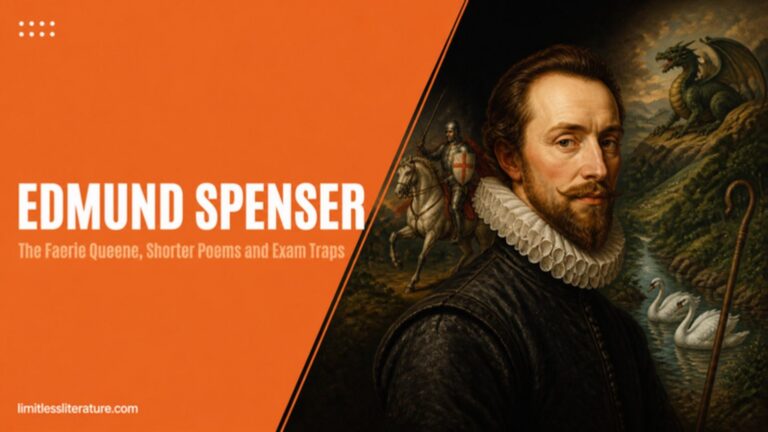
Eight of the thirteen questions on our Edmund Spenser previous year questions page are about The Faerie Queene, and most of them ask the same thing in different clothes: which figure stands for which virtue, and who does what to whom. Una is Truth. Duessa is Deceit. Orgoglio is Pride. Britomart is the warrior maiden. Get that map into your head and you have already covered the largest share of what examiners want from Spenser. The rest is a handful of shorter poems, two verse forms and a few dates.
Quick answer: Edmund Spenser (c. 1552–1599) is the great Elizabethan poet of The Faerie Queene (Books I–III 1590, IV–VI 1596), an allegorical epic in which each book’s knight stands for a virtue. Exams test the book-and-virtue scheme, the Spenserian stanza, The Shepheardes Calender (1579), and the 1595–96 poems Amoretti, Epithalamion and Prothalamion.
Born: c. 1552–53, London
Died: 13 January 1599, London; buried in Westminster Abbey near Chaucer
Education: Merchant Taylors’ School; Pembroke College, Cambridge
Age: Elizabethan (English Renaissance)
Known for: The Faerie Queene, the Spenserian stanza, the Spenserian sonnet, pastoral eclogue
Spenser’s persona: Colin Clout
Asked in: UGC NET, State SET, GATE, KVS/State PGT and TGT, Assistant Professor exams
Why examiners keep coming back to Spenser
Spenser sits at the hinge between Chaucer and Milton. He took Chaucer as his master (he calls him “well of English undefyled” in The Faerie Queene, Book IV), and Milton in turn treated Spenser as his model. Dryden reports in the Preface to Fables (1700) that Milton “acknowledged to me that Spenser was his original”. In Areopagitica (1644) Milton calls him “our sage and serious poet Spenser”, a better teacher “than Scotus or Aquinas”. So a Spenser question is often a literary history question in disguise: who influenced whom, which form came from where.
He also invented things that examiners like to define. The nine-line Spenserian stanza, the linked-rhyme Spenserian sonnet, and the word “Prothalamion” itself all start with him. Charles Lamb’s label for him, “the Poet’s Poet”, turns up as a one-mark attribution item. My advice: do not try to read all six books of The Faerie Queene. Read Book I properly, learn the chart of the other five books below, and spend the rest of your Spenser time on the short poems, which are far easier to score from.
Spenser’s works with dates
| Year | Work | Form | What to remember |
|---|---|---|---|
| 1579 | The Shepheardes Calender | 12 pastoral eclogues | One eclogue per month; signed “Immerito”; dedicated to Philip Sidney; glosses by “E.K.” |
| 1590 | The Faerie Queene, Books I–III | Allegorical romance epic | Printed with “A Letter of the Authors” to Sir Walter Raleigh explaining the plan |
| 1591 | Complaints | Collection of shorter poems | Includes The Ruines of Time, The Teares of the Muses, Mother Hubberds Tale, Muiopotmos |
| 1591 | Daphnaïda | Elegy | Modelled on Chaucer’s Book of the Duchess |
| 1595 | Colin Clouts Come Home Againe | Pastoral eclogue | Colin’s visit to court with the “Shepheard of the Ocean” (Raleigh) |
| 1595 | Astrophel | Pastoral elegy | On the death of Sir Philip Sidney (Astrophel) |
| 1595 | Amoretti and Epithalamion | Sonnet sequence and marriage ode | 89 sonnets of courtship and the poem for his own wedding to Elizabeth Boyle |
| 1596 | The Faerie Queene, Books I–VI | Allegorical romance epic | Books IV–VI added |
| 1596 | Fowre Hymnes | Hymns | Love, Beauty, Heavenly Love, Heavenly Beauty; Neoplatonic |
| 1596 | Prothalamion | Spousal (betrothal) poem | Double wedding of the Earl of Worcester’s daughters; refrain on the Thames |
| 1609 | Two Cantos of Mutabilitie | Fragment of Book VII | Printed after his death with a reprint of the poem |
| 1633 | A View of the Present State of Ireland | Prose dialogue | Written c. 1596; printed only in 1633 by James Ware |
Timeline strip: the life in eight stops
- c. 1552–53: born in London; later a poor scholar at Merchant Taylors’ School.
- Cambridge: sizar at Pembroke College, where he met Gabriel Harvey (the “Hobbinol” of the Calender).
- 1579: The Shepheardes Calender appears anonymously.
- 1580: goes to Ireland in the service of Lord Grey de Wilton, the new Lord Deputy.
- Late 1580s: settles at Kilcolman, County Cork, where much of The Faerie Queene was written.
- 1590: Books I–III of The Faerie Queene published, dedicated to Elizabeth I.
- 1594–96: marries Elizabeth Boyle; Amoretti, Epithalamion, Books IV–VI and Prothalamion follow.
- 1598–99: Kilcolman burned in the Nine Years’ War; Spenser dies in London on 13 January 1599.
The Faerie Queene, book by book
In the letter to Raleigh, Spenser says the whole poem aims “to fashion a gentleman or noble person in vertuous and gentle discipline”. He planned twelve books for twelve private moral virtues, with Prince Arthur (Magnificence) appearing in each and Gloriana, the Faerie Queene, standing for glory and for Elizabeth. Six books and the Mutability fragment exist. This chart is the single most useful thing in this guide.
| Book | Virtue | Knight | Figures and places examiners pick |
|---|---|---|---|
| I | Holiness | Redcrosse (St George) | Una (Truth), Duessa (Deceit), Archimago, Error, Orgoglio (Pride), Despair, Lucifera’s House of Pride, the House of Holinesse (Caelia with Fidelia, Speranza, Charissa), the dragon |
| II | Temperance | Guyon | The Palmer, Phaedria, the Cave of Mammon, Acrasia and the Bower of Bliss |
| III | Chastity | Britomart (a woman knight) | Florimell, Belphoebe and Amoret, the Garden of Adonis, the House of Busirane |
| IV | Friendship | Cambell and Triamond | The Temple of Venus, the marriage of the Thames and the Medway |
| V | Justice | Artegall | Talus the iron man, Radigund, Mercilla and the trial of Duessa |
| VI | Courtesy | Calidore | The Blatant Beast, Pastorella, Colin Clout piping to the Graces on Mount Acidale |
| VII (fragment) | Constancy | none | Mutability claims rule over the universe; Nature judges against her |
Book I in six lines
Una asks Gloriana’s court for a champion to free her parents from a dragon, and Redcrosse takes the quest. Archimago separates the pair; Redcrosse falls in with Duessa, passes through the House of Pride, and is captured by the giant Orgoglio. Prince Arthur rescues him. Despair nearly talks him into suicide. Una takes him to the House of Holinesse, where he is cleansed and shown the New Jerusalem. He then kills the dragon after a three-day fight and is betrothed to Una, though he must first go back to serve the Faerie Queene. The canto closes with a ship image: “Now strike your sailes ye jolly Mariners”.
The two Elizabeths
The letter says Elizabeth is shadowed twice: as Gloriana, the queen, and as Belphoebe, the private woman. Britomart is not one of these. She is the chaste warrior maiden destined to marry Artegall and found the British royal line, which is why examiners use her as a distractor.
The Spenserian stanza
Nine lines: eight in iambic pentameter and a ninth in iambic hexameter (an alexandrine), rhymed ababbcbcc. The long last line slows each stanza to a pause. Later poets borrowed it: James Thomson in The Castle of Indolence, Byron in Childe Harold’s Pilgrimage, Keats in The Eve of St Agnes and Shelley in Adonais. Keats’s first known poem is titled “Imitation of Spenser” (see our John Keats guide).
The shorter poems, one at a time
The Shepheardes Calender (1579)
Twelve eclogues, one for each month, after Virgil and the Renaissance pastoralists. Colin Clout is Spenser’s own mask, and his unhappy love for Rosalind frames the year: he complains in January and says farewell in December. April is the song in praise of “fayre Elisa”, Queen Elizabeth. November is the elegy for Dido. October, the Cuddie eclogue, is about the neglect of poets. The mysterious “E.K.” added an epistle and glosses and sorted the eclogues into plaintive, recreative and moral kinds. The deliberately old, rustic diction drew Ben Jonson’s remark in Timber that “Spenser, in affecting the ancients, writ no language.”
Amoretti (1595)
Eighty-nine sonnets recording his courtship of Elizabeth Boyle. Unlike most Elizabethan sequences, it ends in a marriage rather than in despair. The rhyme scheme links the quatrains: abab bcbc cdcd ee. That interlocking pattern is the “Spenserian sonnet”, a halfway house between the Italian and the Shakespearean forms. Sonnet 75 (“One day I wrote her name upon the strand”) is the most quoted.
Epithalamion (1595)
A wedding ode for his own marriage, published in the same volume as Amoretti. It moves through the wedding day from dawn to night, and the day is St Barnabas’ day, the longest of the year in the old calendar, which the poem names. A. Kent Hieatt showed in 1960 that its 24 stanzas match the hours of the day and its 365 long lines match the days of the year. That number is the whole of one site question. The refrain varies around “The woods shall to me answer and my Eccho ring.”
Prothalamion (1596)
A “spousal verse” for the double betrothal of Lady Elizabeth and Lady Katherine Somerset, the Earl of Worcester’s daughters. The brides appear as two swans on the Thames. Spenser coined the title from “epithalamion”. The refrain “Sweete Themmes runne softly, till I end my Song” was borrowed by T. S. Eliot in “The Fire Sermon” section of The Waste Land, which is a favourite source-of-line question.
Colin Clouts Come Home Againe, Astrophel and Fowre Hymnes
Colin Clouts Come Home Againe is a pastoral eclogue (the site’s question keys it exactly so) about Colin’s trip from Ireland to Cynthia’s court with the Shepheard of the Ocean, Raleigh. Astrophel is the pastoral elegy for Sidney. Fowre Hymnes moves from earthly love and beauty to heavenly love and beauty, a Neoplatonic ladder.
Complaints (1591) and the prose View
Complaints gathers earlier work, including the beast-fable satire Mother Hubberds Tale (the Fox and the Ape) and Muiopotmos (the fate of a butterfly). A View of the Present State of Ireland is a prose dialogue between Irenius and Eudoxus, written around 1596 but printed only in 1633. It is the part of Spenser that postcolonial readers argue about, so expect it in critical-theory framings.
Famous first lines
Opening lines are the cheapest marks in a Spenser paper. Match these on sight.
| First line | Poem |
|---|---|
| “Lo I the man, whose Muse whilome did maske, / As time her taught, in lowly Shepheards weeds” | The Faerie Queene, proem to Book I |
| “A Gentle Knight was pricking on the plaine” | The Faerie Queene, Book I, canto i |
| “A Shepeheards boye (no better doe him call)” | The Shepheardes Calender, January |
| “Happy ye leaves when as those lilly hands” | Amoretti, sonnet 1 |
| “One day I wrote her name upon the strand” | Amoretti, sonnet 75 |
| “Ye learned sisters which have oftentimes / Beene to me ayding” | Epithalamion |
| “Calme was the day, and through the trembling ayre” | Prothalamion |
The proem’s “Lo I the man” echoes the lines once printed before Virgil’s Aeneid: the poet who sang of shepherds now turns to epic. That move from pastoral to epic is the career pattern examiners call “Virgilian”.
Asked in exams: real questions from the site
Every item below is taken from a question already on Limitless Literature. Open the linked page to attempt the full question with options.
| Question (short) | Answer | Source |
|---|---|---|
| Match Faerie Queene figures with virtues and vices | Una – Truth, Guyon – Temperance, Duessa – Deceit, Orgoglio – Pride | Previous year question |
| Epithalamion’s structure corresponds to what? | 365 lines for the days of the year | Previous year question |
| Which two characters represent Elizabeth, according to the letter? | Belphoebe and the Faerie Queene | Previous year question |
| Dame Caelia’s daughters in the House of Holinesse | Fidelia, Speranza and Charissa | Previous year question |
| Eclogue of the Calender that praises Elizabeth I | April | Previous year question |
| The Warrior Virgin of The Faerie Queene | Britomart | Previous year question |
| Accurate description of the Spenserian stanza | Eight iambic pentameter lines and a ninth of six iambic feet | Previous year question |
| Redcrosse’s reward for slaying the dragon | Una’s hand in marriage and her parents’ kingdom | Previous year question |
| Metaphor framing the tale in Book I, canto 12 | A ship filled with jolly mariners | Previous year question |
| Two posthumous cantos of Book VII | The Mutability Cantos | Previous year question |
| Colin Clouts Come Home Againe is an example of | Pastoral eclogue | Previous year question |
| The Shepheardes Calender (1579) was dedicated to | Sidney | Previous year question |
| 18th-century poem imitating Spenser’s stanza and allegory (Knight of Arts and Industry) | The Castle of Indolence | Previous year question |
| Which is NOT true of Spenser? | That he opposed England’s break with the Roman Catholic Church | Previous year question |
For the wider period, work through the Age of Chaucer and Elizabethan poets PYQs, the subject-wise PYQ collection and the full previous year question papers. There are no Spenser mind maps on the site yet.
Exam traps and the right answer
- “The Faerie Queene has twelve books.” It was planned for twelve. Six were completed, plus the Mutability fragment printed in 1609.
- Spenserian stanza or Spenserian sonnet? The stanza has nine lines (ababbcbcc, ending in an alexandrine). The sonnet has fourteen (abab bcbc cdcd ee). Questions swap them on purpose.
- Epithalamion or Prothalamion? Epithalamion (1595) is Spenser’s own wedding. Prothalamion (1596) celebrates the Somerset sisters’ betrothal. The Thames refrain belongs to Prothalamion.
- Britomart, Belphoebe or Gloriana? Gloriana and Belphoebe shadow Elizabeth. Britomart is the warrior maiden of Chastity, not an Elizabeth figure in the letter’s scheme.
- “Sweete Themmes runne softly” is Eliot’s line. Eliot quotes it in The Waste Land; it is Spenser’s, from Prothalamion.
- Who called Spenser “the Poet’s Poet”? Charles Lamb. Do not confuse it with Dryden’s report that Spenser was Milton’s “original”.
Two questions on the Spenser PYQ page are left out of the table above because their keys are open to dispute: the one keying Colin Clout’s appearances to June and December only (he is also the singer of November’s elegy), and the one keying Una rather than Gloriana as the person at whose behest Redcrosse sets out (Una asks, Gloriana assigns). Read both, but do not rely on them.
Self-test: five questions
1. Which book of The Faerie Queene has Justice as its virtue? (A) Book II (B) Book IV (C) Book V (D) Book VI
Answer: C. Book V belongs to Artegall, the knight of Justice, with Talus as his iron servant.
2. The rhyme scheme of the Spenserian sonnet is: (A) abab bcbc cdcd ee (B) abab cdcd efef gg (C) abba abba cde cde (D) ababbcbcc
Answer: A. The linked quatrains are the Spenserian signature; D is the nine-line stanza.
3. Acrasia’s Bower of Bliss is destroyed by: (A) Redcrosse (B) Calidore (C) Artegall (D) Guyon
Answer: D. Guyon, knight of Temperance, ends Book II by destroying the Bower.
4. The Shepheardes Calender was first published under the name: (A) Colin Clout (B) Immerito (C) Hobbinol (D) Astrophel
Answer: B. The 1579 Calender was signed “Immerito”; Colin Clout is the persona inside it.
5. A View of the Present State of Ireland was first printed in: (A) 1596 (B) 1609 (C) 1633 (D) 1590
Answer: C. Written around 1596, it was printed by James Ware in 1633.
FAQ
Which Spenser work should I read first?
Book I of The Faerie Queene. It carries most of the character and allegory questions, and it is complete in itself.
What is the Spenserian stanza?
A nine-line stanza: eight lines of iambic pentameter and a final alexandrine, rhymed ababbcbcc. Spenser created it for The Faerie Queene.
How many books of The Faerie Queene did Spenser finish?
Six. Books I–III appeared in 1590 and IV–VI in 1596; the two Mutability Cantos of a seventh book were printed in 1609.
What is the difference between Epithalamion and Prothalamion?
Epithalamion (1595) celebrates Spenser’s own wedding to Elizabeth Boyle. Prothalamion (1596) celebrates the double betrothal of the Earl of Worcester’s daughters.
Is Spenser on the UP PGT syllabus?
He is not on the UP PGT author list, but he is regularly asked in UGC NET, SET, GATE and Assistant Professor papers, and in KVS and State PGT exams under Elizabethan poetry.
Read next
- Geoffrey Chaucer guide: the master Spenser names in Book IV.
- William Shakespeare guide: the other Elizabethan giant, and the sonnet form Spenser’s differs from.
- John Milton guide: Spenser’s self-declared heir.
- All author guides, A–Z
For a reliable biography, see Edmund Spenser at Britannica.
Keep going
One author down. Here is where to go next.
- English Literature Authors A–Z: every author guide, mind map and question set on this site
- 5,000+ topic-wise previous year questions from UGC NET, GATE and SET
- UGC NET English guide: syllabus, exam pattern and preparation plan
Preparing for UGC NET English December 2026?
The Crash Course UGC NET English Literature: Zero to Hero covers the core authors and the topics that keep coming back, with 150+ video lectures and mock tests, before the exam starts on 14 December.
Diwali offer: ₹300 off with coupon code LIMITLESS for the next 10 days (till 16 November).
See the Crash Course → or WhatsApp us on 7891410858