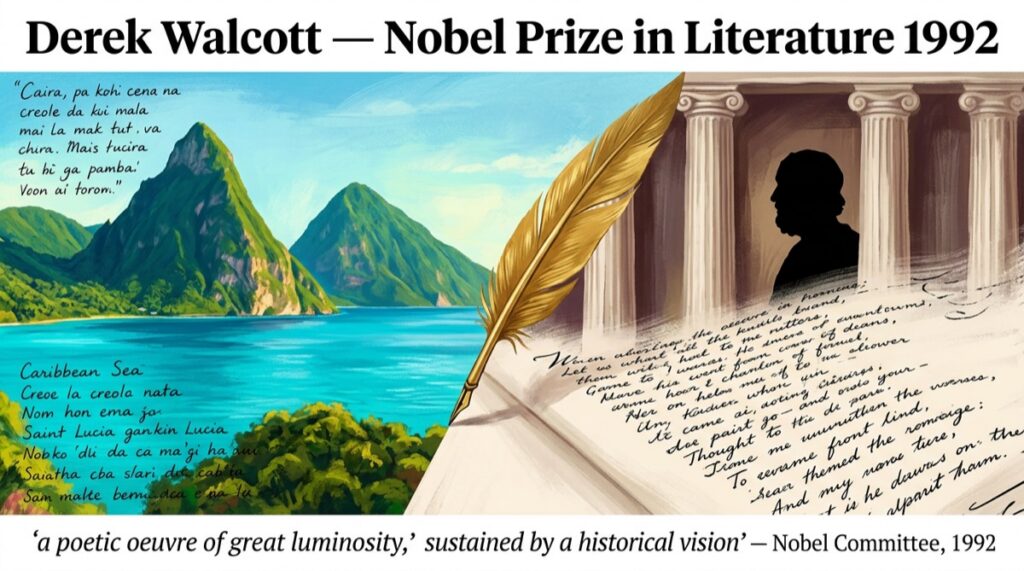
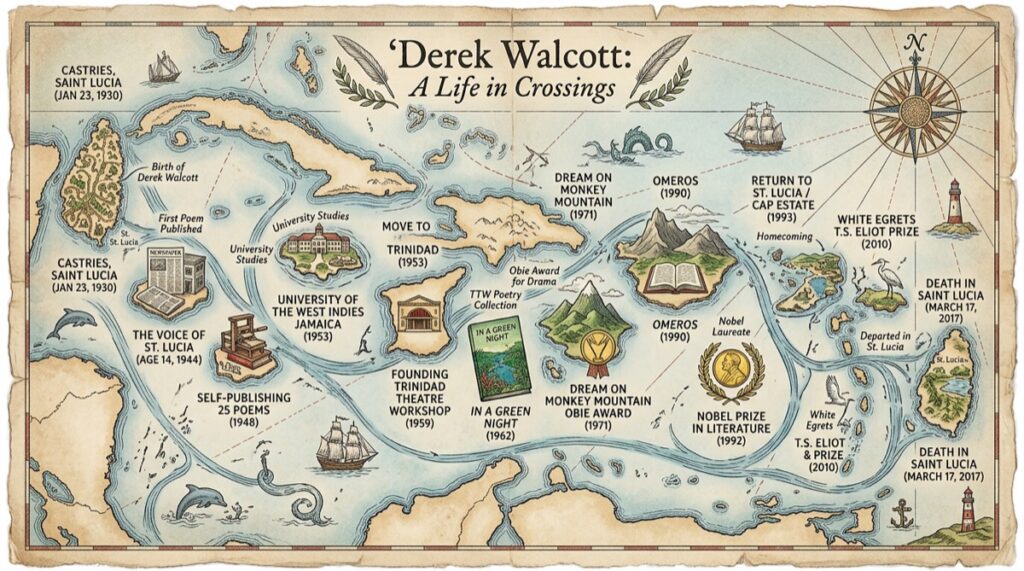
Derek Walcott won the Nobel Prize in Literature in 1992.
He grew up on a small Caribbean island, wrote plays that mixed folk tales with Greek tragedy, and built an epic poem out of Saint Lucian fishermen and Homer’s Iliad.
None of that sounds like standard exam material — and that’s exactly why NTA keeps testing him. Most students skim one paragraph on Walcott and move on.
The ones who actually know his works, his quotes, and which award went to which play are the ones picking up easy marks on Caribbean literature questions.
For UGC NET English Literature, Walcott sits in the World Literature / Literature in English section, alongside postcolonial and Commonwealth writers.
He is not a name you can treat as optional. Once you understand the logic of his three most important works — Omeros, Dream on Monkey Mountain, and Pantomime — the MCQs on him become predictable. This guide gives you everything you need.
For a deeper look at how NTA weights postcolonial and world literature questions, read the UGC NET English exam detailed breakdown.
Major works you must know (with dates)
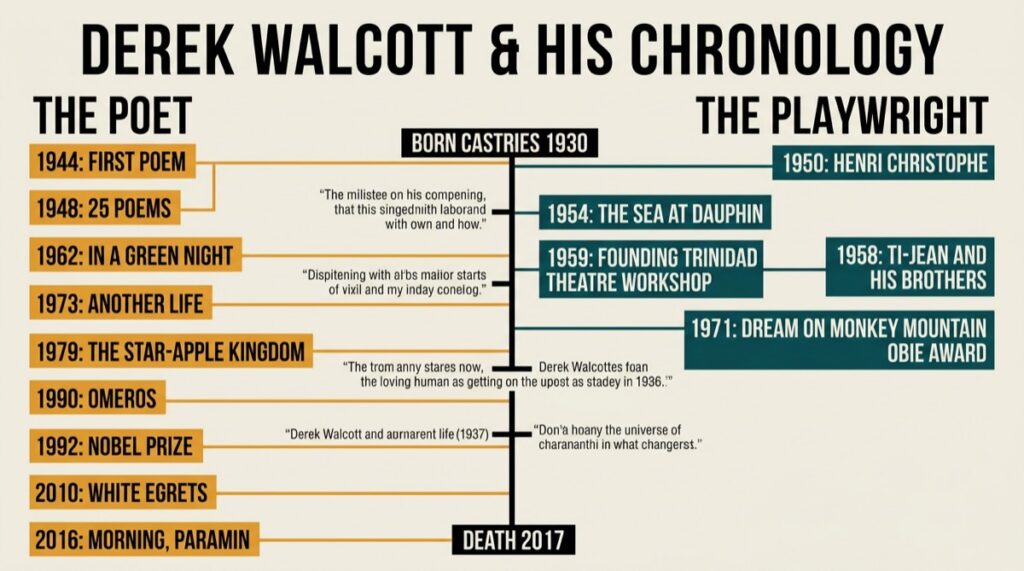
NTA tests chronology, so get these dates right.
Poetry collections:
- 25 Poems (1948) — his first self-published collection, written at 18
- In a Green Night: Poems 1948–60 (1962) — his first major published collection by Jonathan Cape
- The Gulf (1969)
- Another Life (1973) — long autobiographical poem about his youth in Saint Lucia
- Sea Grapes (1976)
- The Star-Apple Kingdom (1979) — contains “The Schooner Flight,” arguably his most-quoted poem
- The Fortunate Traveller (1981)
- Midsummer (1984)
- The Arkansas Testament (1987)
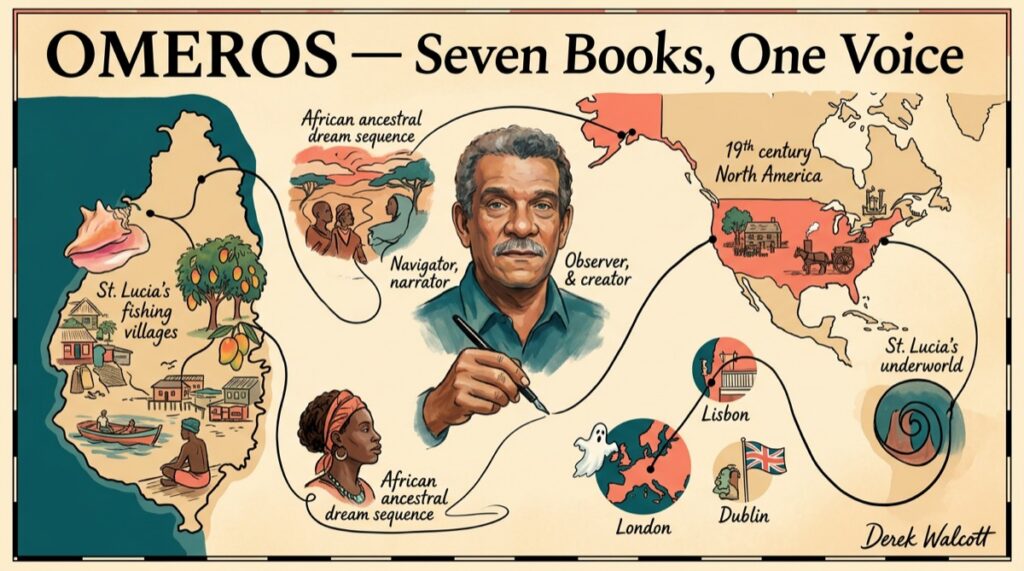
- Omeros (1990) — his most celebrated work, a book-length epic poem
- The Bounty (1997)
- Tiepolo’s Hound (2000) — a poem about the painter Camille Pissarro
- White Egrets (2010) — won the T.S. Eliot Prize for Poetry
Plays:
- Henri Christophe (1950)
- Ti-Jean and His Brothers (1958)
- Dream on Monkey Mountain (1967, published 1970) — won an Obie Award in 1971
- The Joker of Seville (1974)
- Pantomime (1978)
- A Branch of the Blue Nile (1983)
NTA has asked about works from both the poetry and drama sides, so you need at least a working knowledge of all the bolded works above.
Key themes and concepts tested in UGC NET English Literature
1. The double consciousness of the colonial subject
Walcott spent his career navigating what W.E.B. Du Bois called double consciousness — the sense of seeing yourself through the eyes of a colonizer.
His Caribbean characters are neither purely African nor purely European. They exist in a creative, sometimes painful, space between two inheritances.
The famous line “I who am poisoned with the blood of both, / Where shall I turn, divided to the vein?” from “A Far Cry from Africa” is one of the most-quoted lines in postcolonial literature and has appeared in exam questions.
2. Classical myth rewritten from a Caribbean perspective
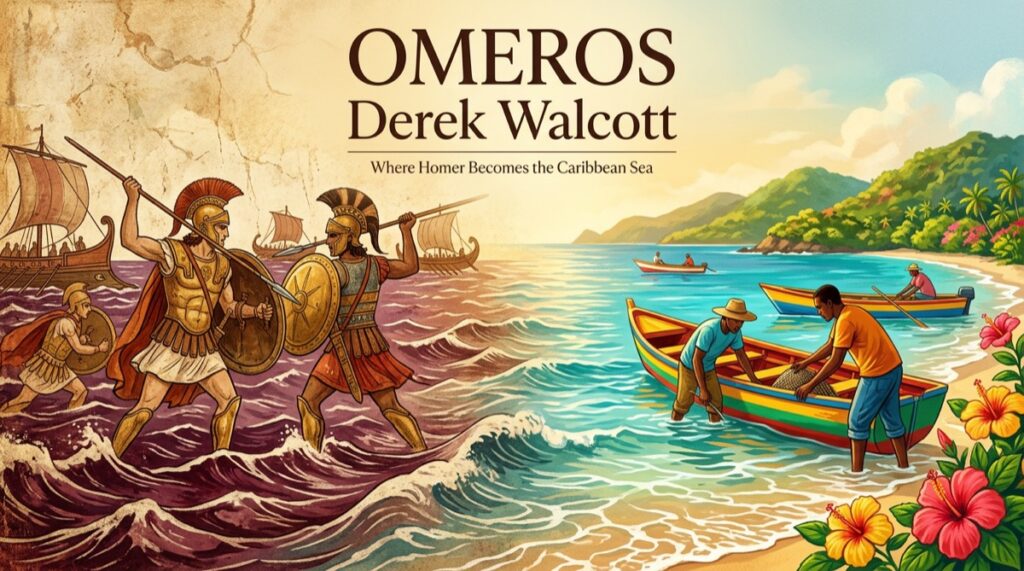
Walcott did not reject European classical tradition — he transformed it. Omeros is the clearest example: it takes Homer’s characters (Achilles, Hector, Helen, Odysseus) and transplants them to Saint Lucia as Caribbean fishermen.
The Helen of Omeros is a Black Saint Lucian woman working as a maid.
This act of rewriting the classical canon from the margins is itself a postcolonial statement. Understanding this is essential for MCQs that ask about Walcott’s technique or the relationship between Omeros and the Iliad/Odyssey.
3. The sea as a central symbol
Walcott grew up on an island. The sea in his poetry carries multiple meanings: the Middle Passage (the Atlantic slave trade route), the constant circulation of colonial history, and also beauty, freedom, and the ordinary life of Caribbean fishermen.
When MCQs ask about the dominant symbol or setting in Walcott’s work, the sea is almost always the right answer.
4. Language and Creole identity
Walcott wrote primarily in English but incorporated Caribbean Creole speech rhythms, patois, and local idiom. This tension between Standard English (the colonizer’s language) and vernacular Caribbean speech is a recurring exam topic.
5. Postcolonial identity and the question of nationhood
The line “Either I’m nobody, or I’m a nation” from “The Schooner Flight” encapsulates Walcott’s preoccupation with identity in the aftermath of colonialism.
This line has appeared in a UGC NET question asking which work it comes from — the answer is The Star-Apple Kingdom (1979), specifically the poem “The Schooner Flight.” The speaker is Shabine, a mulatto sailor — a character who represents the racially and culturally mixed Caribbean person with no fixed home.
For more Caribbean and African-American literature previous year questions, work through the Caribbean literature PYQ collection.
Work-by-work analysis of high-priority texts
Omeros (1990)
This is Walcott’s masterpiece and the most important work for your exam. Omeros is a book-length epic poem in 64 chapters, written in terza rima (the verse form Dante used in The Divine Comedy). The title is the Greek pronunciation of “Homer.”
The main characters:
- Achille — a Saint Lucian fisherman, noble and hardworking
- Hector — Achille’s rival, who gives up fishing to drive a minibus
- Helen — a beautiful Saint Lucian woman both men desire; she also represents the island of Saint Lucia itself
- Plunkett — an Irish colonial-era settler who tries to write the history of the island
- Walcott himself — appears as a character in the poem
The poem’s structure is Homeric (the rivalry between Achille and Hector echoes the Iliad; Achille’s spiritual journey to Africa echoes the Odyssey) but the politics are entirely Caribbean. Walcott is asking: who gets to tell the history of colonized people? The answer he gives is: the fishermen themselves, not the Plunketts of the world.
Exam questions typically ask about the terza rima form, the Homeric parallels, or the meaning of Helen as a symbol.
Dream on Monkey Mountain (1967)
This two-act play with prologue is Walcott’s most performed drama. It centers on Makak, an elderly Black charcoal seller in Trinidad who lives on Monkey Mountain. He is arrested after a drunken disturbance. While in jail, he dreams of a white goddess who tells him he is the king of Africa.
The play is an allegory about colonial self-hatred. Makak’s dream — in which he kills the white goddess at the end — represents the psychological need for Caribbean people to break free from the internalized image of white beauty and authority. The Obie Award (1971) confirmed its theatrical impact.
Key characters: Makak, Moustique (his friend), Lestrade (the corporal), and the apparition (the white goddess).
Pantomime (1978)
A two-hander play: Harry Trewe (a white English hotel owner) and Jackson Philip (his Black employee) are rehearsing a Robinson Crusoe pantomime for tourists. The play reverses the Crusoe/Friday dynamic — what if Friday played Crusoe? The comedy deepens into something sharp as the racial and colonial power structures between the two men surface.
Pantomime is Walcott’s most direct engagement with the Crusoe myth, which he returns to across his career as a metaphor for Caribbean cultural self-invention after colonial shipwreck.
Ti-Jean and His Brothers (1958)
A folk play based on Caribbean oral tradition. Three brothers — Gros Jean, Mi-Jean, and Ti-Jean — each face the Devil. The older two brothers fail by trying to match the Devil in physical strength (Gros Jean) and intellectual argument (Mi-Jean). Ti-Jean, the youngest and seemingly weakest, wins by drawing on folk wisdom and spontaneity. The play celebrates Caribbean vernacular culture over European rationalism.
“A Far Cry from Africa” (poem, in In a Green Night, 1962)
One of Walcott’s most anthologized poems. Written during the Mau Mau Uprising in Kenya, it expresses anguish at being torn between his African ancestry and his English education. “I who have cursed / The drunken officer of British rule, how choose / Between this Africa and the English tongue I love?” — the poem refuses to resolve this contradiction, which is itself its message.
Common exam traps and how to avoid them
Trap 1: Confusing Omeros with the Iliad vs. the Odyssey
Omeros draws on both Homeric epics but is not a strict retelling of either. If a question asks which ancient text Omeros is based on, the safest answer is “Homer’s epics” or “the Iliad and the Odyssey,” not just one. Some questions specify the terza rima connection — that links it to Dante, not Homer directly.
Trap 2: “The Schooner Flight” source text
The line “Either I’m nobody, or I’m a nation” comes from The Star-Apple Kingdom (1979), specifically the poem “The Schooner Flight.” Students often attribute it to Omeros because it sounds like the same kind of identity statement. It is not from Omeros.
Trap 3: Walcott’s Nobel Prize year
He won in 1992, not 1993 or 1990. A common trick question pairs him with other Nobel winners of that decade. Toni Morrison won in 1993 — that is the most common confusion.
Trap 4: The Obie Award
Dream on Monkey Mountain won the Obie Award (Off-Broadway theatre award) in 1971. Some students mix this up with the Nobel Prize date. These are two different honors.
Trap 5: Walcott vs. Aimé Césaire
Both are Caribbean writers associated with postcolonial literature. Césaire is Martinican and French-language; Walcott is Saint Lucian and English-language. NTA has asked comparative questions that test whether you know who wrote what. Césaire wrote Notebook of a Return to the Native Land and A Tempest. Walcott wrote Omeros and Dream on Monkey Mountain. Keep them separate.
You can find many more such PYQ-based traps in the subject-wise English Literature previous year questions collection. Practicing these is faster than re-reading entire works.
How to study Derek Walcott for UGC NET in 5 days (exam strategy)
Day 1 — Biographical skeleton and Nobel facts
Lock in: born 1930, Saint Lucia, died 2017, Nobel 1992, founded Trinidad Theatre Workshop 1959. Read a one-page overview of his life. These facts get tested as standalone MCQs.
Day 2 — Omeros structure and key characters
You do not need to read all 64 chapters. Read a detailed plot summary. Know: terza rima form, five main characters, the Homer connection, Helen as symbol of the island, Achille’s journey to Africa. That covers 80% of exam questions on Omeros.
Day 3 — Dream on Monkey Mountain and Pantomime
Read a scene-by-scene breakdown of both plays. Focus on: Makak’s character arc, the white goddess symbolism, the Obie Award year, the Crusoe/Friday reversal in Pantomime.
Day 4 — Key poems and quotes
Memorize the sources of five famous quotes: “Either I’m nobody, or I’m a nation” (The Star-Apple Kingdom), “I who am poisoned with the blood of both” (“A Far Cry from Africa”), and the terza rima description of Omeros. Read summaries of “A Far Cry from Africa” and “The Schooner Flight.”
Day 5 — MCQ practice
Do 30–40 MCQs on Walcott and related Caribbean/postcolonial writers. Check the December 2025 UGC NET English topic-wise breakdown to see how world literature was weighted in the most recent paper.
Previous year question patterns for Derek Walcott UGC NET
NTA tests Walcott in a few predictable ways:
- Quote identification: Given a line, identify the work. Focus on “The Schooner Flight,” “A Far Cry from Africa,” and Omeros.
- Character identification: Which character in Dream on Monkey Mountain dreams of being an African king? (Makak.)
- Genre and form: What verse form does Omeros use? (Terza rima.)
- Award identification: Which award did Dream on Monkey Mountain win? (Obie Award, 1971.)
- Nobel Prize: Walcott won the Nobel in which year? (1992.)
- Thematic pairing: Which of the following writers deals with postcolonial identity in the Caribbean? (Walcott, not Achebe or Morrison.)
To see how these question types appear in actual papers, download the UGC NET English previous year question papers and search for Walcott across multiple cycles. You will typically find him once or twice per paper in recent years.
For a broader perspective on how African and Caribbean literature is covered in NET papers, the African-American and Caribbean literature previous year questions page has questions sorted by topic, which saves you time compared to going through full papers.
The Nobel Prize committee’s citation for Walcott (1992) called his work “a poetic oeuvre of great luminosity, sustained by a historical vision, the outcome of a multicultural commitment” — a description that essentially outlines what NTA expects you to know: the multicultural tension, the historical awareness, and the lyrical craft.
You can read the official Nobel Prize page for Walcott for a quick authoritative summary.
Preparing for UGC NET English Literature? Our course covers Derek Walcott for UGC NET English Literature and 50+ other high-weightage authors — with video lectures, topic-wise MCQs, and 13 physical booklets delivered to your door. Explore the study material for UGC NET English Literature here.