
Sylvia Plath is not optional for UGC NET English. She sits squarely in Unit 7 (American Literature) of the NTA syllabus, and her work generates 2–4 questions once in a while— covering poem identification, confessional poetry theory, and the semi-autobiographical novel The Bell Jar.
This guide covers what you actually need: her timeline, the specific poems NTA tests, the critical concepts that show up as MCQs, and the mistakes most students make.
Plath (1932–1963) was an American poet, novelist, and short-story writer. She is the defining voice of confessional poetry and one of the most consistently examined American writers across NTA cycles.
Why Sylvia Plath matters for UGC NET English Literature
Plath appears under Unit 7: American Literature in the UGC NET English syllabus. NTA has been testing her work since at least 2015, and she shows up in nearly every exam cycle.
If you’ve looked at the 2025 UGC NET English exam breakdown, you’ll see that American Literature questions have been increasing in weight — which makes Plath a higher-priority author than many students budget time for.
The questions cluster around:
- Identifying poems from lines or descriptions
- The pseudonym used for The Bell Jar
- Plath’s place in the confessional poetry movement
- Chronology of publications (The Colossus vs Ariel vs The Bell Jar)
- The specific addressees or subjects of her major poems
Two to four questions per paper doesn’t sound like much, but Sylvia Plath for UGC NET English Literature is one of those topics where you can score full marks in 20 minutes of focused study — or lose those marks entirely because you confused a date or mixed up two poems.
Major works you must know (with dates)

Chronology is half the battle. NTA regularly mixes up dates to catch students.
Poetry collections:
- The Colossus and Other Poems (1960) — Her first published collection. More controlled, less raw than her later work. Published in the UK; the US edition came out in 1962.
- Ariel (1965, posthumous) — Published two years after her death by her husband, poet Ted Hughes. This is the collection most tested in NTA papers. Important caveat: the manuscript Plath left behind was arranged differently from what Hughes published.
- Crossing the Water (1971, posthumous) — Transitional poems written between Colossus and Ariel.
- Winter Trees (1971, posthumous) — Published the same year as Crossing the Water.
Individual poems you must know:
- “Daddy” — An address to her dead father Otto Plath, who died when Sylvia was eight. Uses Nazi/Holocaust imagery. One of the most discussed and most tested poems.
- “Lady Lazarus” — “Dying / Is an art, like everything else. / I do it exceptionally well.” Confessional poem about suicide attempts; references the biblical Lazarus.
- “Ariel” — Title poem of the collection. A wild, forward-charging ride on a horse; considered her stylistic breakthrough.
- “Mirror” — First-person narration by a mirror. Themes of truth, vanity, and aging. Published in The New Yorker in 1961.
- “Morning Song” — Opens the Ariel collection. Written after the birth of her daughter Frieda.
- “Mad Girl’s Love Song” (1953) — Early villanelle, published in Mademoiselle magazine while Plath was a student at Smith College.
- “The Applicant” — Satirical poem attacking the dehumanizing mechanics of marriage.
- “Nick and the Candlestick” — Addressed to her son Nicholas.
Fiction:
- The Bell Jar (1963) — Published on January 14, 1963, one month before her suicide, under the pseudonym Victoria Lucas. Re-published under her real name in the UK in 1967, and in the US only in 1971. The pseudonym and the US publication date are both standard NTA MCQ facts.
Key themes and concepts tested in UGC NET
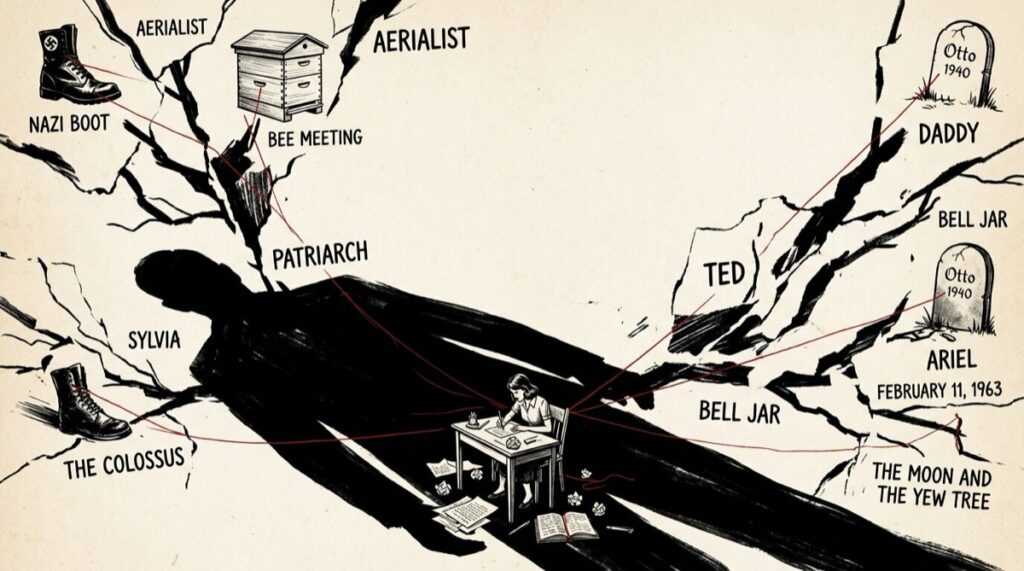
Confessional poetry is the most important critical concept attached to Plath. This is the movement where the speaker is (or seems to be) the poet, and the subject matter is nakedly personal — mental illness, family trauma, suicide, sexuality.
The term itself was coined by critic M.L. Rosenthal in his 1959 review of Robert Lowell’s Life Studies.
NTA has tested this origin story: Lowell is the founder/originator of confessional poetry; Plath is its most famous practitioner, not its origin.
Other confessional poets you should link to Plath: Anne Sexton (Plath’s close friend; both attended Lowell’s seminar at Boston University), John Berryman, and W.D. Snodgrass.
Feminist readings: “Daddy” and “Lady Lazarus” are regularly read through a feminist lens in NTA papers.
The domineering father figure in “Daddy” connects to patriarchal authority broadly, and questions sometimes ask you to identify the critical framework applied to a given Plath poem.
Plath herself was ambivalent about the feminist label, but that ambivalence doesn’t appear in MCQs — the association with feminist literary criticism does.
Death and rebirth: Plath returns obsessively to death as transformation — Lady Lazarus rising from the ash, the horse charging toward the sun in “Ariel.” These aren’t purely confessional; they also have a mythological register. NTA questions sometimes test your ability to identify this mythic dimension in her imagery.
The Bell Jar as bildungsroman: Esther Greenwood’s story is a coming-of-age narrative, but an inverted one — she descends rather than rises. The novel draws from Plath’s own 1953 breakdown, hospitalization, and electroconvulsive therapy at McLean Hospital. The bell jar itself is a metaphor for depression: being sealed inside your own suffocating thoughts.
For exam practice on American Literature questions broadly, the American Literature previous year questions collection is the most efficient way to test yourself on Plath and her contemporaries together.
Poem-by-poem breakdown: what the exam actually test

“Daddy” (1962)
Written October 12, 1962 — four months before Plath’s death.
The speaker addresses her father, Otto Plath, who died of diabetes when Sylvia was eight.
The poem extends this personal grief into a broader political metaphor: the father as Nazi, the speaker as Jewish prisoner.
This use of Holocaust imagery was criticized by George Steiner, who found it disproportionate — and that critical controversy has appeared in NTA questions.
The poem ends with a symbolic killing: “Daddy, daddy, you bastard, I’m through.” Know the addressee, the metaphorical framework, and the Steiner controversy.
“Lady Lazarus” (1962)
Three suicide attempts treated as performances, with a circus-showman persona narrating each one. The famous lines — “Dying / Is an art, like everything else. / I do it exceptionally well” — are frequently excerpted in MCQs asking you to identify the poem.
The poem ends with a threat of revenge. Lazarus rises not meekly but as a consuming fire: “Out of the ash / I rise with my red hair / And I eat men like air.”
“Mirror” (1961)
The mirror speaks: “I am silver and exact. I have no preconceptions.” Themes of women’s relationship to aging and self-image. Published in The New Yorker before appearing in Crossing the Water.
If you’re also studying Jane Austen note that NTA occasionally frames comparative questions about women’s self-perception — Austen’s scenes and Plath’s “Mirror” are both in play.
“Ariel” (1962)
Written in the same October burst that produced “Daddy.” The poem moves from “Stasis in darkness” to an ecstatic charge toward the sun.
The name Ariel carries multiple meanings: a horse Plath rode, the spirit in Shakespeare’s The Tempest, and the Hebrew word for “lion of God.” Ted Hughes changed the poem order in the published 1965 collection; Plath’s original manuscript began with “Morning Song” and ended with “Words.”
Plath’s daughter Frieda Hughes published a restored Ariel in 2004 with the original arrangement. This editorial history is a documented NTA topic.
The Bell Jar
Five facts to memorize, in order of exam frequency:
- Pseudonym: Victoria Lucas
- Publication date: January 14, 1963
- Protagonist: Esther Greenwood
- US publication: 1971 (eight years after Plath’s death — her mother Aurelia objected)
- The bell jar metaphor: depression as suffocation/enclosure
The novel is set largely in New York City, during a summer internship at Ladies’ Day magazine — based on Plath’s real 1953 internship at Mademoiselle.
The McLean Hospital scenes draw from her own hospitalization. For an in-depth look at how NTA has framed recent American Literature questions, check the subject-wise UGC NET previous year questions.
Common exam traps and how to avoid them
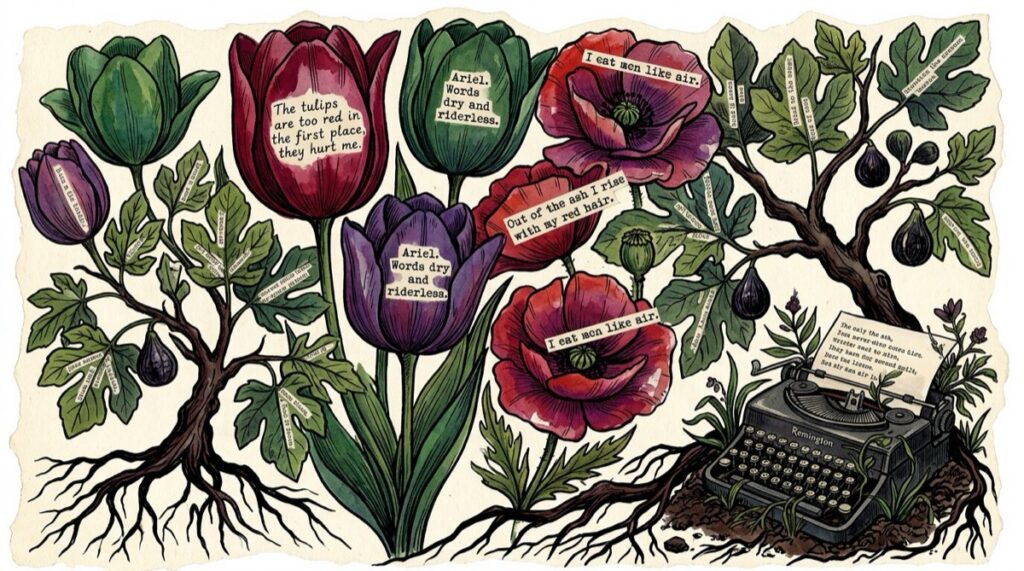
Trap 1: Ariel’s publication date
Students often say 1962 (when most poems were written) or 1963 (the year Plath died). The correct answer is 1965 — Ted Hughes published it two years after her death.
Trap 2: The Bell Jar pseudonym
Many students know the novel but blank on the pseudonym mid-exam. It was published as Victoria Lucas. This is one of NTA’s favorite one-liner questions on Plath.
Trap 3: Who founded confessional poetry?
“Who is considered the originator of confessional poetry?” — the answer is Robert Lowell, not Plath. Plath is the most famous figure in the movement, but Lowell’s Life Studies (1959) came first, and M.L. Rosenthal coined the term in a review of that book.
Trap 4: “Lady Lazarus” vs. “Daddy” quotations
“Dying / Is an art, like everything else” is from “Lady Lazarus.” “Daddy, daddy, you bastard, I’m through” is from “Daddy.” These lines are frequently swapped in MCQ options. Keep them separate from the start.
Trap 5: Ted Hughes’s editorial intervention
The Ariel that was published in 1965 was NOT the manuscript Plath left. Hughes changed the poem order and removed several poems.
This fact shows up in questions about editorial controversy, feminist criticism of Hughes, and the 2004 restored edition.
How to study Sylvia Plath for UGC NET in 5 days

This plan works whether you have 5 days or 5 hours — just compress the proportions.
Day 1: Nail the chronology. Colossus (1960), The Bell Jar (January 1963, Victoria Lucas), Ariel (1965, posthumous). Read “Lady Lazarus” and “Daddy” — full text, not summaries. Write the five Bell Jar facts from memory.
Day 2: Read “Mirror,” “Morning Song,” and “Ariel.” Make a simple chart: poem title → key image → what it’s actually about → most likely MCQ trap. This takes about 45 minutes and is more useful than long notes.
Day 3: Learn the confessional poetry framework in sequence: Lowell → Life Studies → Rosenthal coins the term → Plath, Sexton, Berryman. Solve 10–15 questions from UGC NET previous year question papers on American Literature.
Day 4: The Bell Jar, in depth. If you haven’t read it, a detailed plot summary will do — but focus on the five testable facts. Also review the Ted Hughes/Ariel editorial controversy since it appears in higher-difficulty papers.
Day 5: Past papers only. Check the December 2025 UGC NET English topic-wise breakdown for recent Plath questions and the June 2025 question paper for the latest NTA phrasing.
If you’re building a full preparation schedule from scratch, the 40-day UGC NET prep guide gives a subject-wise plan you can slot Plath into alongside the rest of American Literature.
Previous year question patterns
NTA’s Plath questions fall into three types:
Type 1 — Identification from lines: “Which poem contains the line ‘Dying / Is an art, like everything else’?” or “Which of the following is NOT a poem by Sylvia Plath?” These are full marks if you know the poems; zero if you don’t. There’s no shortcut except reading the actual poems.
Type 2 — Biographical and bibliographic facts: Publication dates, the Victoria Lucas pseudonym, Smith College and Cambridge (she won a Fulbright Scholarship in 1955 to study at Newnham College, Cambridge), her mentor Robert Lowell at Boston University, and her marriage to Ted Hughes.
Type 3 — Critical and theoretical angles: “Which movement is Plath associated with?” (confessional poetry), “Who coined the term confessional poetry?” (M.L. Rosenthal), “Which critic objected to Plath’s use of Holocaust imagery?” (George Steiner), and questions framing her within feminist literary theory.
Plath frequently appears in the same question cluster as Anne Sexton, Robert Lowell, and John Berryman. If you’ve already studied T.S. Eliot and Toni Morrison as part of your American Literature preparation, Plath fits naturally as the third anchor author for that unit.
For a comprehensive biography and primary text reference, Britannica’s Sylvia Plath entry is a reliable authority source to cross-check dates and facts.
Preparing for UGC NET English Literature? Our course covers Sylvia Plath and 50+ other high-weightage authors with 300+ video lectures, topic-wise MCQs, and 13 physical booklets delivered to your door. Learn more about the Limitless Literature UGC NET course here.