
The June 2026 UGC NET English paper carried a question built entirely around one Derrida line: “there is nothing outside the text.”
Half the candidates who attempted it picked the answer that treats the line literally, as if Derrida were claiming nothing exists beyond words on a page.
That reading is wrong, and NTA knows most students will fall for it.
This is exactly how Derrida gets tested in UGC NET English Literature — not through biography, but through precise conceptual traps built around his most quoted lines.
Derrida sits in the Literary Criticism and Theory unit of the syllabus, specifically under Poststructuralism and Deconstruction.
He is one of the most consistently tested theorists across NTA cycles because his ideas resist paraphrase, which makes him perfect MCQ material — you either know the exact distinction he’s drawing or you guess wrong.
This guide gives you what actually shows up: the works with dates, the concepts NTA tests, the traps that cost marks, and a five-day plan if your exam is close.
Why Derrida is important for UGC NET
Derrida is the founding figure of deconstruction, and deconstruction is one of the highest-weightage topics in the Literary Theory section of UGC NET English.
Expect three-to-four direct questions on him in most cycles, sometimes three when the paper leans heavily toward poststructuralism.
NTA likes to pair him with Ferdinand de Saussure (for the sign/signifier relationship he inherits and complicates) and with Roland Barthes (for “The Death of the Author,” which shares DNA with Derrida’s attack on fixed authorial meaning).
Check the deconstruction previous year questions page and you’ll see this Saussure–Derrida–Barthes cluster repeat across multiple exam cycles.
He also bridges two units examiners like to test together: Literary Theory and Postcolonial Studies. Gayatri Chakravorty Spivak translated Of Grammatology into English in 1976 and wrote a lengthy critical preface that is itself sometimes quoted in questions, which is why Derrida occasionally shows up in the postcolonial theory previous year questions too.
If you’re building a priority list for theory, Derrida sits near the top — alongside Foucault, Barthes, and Saussure — because deconstruction as a method underlies half the other poststructuralist theory NTA tests.
Major works you must know (with dates)
NTA tests chronology on theorists as heavily as it tests it on novelists, so memorise these in order.
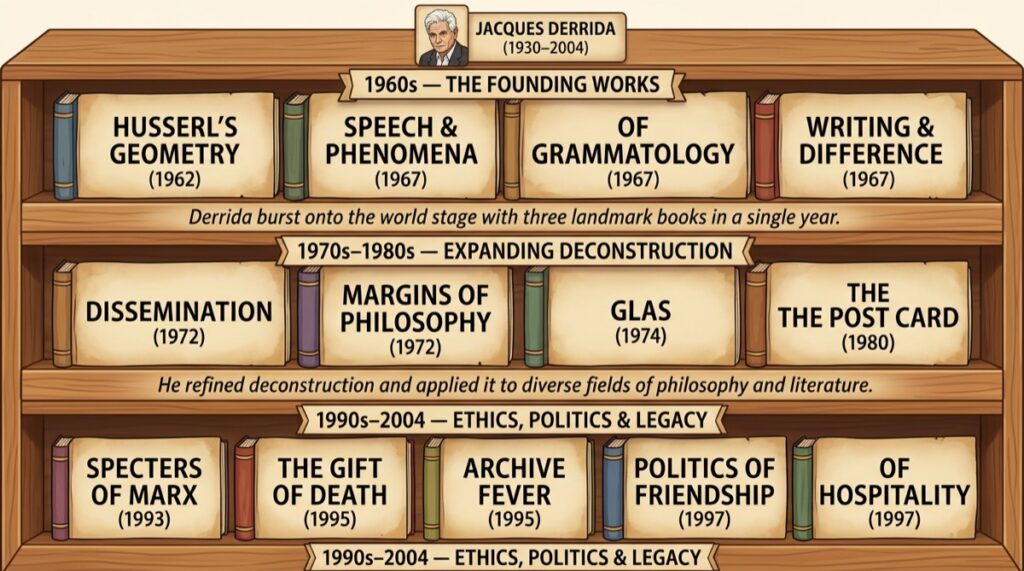
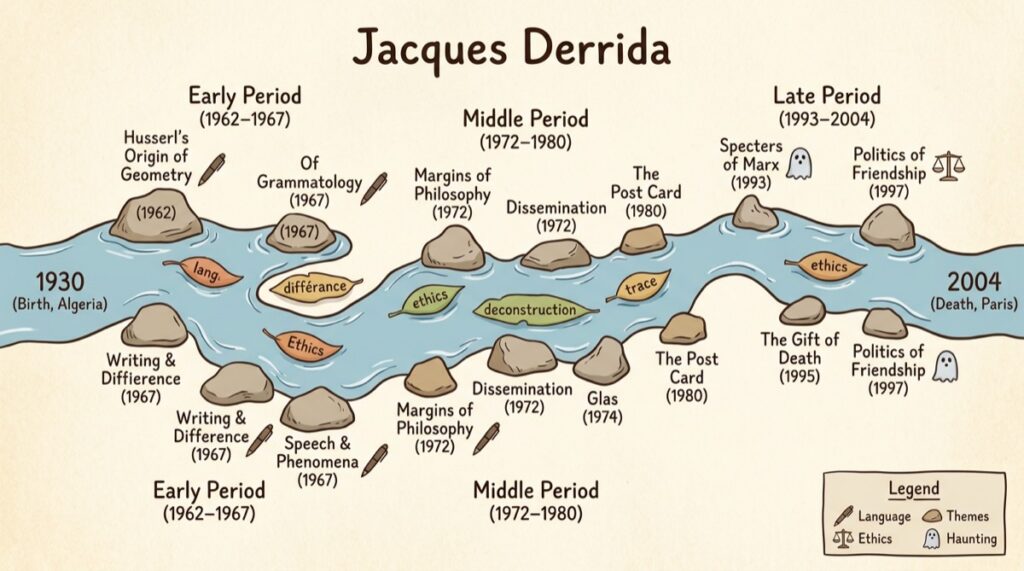
1967 — the breakout year. Derrida published three foundational texts in the same year: Of Grammatology (De la grammatologie), Writing and Difference (L’Écriture et la différence), and Speech and Phenomena (La Voix et le phénomène). Questions sometimes ask which of the three is NOT from 1967, so know all three by name.
1966 — “Structure, Sign, and Play in the Discourse of the Human Sciences.” This is technically a conference paper delivered at Johns Hopkins University (October 18–21, 1966) before it was published, and it’s the essay most commonly excerpted in UGC NET MCQs. It’s where Derrida critiques Claude Lévi-Strauss’s structuralism and introduces the idea of “freeplay” once a text loses its fixed center.
1968 — “Différance.” Originally a lecture given to the Société française de philosophie, this essay coins Derrida’s signature term and is almost guaranteed to appear as a quote-identification or fill-in-the-concept question.
1972 — Positions and Dissemination. Positions is a collection of interviews where Derrida explains his own method in relatively plain language — useful if you’re short on time, since it’s more accessible than Of Grammatology.
1976 — Of Grammatology, English translation. Spivak’s translation (with her critical introduction) is the edition most Indian syllabi reference, so if a question mentions a translator’s name alongside Derrida, it’s almost certainly Spivak.
1994 — Specters of Marx. A later work engaging with Marxism after the fall of the Soviet Union; less frequently tested but has appeared as a distractor option in “which of these is NOT an early Derrida text” questions.
Key themes and concepts tested in UGC NET
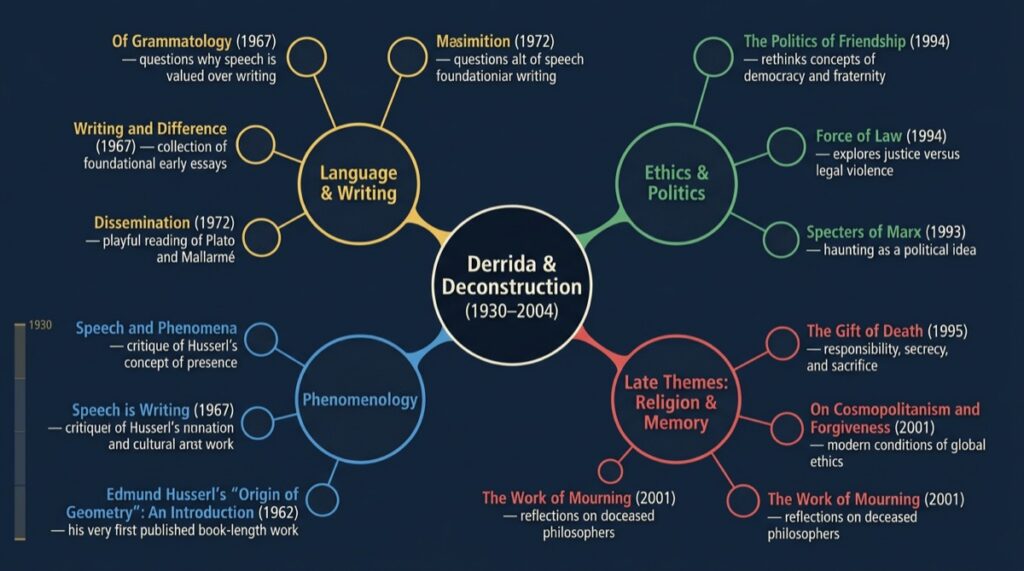
Logocentrism. Derrida’s term for Western philosophy’s assumption that speech is closer to truth and meaning than writing, because speech seems to carry the speaker’s presence with it. Deconstruction begins as an attack on this assumption.
Metaphysics of presence. The broader philosophical habit of privileging what is immediately present (a speaker, a fixed origin, a stable center of meaning) over what is absent, deferred, or supplementary. NTA has asked direct questions on what Derrida rejects about this idea — know that he doesn’t claim presence doesn’t exist, he claims it’s never as stable or self-sufficient as philosophy assumes.
Différance. A word Derrida invented by changing one letter in the French “différence.” It plays on two French verb senses: to differ and to defer. Meaning is never fully present in a sign — it depends on its difference from other signs, and it’s constantly deferred along an endless chain of signifiers. This is the single most-tested Derrida concept in UGC NET; expect it to show up as a standalone definitional question almost every cycle.
The transcendental signified. A fixed, final meaning that supposedly exists outside the endless play of signifiers and anchors everything else. Derrida argues no such fixed point exists — every signified is itself another signifier in the chain. This concept from Of Grammatology has appeared in direct quote-based questions.
Binary oppositions. Western thought organizes itself around paired hierarchies — speech/writing, presence/absence, nature/culture, reason/emotion — where the first term is always privileged over the second. Deconstruction’s method is to locate these oppositions in a text and show that the “inferior” term is actually necessary for the “superior” one to function at all.
The supplement. A term with a deliberate double meaning: a supplement adds something extra to a whole, but it also implies the whole was incomplete to begin with. Derrida uses “writing as supplement to speech” as his primary example — writing is supposedly secondary to speech, but its existence reveals that speech was never self-sufficient.
“Il n’y a pas de hors-texte.” Usually mistranslated as “there is nothing outside the text.” The more accurate rendering is “there is no outside-text” — Derrida isn’t denying reality exists, he’s saying there’s no vantage point outside language, context, and interpretation from which meaning can be fixed once and for all. This is the exact line the January 2025 paper tested, and it’s worth memorising the correct interpretation word for word.
Deconstruction as a reading practice
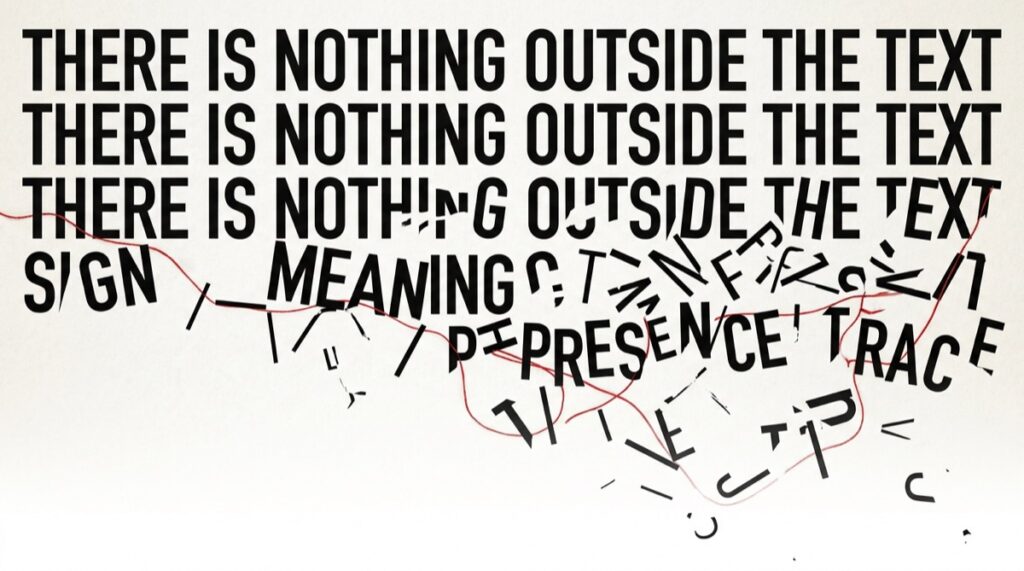
Deconstruction is not a theory you apply from outside a text — it’s a practice of close reading that locates the moments where a text’s own logic undermines its stated meaning.
Derrida’s method usually follows a pattern: identify a binary opposition the text relies on, show which term is treated as primary, then find the passage where the text itself reveals the secondary term is doing essential work.
In “Structure, Sign, and Play,” he does this to Lévi-Strauss’s structuralist anthropology — showing that the very idea of a “center” holding a structure together is something structuralism needs but can never locate.
That essay is why deconstruction is often taught as an outgrowth of, and a reaction against, structuralism; if you want to see how NTA tests that pivot, the structuralism and new criticism previous year questions page has several relevant entries.
One distinction NTA loves to test: deconstruction is not the same as destruction. Derrida is explicit that deconstruction doesn’t tear a text apart or prove it means nothing — it shows a text means more than one thing, and that these meanings can be in tension with each other.
Questions phrased as “deconstruction claims texts have no meaning” are almost always false-option traps.
Common exam traps and how to avoid them

Trap 1: Confusing différance with simple “difference.” Différance is a portmanteau covering both differing and deferring in time. An option that defines it as only “difference between signs” is incomplete and usually the wrong answer.
Trap 2: Reading “there is no outside-text” as anti-realism. As covered above, this line does not deny the existence of a physical world. Questions testing this line usually have one option claiming Derrida denies reality — that’s the trap.
Trap 3: Mixing up Derrida’s terms with Saussure’s. Saussure gave us signifier/signified and the arbitrary nature of the sign. Derrida builds on this but adds différance, the transcendental signified, and logocentrism. A question naming “arbitrary nature of the linguistic sign” is testing Saussure, not Derrida, even in a Derrida-themed question set.
Trap 4: Attributing Of Grammatology’s English translation and preface to the wrong scholar. It’s Gayatri Chakravorty Spivak, not Homi Bhabha or Edward Said. This detail has appeared as a direct MCQ.
Trap 5: Getting the 1967 vs. 1966 vs. 1968 dates confused. Structure, Sign, and Play was delivered in 1966 (published 1967 in the conference proceedings, and again in Writing and Difference in 1967). Of Grammatology, Writing and Difference, and Speech and Phenomena are all 1967. Différance is 1968.
Write these out as a timeline and drill them separately from content questions — pure date-recall MCQs are common and easy marks once memorised. For a broader sense of how NTA structures the Literary Criticism section relative to the rest of the paper, see the 2025 UGC NET English detailed breakdown.
How to study Derrida For UGC NET English?
Day 1 — Get the vocabulary fixed. Write out definitions in your own words for logocentrism, metaphysics of presence, différance, transcendental signified, binary opposition, and supplement. Don’t move on until you can explain each one without looking at notes.
Day 2 — Build the timeline. Structure, Sign, and Play (1966), Of Grammatology, Writing and Difference, Speech and Phenomena (all 1967), Différance (1968), Spivak’s English translation of Of Grammatology (1976). Test yourself by covering the dates and recalling them cold.
Day 3 — Read one primary excerpt. Find a short excerpt from “Structure, Sign, and Play” (widely available online) and read it once for the argument, not the prose style. Focus on how he critiques Lévi-Strauss’s idea of a structural “center.”
Day 4 — Drill the traps. Go through the five traps above and write out, in one sentence each, why the wrong answer is wrong. This is more useful than re-reading definitions, because MCQs test your ability to spot the incorrect option, not just recall the correct one.
Day 5 — Solve PYQs under time pressure. Pull every Derrida question from past papers and attempt them in one sitting, timed. The subject-wise previous year questions collection groups Literary Theory questions together, which makes this drill faster than hunting through full papers.
Previous year question patterns
NTA tests Derrida in three recurring formats. The first is direct definition matching — “which term refers to X” — and this is the easiest format if you’ve drilled the vocabulary in Day 1 above.
The second is quote identification, where a line from “Structure, Sign, and Play,” Of Grammatology, or “Différance” is given and you have to identify the essay or the correct interpretation, which is where the January 2025 “there is no outside-text” question fits.
The third is comparison and elimination, where Derrida is grouped with Saussure, Barthes, or Lévi-Strauss and you have to identify which idea belongs to which thinker — this format punishes students who’ve learned Derrida in isolation without also knowing what he’s reacting against.
The literary criticism previous year questions page groups these three formats together across cycles, and cross-referencing them against the full previous year question papers is the fastest way to see exactly how often each format recurs.
If you’ve already studied T.S. Eliot’s critical essays, it’s worth revisiting our T.S. Eliot guide alongside this one — Eliot’s “Tradition and the Individual Talent” is sometimes used as a contrast question against Derrida’s rejection of fixed, author-centered meaning.
Preparing for UGC NET English Literature? Our course covers Jacques Derrida and 50+ other high-weightage theorists and authors with video lectures, topic-wise MCQs, and 13 physical booklets delivered to your door. Learn more about the course here.