If you are preparing R.K. Narayan for UGC NET English Literature and you only remember him as “the man who wrote The Guide,” you are walking into the exam half-ready.
NTA does test plot summaries, but more importantly, it tests dates, character names, the order his novels appeared, and which of the “Big Three” wrote what.
Narayan sits inside the Indian Writing in English unit, and almost every recent paper has carried at least one question on him or on his fictional town, Malgudi.
This post gives you the full works list with publication years, the themes that turn into MCQs, and the specific mistakes that make students pick the wrong option even when they have read him.
Rasipuram Krishnaswami Iyer Narayanaswami (1906–2001) shortened his own name on the advice of Graham Greene, who also found a London publisher for his first novel.
Keep that Greene connection in your head. It shows up in factual questions more often than you would expect.
Why R.K. Narayan is important for UGC NET English Literature
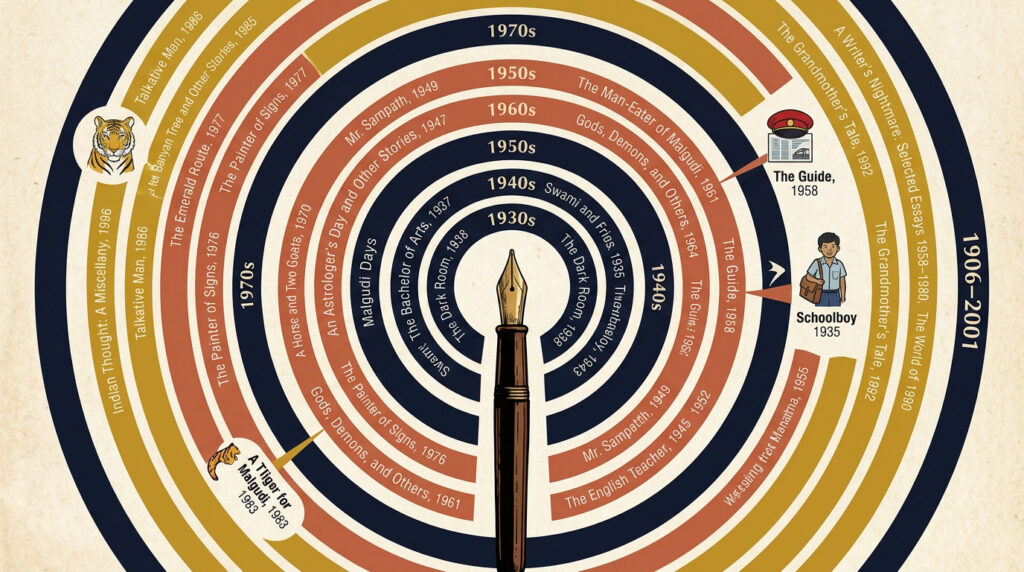
Narayan is one of the “Big Three” or Trimurti of the Indian English novel, alongside Mulk Raj Anand and Raja Rao. That grouping alone is a frequent MCQ.
NTA loves to give you a list of works and ask you to match them to the right author, and the Big Three are the easiest trio to confuse if your reading is shallow.
Anand writes about caste and class with anger; Rao writes philosophical, Sanskritised prose; Narayan writes quiet comedy about ordinary South Indian lives. Knowing that contrast is half the battle.
He appears in the Indian Writing in English section of the syllabus, which has grown heavier since the syllabus revision.
In the last few cycles, Indian English literature has carried a meaningful chunk of Paper 2, and Narayan is a fixed name in that pool.
If you want to see how the weightage actually breaks down across units, read our detailed breakdown of the 2025 UGC NET English paper before you decide how much time to give him.
The short version: do not skip him, and do not over-invest either. Two hours of focused work covers what NTA asks.
Major works you must know (with dates)
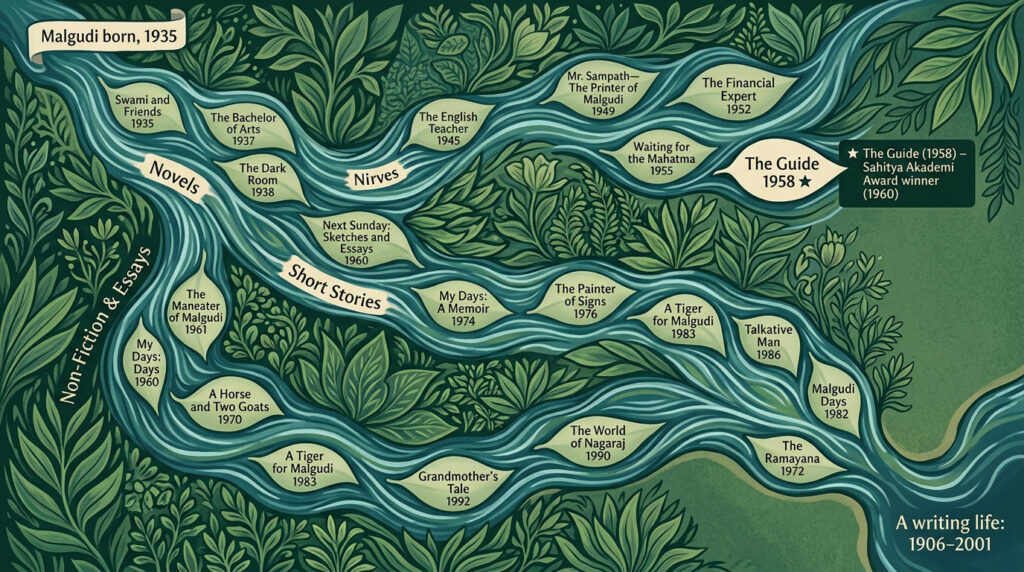
NTA tests chronology hard, so memorise these years rather than just the titles. The novels, in order:
- Swami and Friends (1935) — his first novel, and the book that introduced Malgudi. Remember this: Malgudi first appears here, not in Malgudi Days.
- The Bachelor of Arts (1937) — Chandran, a disillusioned lover, briefly becomes a wandering sanyasi.
- The Dark Room (1938) — his early treatment of an unhappy marriage; protagonist Savitri.
- The English Teacher (1945) — autobiographical, based on the death of his wife. Protagonist Krishna and his wife Susila. Published in the US as Grateful to Life and Death.
- Mr. Sampath – The Printer of Malgudi (1949).
- The Financial Expert (1952) — Margayya, the money-lender who works under a banyan tree.
- Waiting for the Mahatma (1955) — Sriram, Bharati, and Gandhi as an actual character.
- The Guide (1958) — Raju. His most famous novel and the one that won him the Sahitya Akademi Award in 1960.
- The Man-Eater of Malgudi (1961) — the taxidermist Vasu, built on the Bhasmasura myth.
- The Vendor of Sweets (1967), also published as The Sweet-Vendor — Jagan.
- The Painter of Signs (1976) — Raman and Daisy.
- A Tiger for Malgudi (1983) — narrated partly from a tiger’s point of view.
- Talkative Man (1986).
- The World of Nagaraj (1990) — his last novel.
Beyond the novels, know the short story collections: Malgudi Days (1943) and An Astrologer’s Day (1947). His memoir is My Days (1974).
He also produced prose retellings of The Ramayana (1972) and The Mahabharata (1978), plus Gods, Demons and Others. When a question lists a non-fiction or mythological title and asks who wrote it, these are the traps.
Practising with real subject-wise previous year questions on Indian literature is the fastest way to see which titles keep coming back.
Key themes and concepts tested in UGC NET
Malgudi is the single most important concept. It is a fictional town in South India, invented in Swami and Friends, and used across almost all his fiction as a self-contained world.
Expect a direct question on what Malgudi is and where it first appeared. Critics often compare it to Hardy’s Wessex or Faulkner’s Yoknapatawpha, and that comparison itself can be an MCQ.
The second recurring idea is irony and gentle comedy. Narayan does not preach.
His characters drift into transformation almost by accident, and he watches them with affection rather than judgement.
In The Guide, Raju does not choose to become a holy man; the role is forced on him and he grows into it. That accidental, ironic saintliness is the theme examiners pick when they ask about the novel’s meaning.
Third, Gandhian thought and Hindu tradition. Waiting for the Mahatma puts Gandhi on the page directly, and The Guide and The Vendor of Sweets both deal with renunciation and faith.
Narayan treats religion as part of ordinary life, not as a grand statement.
If you are mapping how these themes connect to the larger Indian English tradition, our note on Rabindranath Tagore for UGC NET English Literature is useful background, since Tagore questions often sit in the same cluster as Narayan in the paper.
Novel-by-novel deep dive: the four NTA actually asks about
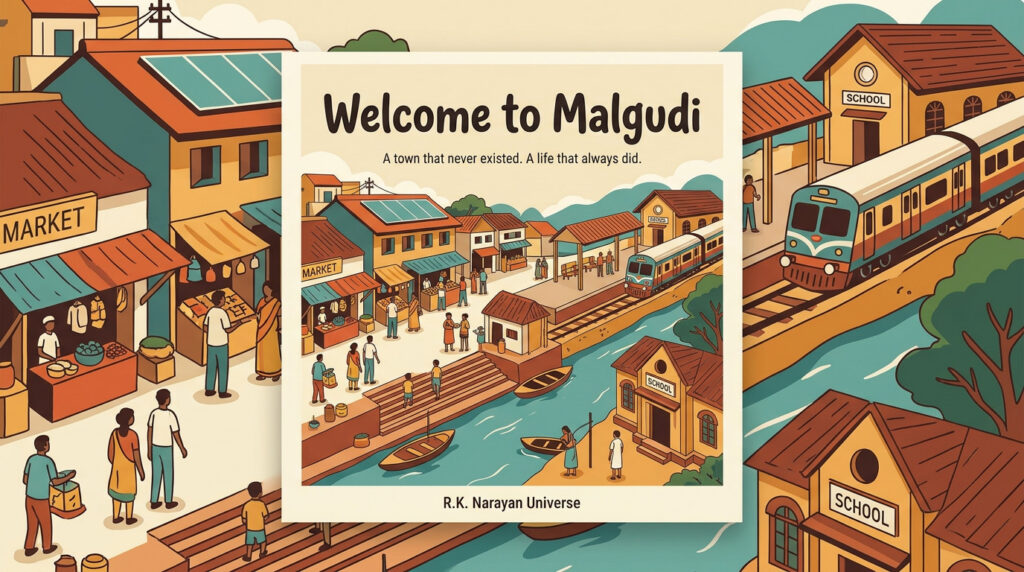
You do not need deep knowledge of all fourteen novels. Four carry almost all the exam weight.
The Guide (1958). Raju starts as a railway-station tour guide, becomes the lover and manager of the dancer Rosie (stage name Nalini), is jailed for forgery, and after release is mistaken for a holy man by villagers during a drought. He undertakes a fast to bring rain and dies, or appears to, at the end. Rosie’s husband is the archaeologist Marco. The novel won the Sahitya Akademi Award in 1960 and was filmed in 1965. The character names Raju, Rosie/Nalini, and Marco are prime MCQ material.
The English Teacher (1945). Krishna, a college lecturer, loses his wife Susila to typhoid and later tries to reach her through a medium. It is the most personal of his novels, drawn from the death of Narayan’s own wife Rajam. Examiners flag it as autobiographical.
The Financial Expert (1952). Margayya rises from a small-time financial advisor working under a banyan tree to wealth, then loses it all. A study of greed handled with comedy rather than tragedy.
The Man-Eater of Malgudi (1961). Nataraj, a mild printer, is bullied by Vasu, a violent taxidermist who eventually destroys himself, an echo of the demon Bhasmasura who burns himself with his own power. The myth link is the favourite exam angle here.
Common exam traps and how to avoid them
These are the mistakes that cost marks. Read them twice.
- Malgudi’s first appearance. Many students answer Malgudi Days (1943). Wrong. Malgudi first appears in Swami and Friends (1935). The short story collection came later.
- Mixing up the Big Three. Untouchable and Coolie are Mulk Raj Anand. Kanthapura and The Serpent and the Rope are Raja Rao. Narayan owns Malgudi and The Guide. NTA builds whole questions on this confusion.
- Rosie versus Nalini. In The Guide, Rosie is her real name and Nalini is her stage name as a dancer. A question may use either name to test whether you actually read the novel. Her husband is Marco, not Raju.
- The English Teacher’s alternate title. It was published in America as Grateful to Life and Death. If both titles appear as options, they refer to the same book.
- The Greene fact. Graham Greene helped publish Swami and Friends and advised Narayan to shorten his name. Students often attribute this help to a different mentor. It was Greene.
When you drill these through full papers rather than isolated facts, the traps stop working on you. Work through complete sets in our collection of UGC NET English previous year question papers so you see how the options are framed, not just the answers.
How to study R.K. Narayan in 5 days (exam strategy)
This is a last-minute plan that assumes you have the syllabus but limited time.
Day 1 — Chronology. Write out all fourteen novels with their years from memory until you can do it cleanly. Add the two short story collections and the memoir. This is the highest-return hour you will spend.
Day 2 — The Guide. Learn the full character map: Raju, Rosie/Nalini, Marco, the Sahitya Akademi Award (1960), the 1965 film. This one novel can carry two or three marks.
Day 3 — The other three. The English Teacher (autobiographical, Krishna and Susila), The Financial Expert (Margayya), The Man-Eater of Malgudi (Vasu, Bhasmasura myth). One line of detail each is enough.
Day 4 — The Big Three contrast. Sit Narayan beside Anand and Raja Rao and learn three signature works for each. Most Indian Writing questions reward this single comparison. For more last-minute structure, our guide on what to do in the 40 days before the exam lays out how to sequence revision across authors.
Day 5 — Test yourself. Solve every Narayan and Indian Writing MCQ you can find from past papers. Mark what you miss and re-learn only those. Do not re-read summaries you already know.
Previous year question patterns
NTA frames Narayan questions in three reliable ways.
The first is straight matching: a list of novels against a list of authors, where Narayan, Anand, and Rao are deliberately jumbled.
The second is character identification: “Who is the dancer in The Guide?” or “In which novel does Margayya appear?”
The third is the chronology or “first appearance” question, usually about Malgudi or about which novel came first.
The December 2024 paper carried a notable cluster of Indian Writing in English questions, and Narayan featured among them.
The pattern has held steady across cycles, which makes him low-risk, high-reward revision. To see exactly how these questions are worded and to practise the matching format, study the Indian literature previous year questions collection and time yourself.
If you can answer those without hesitation, you have covered everything NTA is likely to ask. For an external biographical reference, the Encyclopaedia Britannica entry on R.K. Narayan is reliable for dates and titles.
Preparing R.K. Narayan for UGC NET English Literature? Our course covers Narayan and 50+ other high-weightage authors with video lectures, topic-wise MCQs, and 13 physical booklets delivered to your door. Learn more about the course here.