If you are preparing Mulk Raj Anand for UGC NET English Literature, here is the blunt truth: this is one of the most reliable scoring areas in the Indian Writing in English unit.
NTA asks about him almost every cycle, the questions are mostly factual, and the facts do not change.
Get his novels, characters, and dates locked in, and you have a near-guaranteed mark or two without needing any deep critical theory.
This post gives you exactly what the paper tests and skips what it does not.
Mulk Raj Anand (1905–2004) sits in the founding generation of the Indian English novel. Examiners love him because his work is easy to frame into clean MCQs: match the character to the novel, match the novel to the year, match the social issue to the book.
Below you will find every work worth memorising, the themes that show up in the paper, the traps that cost students marks, and a 5-day plan to finish him before the exam.
Why Mulk Raj Anand is important for UGC NET
Anand appears in Unit 4 (Indian Writing in English) of the UGC NET English syllabus, the unit that has steadily grown in weight over the last few cycles.
He is part of the so-called “trinity” of Indian English novelists alongside R.K. Narayan and Raja Rao, and that grouping itself is a frequent question.
When NTA sets a question on the early Indian English novel, Anand is the default name. His name is one of the safest bets in the whole Indian Writing unit.
On average you can expect one direct question on Anand in most papers, and often a second through a matching set that pairs him with other Indian writers.
These are not analysis questions. They are recall. That makes him high-return for low effort. If you want to see how this unit is weighted against the rest of the paper, study our detailed breakdown of the 2025 UGC NET English exam before you decide how many hours to give him.
For broader practice across the whole syllabus, work through the subject-wise previous year question collection, which sorts past questions topic by topic so you can drill Indian Writing on its own.
Major works you must know (with dates)
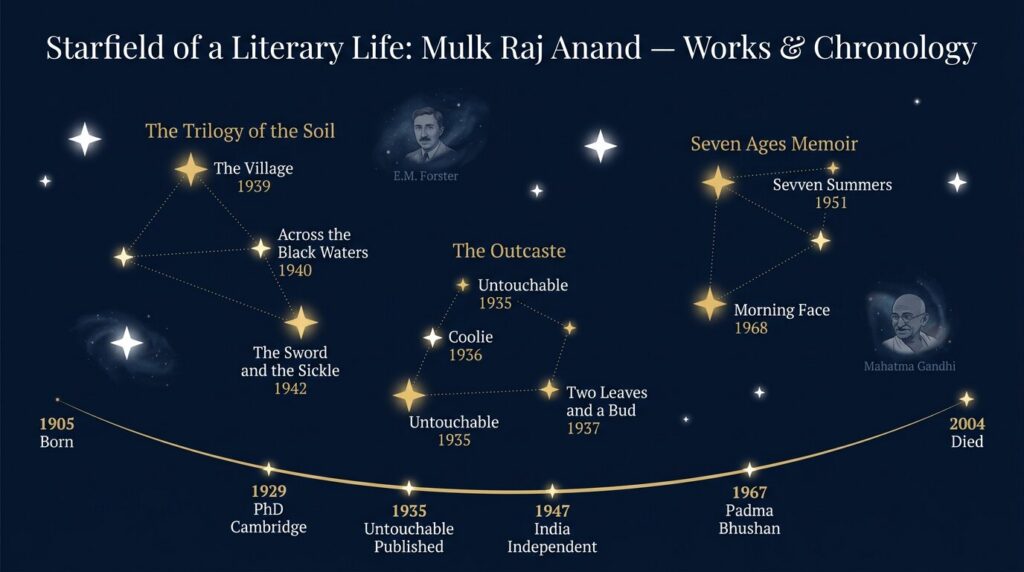
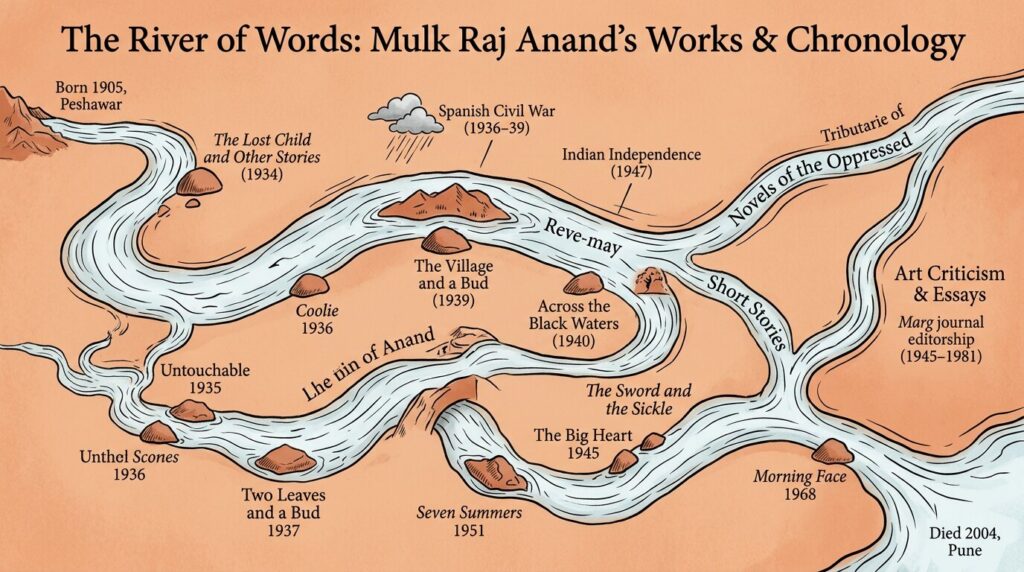
NTA tests chronology hard, so memorise the years, not just the titles. Here is the list worth your time.
Novels
- Untouchable (1935) — his debut, with a preface by E.M. Forster
- Coolie (1936)
- Two Leaves and a Bud (1937)
- The Village (1939) — first novel of the Lalu trilogy
- Across the Black Waters (1940) — second of the trilogy
- The Sword and the Sickle (1942) — third of the trilogy
- The Big Heart (1945)
- Seven Summers (1951) — first of his autobiographical “Seven Ages of Man” series
- The Private Life of an Indian Prince (1953)
- Morning Face (1968) — won the Sahitya Akademi Award in 1971
- Confession of a Lover (1976)
- The Bubble (1984)
Short story collections
- The Lost Child and Other Stories (1934) — the title story “The Lost Child” is itself a frequent question
- The Barber’s Trade Union and Other Stories (1944)
Non-fiction
- Apology for Heroism (1946) — his intellectual autobiography
- Founder-editor of Marg (1946), the art magazine
If you only have time to memorise five, make them Untouchable, Coolie, Two Leaves and a Bud, the Lalu trilogy as a block, and Morning Face (for the Sahitya Akademi link). Those five cover the bulk of what gets asked.
Key themes and concepts tested in UGC NET
Anand wrote with a clear social purpose, and the paper tests that purpose directly.
The themes you need to attach to him are caste oppression, poverty, the exploitation of labour, and the influence of Gandhi and Marxism on the Indian novel.
He was a founding member of the Progressive Writers’ Movement, formally launched in London in 1935 and in India in 1936.
This affiliation is a common question, and it explains the political edge in his fiction. His work is often labelled “social realism”, a term examiners pair with his name.
The other concept to hold onto is his place in the trinity of Indian English novelists (Anand, Narayan, Raja Rao).
Each represents a different strand. Anand wrote the social protest novel, Narayan built the comic-realist small-town world of Malgudi, and Raja Rao worked in a philosophical and mythic register.
When a question asks you to distinguish the three, that one-line description for each is usually enough to pick the right option.
Another idea linked to Anand is the use of Indian speech rhythms in English prose.
He translated Punjabi and Hindustani idioms directly into his English, a technique that fed the wider debate about whether Indian writers should write in English at all.
You do not need to argue that debate in the exam, but recognising that Anand sits inside it helps with the harder theory-flavoured questions.
You will also see his connection to Gandhi tested. Anand revised the manuscript of Untouchable after spending time at Gandhi’s Sabarmati Ashram, and Gandhi advised him to cut the prose down.
That biographical detail surfaces in tougher papers. For the full sweep of how Indian writers are framed in the exam, the Indian Literature previous year question set is the fastest way to see the pattern across authors.
Novel-by-novel deep dive
This is the section that wins you marks. Learn the protagonist and the central issue of each book.
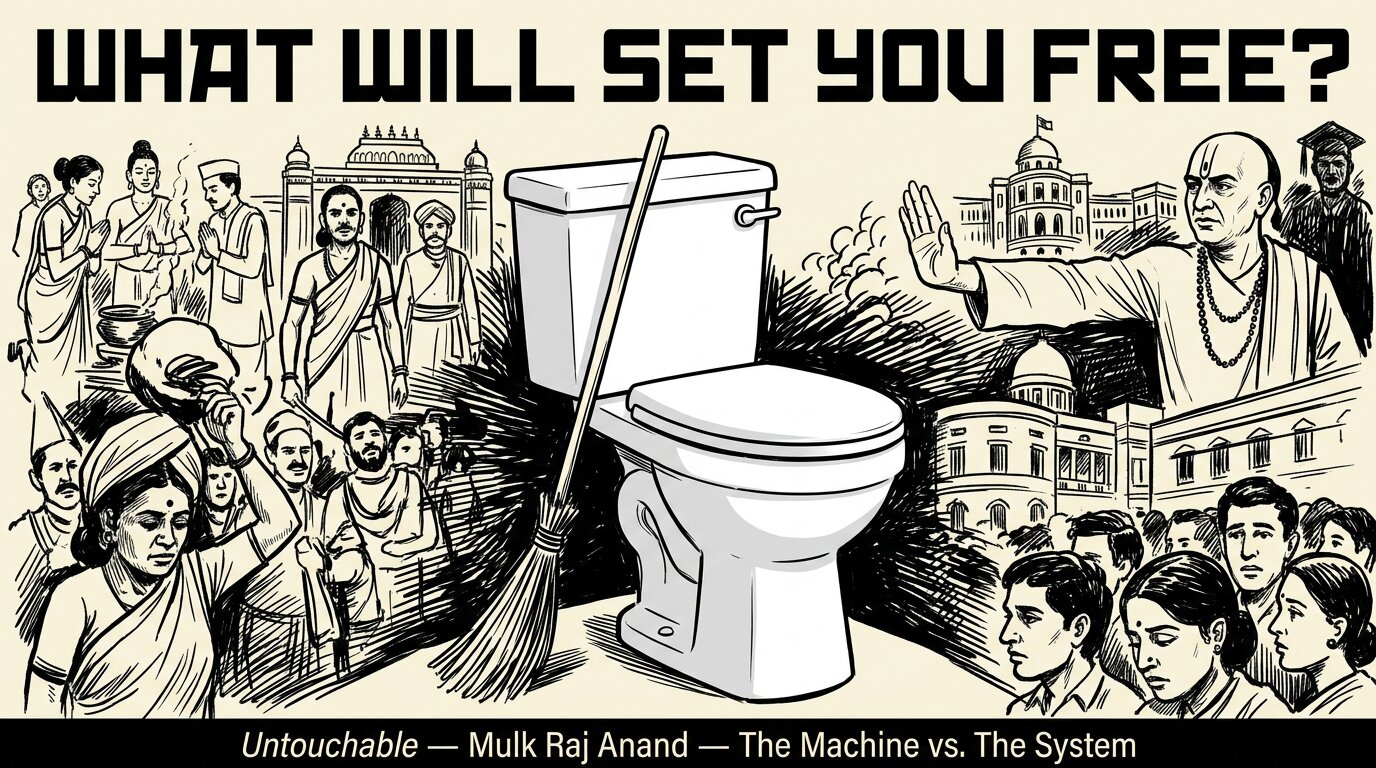
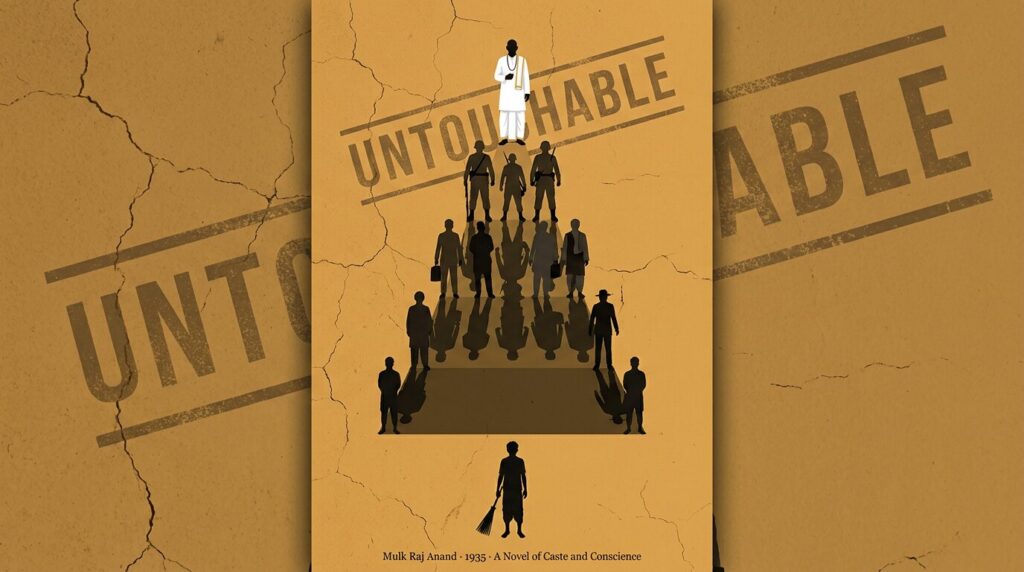
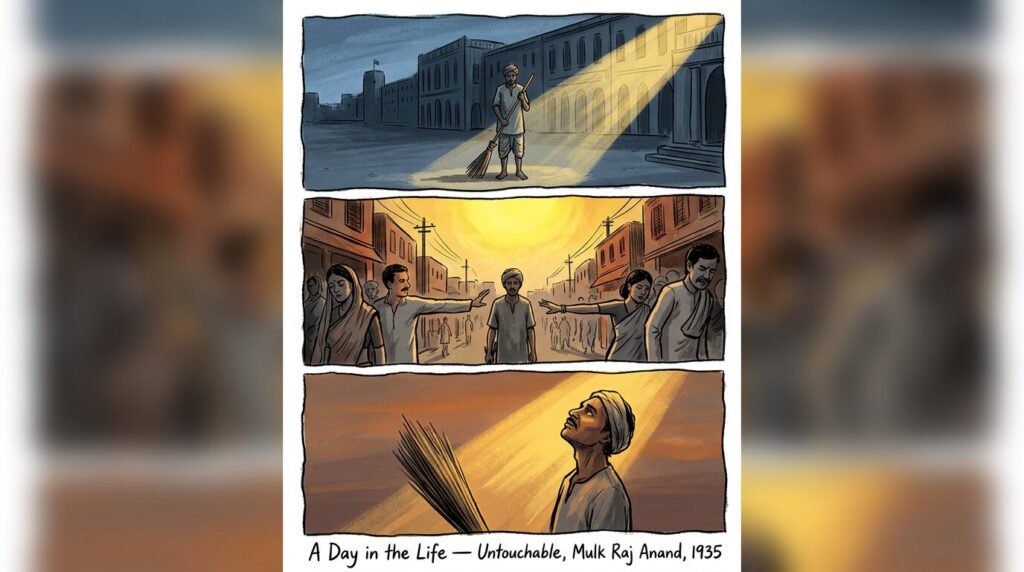
Untouchable (1935). Set across a single day in the life of Bakha, a young sweeper from the Dalit community. The novel exposes caste humiliation and ends with three proposed solutions to untouchability: the Christian convert, Gandhi’s appeal, and the modern flush toilet that would end the need for manual scavenging. The single-day structure and the E.M. Forster preface are the two most-tested facts here.
Coolie (1936). Follows Munoo, a hill boy from Kangra who moves through a chain of jobs (domestic servant, factory worker, rickshaw puller) and dies of tuberculosis in Simla. The theme is class exploitation and the destruction of the poor under an indifferent economic system.
Two Leaves and a Bud (1937). Centres on Gangu, a peasant who is lured to a tea plantation in Assam and exploited by the colonial system; he is shot dead by a British officer. The “two leaves and a bud” refers to the tea-picking standard. Remember the character Gangu, because examiners love to swap him with Munoo or Bakha.
The Lalu trilogy — The Village (1939), Across the Black Waters (1940), The Sword and the Sickle (1942). The protagonist across all three is Lalu (Lal Singh). Across the Black Waters is notable as the rare Indian English novel set during the First World War, following Indian sepoys fighting in France. If a question asks which Indian English novel deals with WWI, this is the answer.
The Big Heart (1945). Protagonist Ananta, a coppersmith, set against the conflict between traditional craftsmen and industrial machinery in Amritsar.
The Private Life of an Indian Prince (1953). A psychological study of a declining prince, often read as Anand’s most personal and inward novel. It marks a shift away from the labouring-class hero of his early work toward the inner life of a single troubled man, which is why critics treat it as a turning point in his career.
One more title worth a flashcard is the short story “The Lost Child” (1934). It is short, frequently anthologised, and NTA has asked about it directly.
The story follows a small boy who gets separated from his parents at a village fair and, once lost, no longer wants the toys and sweets he had been begging for.
Know the title, the author, and the basic situation, and you have covered every way it can be asked.
For how these novels are actually phrased in the question paper, the Indian novels previous year UGC NET question collection shows the exact framing NTA uses.
It is worth pairing your reading of this list with a related author too — see our post on Salman Rushdie, Kamala Das, R.K. Narayan for UGC NET, since these writers are appearing frequently in exam.
Common exam traps and how to avoid them
These are the mistakes that quietly cost students marks every cycle.
Trap 1: Mixing up the protagonists. Bakha (Untouchable), Munoo (Coolie), Gangu (Two Leaves and a Bud), Lalu (The Village trilogy), Ananta (The Big Heart). NTA loves a matching question that scrambles these. Build a flashcard for each pair and drill until the answer is automatic.
Trap 2: Assuming Forster wrote Untouchable. E.M. Forster wrote the preface to Untouchable, not the novel. The question is often worded to tempt you into the wrong inference. Forster’s involvement is real, but he is the prefacer, not the author.
Trap 3: The Sahitya Akademi confusion. Anand received the Sahitya Akademi Award in 1971 for Morning Face, not for Untouchable or Coolie. The famous early novels won him fame, not the prize. He also received the Padma Bhushan in 1967, so keep the two honours separate.
Trap 4: Forgetting he founded Marg. Questions sometimes test his non-literary work. He founded the art and architecture journal Marg in 1946. If you see Marg as an option in an author-match question, it points to Anand.
Trap 5: The WWI novel. When a question asks for the Indian English novel set in the First World War, the answer is Across the Black Waters (1940). Students often default to a more famous title and lose the mark.
How to study Mulk Raj Anand in 5 days (exam strategy)
You do not need to read the novels cover to cover. Here is a tight plan.
Day 1 — Memorise the full novel list with dates. Write the timeline by hand twice. Focus on 1935–1942, his most-tested decade.
Day 2 — Lock the protagonist-to-novel pairs. Make five flashcards (Bakha, Munoo, Gangu, Lalu, Ananta) and test yourself until you get all five in under thirty seconds.
Day 3 — Learn the themes and the biographical hooks: Progressive Writers’ Movement, the trinity, the Gandhi-Sabarmati connection, Marg, the Forster preface. These are the “second-level” questions.
Day 4 — Solve every Anand question you can find in past papers. Use the full previous year question papers hub to attempt him in real exam context rather than as isolated facts.
Day 5 — Revise only your wrong answers from Day 4, plus the five traps above. For a wider last-week routine, our guide on what to do in the 40 days before the exam keeps your whole revision on track, not just one author. If you still need structured material, the UGC NET English study material and course packages every high-weightage author with video lectures and topic-wise MCQs.
For an authoritative biography to cross-check any fact, the Britannica entry on Mulk Raj Anand is reliable.
Previous year question patterns
NTA frames Anand questions in three repeating shapes.
First, the straight match: “Who is the protagonist of Coolie?” or “Untouchable depicts a single day in the life of whom?” These are pure recall.
Second, the multi-select assertion type, such as “Which of the following are characters in novels by Mulk Raj Anand?” with options like Munoo, Bakha, Sampath, Gangu, where Sampath is the decoy (he belongs to R.K. Narayan’s Mr Sampath).
Third, the theme match, such as “Coolie primarily deals with…” where the correct answer is social injustice or class exploitation.
The decoys almost always come from Narayan or Raja Rao, which is exactly why you study the trinity together.
To train on the real question style across the whole Indian Writing unit, work through the Indian Literature previous year questions and time yourself.
Preparing for UGC NET English Literature? Our course covers Mulk Raj Anand for UGC NET English Literature and 50+ other high-weightage authors with video lectures, topic-wise MCQs, and 13 physical booklets delivered to your door. Learn more about the course here.