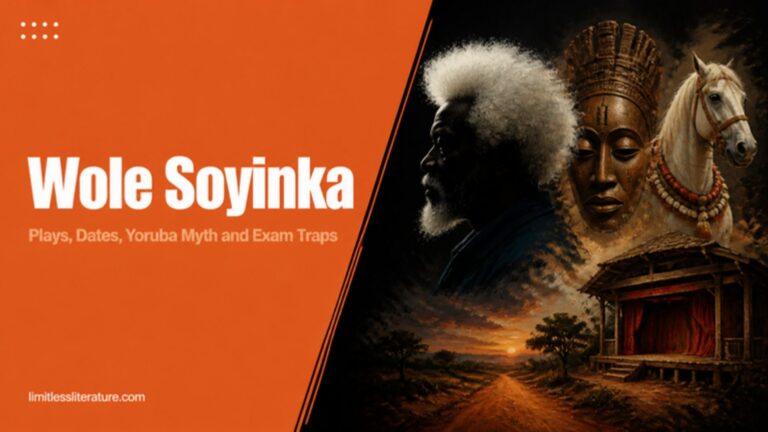
The mistake that costs most marks on Soyinka: students file him next to Chinua Achebe as “the Nigerian novelist” and stop there. Soyinka did write novels, but he is a playwright first. The questions on this site prove it. When an examiner wants to test him, the usual shape is an odd-one-out item: four play titles, one of which is not his. In one paper the stranger was Master Harold…and the Boys, a South African play by Athol Fugard. In another it was Home and Exile, which is Achebe’s. Knowing only “first African Nobel laureate, 1986” wins one mark and loses three.
So this guide treats him as a dramatist first. Learn the plays with dates, three of them in detail, and his line on Negritude. That covers almost everything asked so far.
Quick answer: Wole Soyinka (born 13 July 1934, Abeokuta, Nigeria) is a Yoruba playwright, poet, novelist and memoirist who in 1986 became the first African to win the Nobel Prize in Literature. Exams test him mainly as a dramatist: The Lion and the Jewel, A Dance of the Forests (written for Nigerian independence, 1960), Kongi’s Harvest, Madmen and Specialists and Death and the King’s Horseman (1975). Also know his mockery of Negritude: a tiger does not proclaim its tigritude.
Full name: Akinwande Oluwole Babatunde Soyinka
Born: 13 July 1934, Aké, Abeokuta, in western Nigeria
Education: Government College and University College, Ibadan; BA in English, University of Leeds
Writes: plays (his main work), poems, two early novels and a late third, memoirs, essays and criticism
Best-known works: The Lion and the Jewel, A Dance of the Forests, The Road, Death and the King’s Horseman, The Interpreters, The Man Died, Aké
Big award: Nobel Prize in Literature 1986, the first for an African writer
Asked in: UGC NET, State SET, GATE, KVS and State PGT/TGT, Assistant Professor exams (UP Assistant Professor prescribes The Lion and the Jewel)
Why examiners keep picking Soyinka
First, the Nobel. The 1986 prize makes him the anchor of every “Nobel laureate” question that includes African writers. The Swedish Academy praised him as a writer “who in a wide cultural perspective and with poetic overtones fashions the drama of existence”. Gordimer (1991), Walcott (1992) and Coetzee (2003) are set against him; Achebe, who never won, is the favourite trap.
Second, the early plays come in a tight cluster, staged between 1958 and 1965. That suits “which is not by Soyinka” and “match the play” items, with Walcott, Ngugi, Fugard and Achebe in the other slots.
Third, theory. His jibe at Negritude and his reading of Death and the King’s Horseman turn up in statement-type questions in the postcolonial unit.
My advice: learn the play list with dates cold, and three plays at character level (Death and the King’s Horseman, The Lion and the Jewel, A Dance of the Forests). The novels and memoirs need one line each. Poetry is low priority.
Soyinka’s works in order, with dates
Many early plays were staged years before they were printed, so a question may use either date. Dates follow the Nobel Prize biography.
| Year | Work | Form |
|---|---|---|
| 1958 (publ. 1963) | The Swamp Dwellers | Play |
| 1959 (publ. 1963) | The Lion and the Jewel | Comedy |
| 1960 (publ. 1963) | The Trials of Brother Jero | Satirical comedy |
| 1960 (publ. 1963) | A Dance of the Forests | Play for Nigerian independence |
| 1963 (staged 1966) | The Strong Breed | Tragedy, one act |
| 1965 | The Road | Play |
| 1965 | The Interpreters | Novel (his first) |
| 1965 (publ. 1967) | Kongi’s Harvest | Political satire |
| 1967 | Idanre and Other Poems | Poems |
| 1970 (publ. 1971) | Madmen and Specialists | Play |
| 1971–72 (sources differ) | A Shuttle in the Crypt | Prison poems |
| 1972 | The Man Died: Prison Notes | Prison memoir |
| 1973 | Season of Anomy | Novel |
| 1973 | The Bacchae of Euripides: A Communion Rite | Adaptation of Euripides |
| 1975 | Death and the King’s Horseman | Tragedy |
| 1976 | Myth, Literature and the African World | Criticism |
| 1976 | Ogun Abibiman | Long poem |
| 1981 | Aké: The Years of Childhood | Childhood memoir |
| 1984 | A Play of Giants | Satire on dictators |
| 1989 | Ìsarà: A Voyage around “Essay” | Memoir of his father |
| 2006 | You Must Set Forth at Dawn | Memoir |
| 2021 | Chronicles from the Land of the Happiest People on Earth | Novel (his third, 48 years after the second) |
One date link to remember: the August 2024 UGC NET evening paper asked you to order five works by year, and the Soyinka item in it was Death and the King’s Horseman, 1975. Use the publication year unless a question says “first staged”.
The plays, one by one
The Lion and the Jewel (1959)
A comedy set in the village of Ilujinle. Sidi, the village beauty, is “the jewel”. Lakunle, the Westernised schoolteacher, wants to marry her without paying the bride price and talks endlessly about modern ways. Baroka, the old Bale (village head), is “the lion”. With help from Sadiku, his senior wife, Baroka lets it be known that he has lost his manhood, Sidi goes to mock him, and she comes back as his next bride. The joke is on Lakunle: the “backward” chief outwits the “modern” teacher. This is the play the UP Assistant Professor syllabus prescribes.
A Dance of the Forests (1960)
Written for Nigeria’s independence celebrations in 1960, and the opposite of a celebration. The living summon illustrious ancestors to a great gathering, and the forest sends instead a Dead Man and a Dead Woman, victims of the cruel court of Mata Kharibu centuries earlier. Demoke the carver, Rola and Adenebi turn out to be reincarnations of those who wronged them. The message: the past was no golden age, and a new nation that builds on that myth is fooling itself. On this site’s question pages it sometimes appears as “The Dance of the Forests” or “A Dance of the Forest”; the correct title is A Dance of the Forests.
The Trials of Brother Jero (1960)
A short satire on a fake beach prophet in Lagos who exploits his follower Chume.
The Strong Breed (published 1963)
A one-act tragedy about the “carrier”, a person who carries the village’s evil away at the New Year. Eman, a teacher from outside, takes the place of Ifada, the simple-minded boy chosen for the role, and dies. Eman’s own father was a carrier in his home village, which is why the title calls his line “the strong breed”.
The Road (1965)
Set at a roadside shack used by drivers and touts. Professor, a former lay reader who forges driving licences, searches for “the Word” in the meaning of death. Kotonu is a driver who has given up the road; Samson is his tout; Murano, who cannot speak, was struck by a lorry while possessed in an egungun masquerade. The play links the road to Ogun, god of iron and of the road.
Kongi’s Harvest (staged 1965)
A satire on an African dictator. Kongi wants the traditional king, Oba Danlola, to hand him the New Yam at the festival, so that his power looks sacred. Daodu, Danlola’s heir, and Segi oppose him. A Play of Giants (1984) is the later, blunter satire on real dictators.
Madmen and Specialists (staged 1970)
Written after his civil war imprisonment. Dr Bero, trained as a doctor, comes back from the war as an intelligence “specialist” and holds his own father, the Old Man, captive; four crippled mendicants act as a grotesque chorus. One site question matched it to Soyinka against Walcott, Ngugi and Dennis Scott.
Death and the King’s Horseman (1975)
The most taught Soyinka play. It is based on events in Oyo in 1946, moved back to the war years. The king has died, and Elesin Oba, his horseman, must die by ritual on the night of the burial so that he can accompany the king to the world of the ancestors. Elesin delays to take a young bride that evening, over the doubts of Iyaloja, “mother” of the market. Simon Pilkings, the British District Officer, has him arrested to stop the death. Olunde, Elesin’s eldest son, who has been studying medicine in England, comes home and dies in his father’s place. Elesin then strangles himself with his chain.
The exam point is the author’s note. He rejects the label “clash of cultures” and treats the colonial factor as only the catalyst. The tragedy is Elesin’s own failure of will. A statement that calls the play “chiefly an attack on British colonial rule” is the one to mark as wrong.
Soyinka in the questions on this site
Real previous year questions from the site’s own pages. Several use Soyinka as a distractor, which shows you the names he is set against.
| Question (short) | Answer | Source |
|---|---|---|
| Which play is NOT by Soyinka? The Lion and the Jewel / The Dance of the Forests / Master Harold and the Boys / Kongi’s Harvest | (C) Master Harold…and the Boys (Athol Fugard) | African-American and Caribbean PYQs, Q27 |
| Which is NOT by Soyinka? Home and Exile / Kongi’s Harvest / The Interpreters / The Swamp Dwellers | (A) Home and Exile (Chinua Achebe) | African-American and Caribbean PYQs, Q40 |
| A Dance of the Forest is written by | (D) Wole Soyinka | African-American and Caribbean PYQs, Q25 |
| Which writer did NOT receive the Nobel Prize? Soyinka / Achebe / Coetzee / Gordimer | (B) Chinua Achebe | African-American and Caribbean PYQs, Q6 |
| Match the plays: Madmen and Specialists, The Sea at Dauphin, The Trial of Dedan Kimathi, An Echo in the Bone | Soyinka, Walcott, Ngugi wa Thiong’o, Dennis Scott (option 2) | African American / African Literature PYQs, Q9 |
| Match the author to the Nobel year: Soyinka, Gordimer, Walcott, Coetzee | Soyinka 1986 (A-IV); option 3 | UGC NET August 2024 evening, Q36 |
| Put in ascending order: Diamond Dust, Breast-Giver, Death and the King’s Horseman, Dream on Monkey Mountain, Exile and the Kingdom | E, D, C, B, A (Soyinka’s play is 1975) | UGC NET August 2024 evening, Q12 |
| Responses to Negritude: which statements are right? (D: Soyinka saw it as an unhealthy fetishism of the “native” state) | (4) C and D only | UGC NET June 2024 (cancelled), Q26 |
| July’s People is a novel by (Soyinka is option C) | (D) Nadine Gordimer | African-American and Caribbean PYQs, Q24 |
Three lessons. First, his plays are tested by attribution, with wrong options from Fugard, Achebe, Walcott and Ngugi. Second, the Nobel year 1986 appears in matching items alongside 1991, 1992 and 2003. In the August 2024 item, List II printed 1993 where Walcott’s year (1992) should have been, and the answer still worked by elimination. Third, the Negritude point has been set more than once: the June 2024 evening shift paper, Q60 repeats the same statements with one changed. For more practice use the topic-wise PYQ collection and the full previous year question papers.
Negritude, Ogun and the theory behind the plays
The tigritude line. At the 1962 African writers’ conference at Makerere University in Kampala, Soyinka dismissed Negritude with the quip “A tiger does not proclaim his tigritude, he pounces.” He later said the point was literary: poetry should show its quality, not announce its identity. Negritude itself belongs to Aimé Césaire, Léopold Sédar Senghor and Léon Damas. So if a question asks who coined Negritude, the answer is not Soyinka; if it asks which African writer mocked it, the answer is.
Ogun. Soyinka builds his drama on Yoruba myth with Ogun, god of iron and war, at the centre. In Myth, Literature and the African World (1976) he reads Ogun as the god who first crossed the gulf between gods and humans, and makes that crossing the model for tragedy. Idanre and Ogun Abibiman are his Ogun poems.
English, not Yoruba. Soyinka writes in English, though he draws on Yoruba song, masquerade and proverb. Ngugi wa Thiong’o is the writer who turned away from English; do not give Ngugi’s position to Soyinka. The Nobel biography also names the Irish dramatist J. M. Synge as an influence.
For the wider theory unit, the postcolonial theory PYQs and the guides to Edward Said and Homi Bhabha fill in the critics who sit beside him.
Names, groups and titles decoded
| Name | What it is |
|---|---|
| Wole | Short for Oluwole; full name Akinwande Oluwole Babatunde Soyinka |
| Aké | The part of Abeokuta where he was born; the title of his 1981 childhood memoir |
| Ìsarà | His father’s home town, and the 1989 book about his father, called “Essay” |
| Pyrate Confraternity | Student society he co-founded at University College Ibadan |
| 1960 Masks | Theatre company he founded in 1960 |
| Orisun Theatre Company | His second company, founded in 1964 |
A short Yoruba glossary for the plays
| Term | Meaning in the plays |
|---|---|
| Ogun | God of iron, war and the road; the centre of Soyinka’s theory of tragedy |
| Obatala and Sango | The other two gods Soyinka discusses beside Ogun: Obatala of creation, Sango of thunder |
| Egungun | Ancestral masquerade. The Pilkings wear egungun costumes to a ball; Murano in The Road was struck while masked |
| Elesin | The king’s horseman, who must follow the king in death |
| Iyaloja | “Mother” of the market women, the voice of the community against Elesin |
| Carrier | The person who bears away the village’s evil in The Strong Breed |
Six traps, with the correct answer
- “Achebe won the Nobel Prize.” Wrong. Soyinka (1986) is the first African laureate; Achebe never won it. The site’s Nobel question is built on exactly this.
- “Home and Exile is a Soyinka memoir.” Wrong. It is Achebe’s. Soyinka’s memoirs include Aké, Ìsarà and You Must Set Forth at Dawn.
- “Master Harold…and the Boys is Soyinka’s.” Wrong. It is by Athol Fugard of South Africa.
- “Death and the King’s Horseman is mainly about colonial rule.” Wrong on Soyinka’s own terms. He calls the colonial factor a catalyst; the tragedy is Elesin’s failure to complete the ritual.
- “Olunde kills Pilkings” or “Elesin completes the ritual.” Both wrong. Olunde dies in his father’s place; Elesin strangles himself in his cell afterwards.
- “Soyinka coined Negritude.” Wrong. Césaire, Senghor and Damas are its founders. Soyinka is its most famous mocker (tigritude, 1962).
Self-test: five questions
1. Which Soyinka play was written for Nigerian independence in 1960? (A) The Road (B) The Strong Breed (C) A Dance of the Forests (D) Kongi’s Harvest
Answer: (C). A Dance of the Forests was staged for the 1960 celebrations and attacks the myth of a glorious past.
2. In The Lion and the Jewel, who is “the lion”? (A) Baroka (B) Lakunle (C) Sadiku (D) Chume
Answer: (A). Baroka, the old Bale of Ilujinle, wins Sidi from the schoolteacher Lakunle.
3. Who dies in Elesin’s place in Death and the King’s Horseman? (A) Amusa (B) Iyaloja (C) Pilkings (D) Olunde
Answer: (D). Olunde, the son who studied medicine in England, dies to restore the order his father broke.
4. Which of these is a Soyinka novel? (A) Petals of Blood (B) Season of Anomy (C) Arrow of God (D) July’s People
Answer: (B). Season of Anomy (1973); the others are by Ngugi, Achebe and Gordimer.
5. Soyinka’s “tigritude” remark was aimed at: (A) Pan-Africanism (B) Afrofuturism (C) Negritude (D) Black Arts
Answer: (C). He mocked Negritude at the 1962 Makerere conference: a tiger does not proclaim its tigritude.
Where to go next
Read Soyinka beside his matching partners: the Derek Walcott guide for the Caribbean plays and the 1992 Nobel, and the Toni Morrison guide for the 1993 laureate. If you are preparing for UP Assistant Professor, the Unit X New Literatures in English page covers The Lion and the Jewel with the other prescribed African and Caribbean texts. For prize questions, try the Nobel Prize in Literature quiz. Every guide is listed on the English literature authors A–Z page.
For a reliable record of his life and works, see Wole Soyinka’s biography on the Nobel Prize site.
FAQ
When did Wole Soyinka win the Nobel Prize?
In 1986. He was the first African writer to win the Nobel Prize in Literature. The Swedish Academy described him as a writer who “in a wide cultural perspective and with poetic overtones fashions the drama of existence”.
Which Soyinka play should I read first?
Death and the King’s Horseman (1975). It is the most taught and most asked of his plays. Then The Lion and the Jewel and A Dance of the Forests.
What did Soyinka say about Negritude?
At the 1962 Makerere conference he said a tiger does not proclaim its tigritude; it pounces. He meant that African writing should show its quality rather than announce its identity.
Is Wole Soyinka a novelist?
Mainly a playwright. He wrote three novels: The Interpreters (1965), Season of Anomy (1973) and Chronicles from the Land of the Happiest People on Earth (2021).
Keep going
One author down. Here is where to go next.
- English Literature Authors A–Z: every author guide, mind map and question set on this site
- 5,000+ topic-wise previous year questions from UGC NET, GATE and SET
- UGC NET English guide: syllabus, exam pattern and preparation plan
Preparing for UGC NET English December 2026?
The Crash Course UGC NET English Literature: Zero to Hero covers the core authors and the topics that keep coming back, with 150+ video lectures and mock tests, before the exam starts on 14 December.
Diwali offer: ₹300 off with coupon code LIMITLESS for the next 10 days (till 16 November).
See the Crash Course → or WhatsApp us on 7891410858
