The UP Assistant Professor English exam (UPESSC, Subject Code-10) will be held on 19 and 20 November 2026. The revised syllabus is long: seven of its ten units name specific texts, more than 200 poems, plays, essays and novels in all, and Unit VI lists sixteen critical approaches. This guide gives you the full syllabus unit by unit, the exam pattern, and the exact strategy we use with our own students, with links to summaries and mind maps for every work we have already covered on this website.
UP Assistant Professor English 2026 at a Glance
Quick answer: The written exam has 120 objective questions (30 General Knowledge and 90 English Literature) for 360 marks in 2 hours, with +3 for a correct answer and −1 for a wrong one, followed by a 40-mark interview. The English syllabus (Code-10) has ten units, from literary history and British drama to linguistics and New Literatures in English.
| Conducting body | Uttar Pradesh Education Service Selection Commission (UPESSC), Prayagraj |
| Advertisement | No. 04/2026 (1,936 Assistant Professor posts across all subjects) |
| English posts | 111 (81 in co-education colleges, 30 in women’s colleges), as listed in the advertisement |
| Written exam date | 19 and 20 November 2026 |
| Questions | 120 multiple-choice questions: 30 General Knowledge + 90 English (Code-10) |
| Marks | 360 for the written exam + 40 for the interview |
| Marking | +3 correct, −1 wrong |
| Duration | 2 hours |
Always confirm dates and vacancy details on the official UPESSC website before the exam.
Watch First: Last 30 Days to UP Assistant Professor English (6 Minutes)
Short on time? Nakul’s 6-minute video gives you the complete last-30-days strategy. The full written plan is in our 30-day study plan.
From Nakul: The UP Assistant Professor English syllabus is exactly the same as, or very similar to, the UPPSC GDC syllabus. We have already helped more than 80 students qualify the UPPSC GDC exam, and the same approach works here. What I see every day is students collecting notes from here and there. You don’t have to do that. Simply come to our website, read the summaries, and then start working on the mock tests. That is the best strategy for this exam.
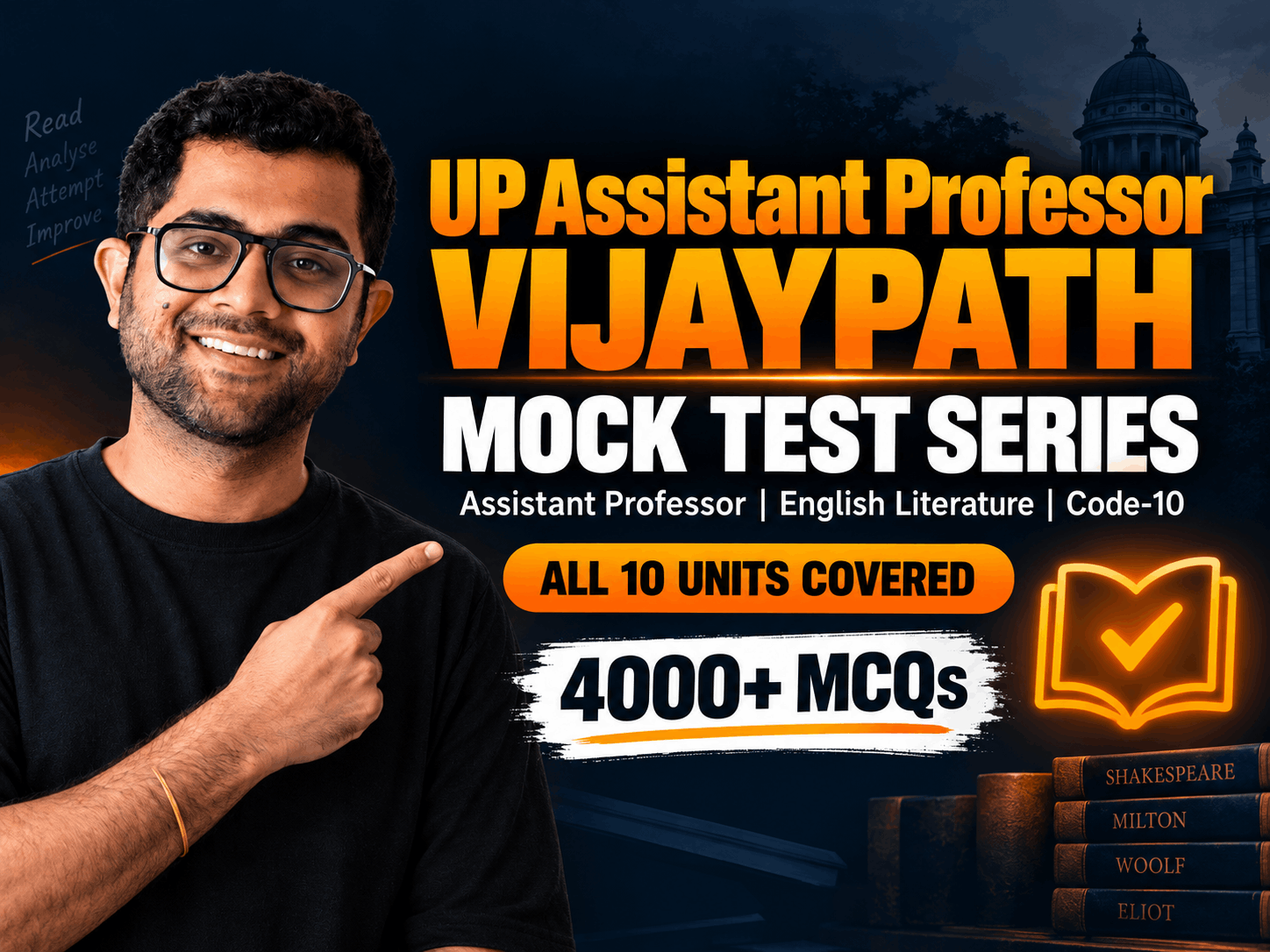
Vijaypath Mock Test Series for UP Assistant Professor English (Code-10)
4000+ MCQs made strictly on the revised syllabus. Unit-wise tests for all 10 units, 7 full-length papers, detailed solutions and All-India ranking.
Start the Vijaypath Mock TestsHow Negative Marking Changes Your Strategy
Every wrong answer costs 1 mark and every right answer earns 3, so three wrong guesses wipe out one correct answer. Do the maths on a pure guess: with four options, a blind guess has a one-in-four chance of +3 and a three-in-four chance of −1. On average that is exactly zero. Blind guessing neither helps nor hurts you; it only adds risk.
The picture changes the moment you can eliminate even one option. With three options left, the average return of a guess turns positive, and with two options left it is clearly worth attempting. That is why knowing the wrong options matters as much as knowing the right one in this exam.
UP Assistant Professor English Syllabus 2026 (Code-10): Unit-wise Overview
| Unit | Area | What it contains |
|---|---|---|
| I | Literature and Society | Renaissance and Reformation, Restoration, Neo-classical, Romantic, Victorian, Modern and Post-Modern periods |
| II | British Drama | 26 plays, from Marlowe’s Doctor Faustus to Caryl Churchill’s Top Girls |
| III | British Prose and Fiction | 32 essays and novels, from Bacon’s essays to Ishiguro’s The Remains of the Day |
| IV | British Poetry | 60 poems, from Chaucer’s Prologue to Carol Ann Duffy’s “Valentine” |
| V | Literary Theory and Criticism | 14 critical texts, from Aristotle’s Poetics to F. R. Leavis |
| VI | Literary Theory and Literary Criticism | 16 approaches, including Rasa and Dhvani, Eco-Criticism, Queer Theory, Digital Humanities, Posthumanism and Medical Humanities |
| VII | American Literature | 34 poems, plays, novels and essays, from Emerson to Maxine Hong Kingston |
| VIII | Indian Literature in English | 31 texts, from Toru Dutt to Girish Karnad’s Hayavadana |
| IX | Linguistics, Phonetics and Modern Grammar | 10 topics, from properties of language and Saussure to Chomsky, stylistics, ELT and sociolinguistics |
| X | New Literatures in English | 26 texts from Australia, New Zealand, Canada, Africa and the Caribbean |
From Nakul: The syllabus has been revised and a lot of works have been added. For Unit X, New Literatures, there is hardly any content available. Some questions come from writers who are barely mentioned on the internet, and never in detail. While building our mock tests we struggled to find material on several of these works ourselves, which is exactly why we built unit-wise tests for every one of them.
What Will Actually Decide Your Result
The units that name specific works are where this paper will be won or lost. Many students will walk in with their old UGC NET notes on theory and criticism and skip the newly added texts. For Units VI and IX, the theory, criticism and linguistics you studied for UGC NET will largely be sufficient. The difference will come from the prescribed works in Units II, III, IV, VII, VIII and X, especially the new additions in Unit X.
One caution on Unit VI: four approaches on the list are newer than most UGC NET notes, namely Digital Humanities, Posthumanism, Medical Humanities and Queer Theory. Make sure you have at least a definition, two key thinkers and one key text for each.
The prescribed works decide this paper. Test yourself on every one of them.
Vijaypath has unit-wise tests for British Drama, Prose and Fiction, Poetry, American, Indian and New Literatures, plus Criticism, Theory and Linguistics.
Get the Unit-wise TestsThe 3-Page Method: How to Cover 200+ Works in Time
There is no time to read every prescribed work in full before November. Instead, give every work exactly three pages in your notebook.
- Page 1: a mind map. Summary, major and minor characters, year of publication, genre. Read the summaries and mind maps on our website (links in the unit tables below). You can comfortably make 10 to 12 of these a day, so all the work-based units can be mapped in 10 to 15 days.
- Page 2: depth. Leave it blank at first. Fill it only if time remains after page 1 is done for every work.
- Page 3: what the mocks teach you. Attempt each unit test, reattempt it, and write down every fact you didn’t know: a title borrowed from a poem, a technique, a character’s name.
Write in arrows and commas, never in long sentences. For Doctor Faustus, page 1 can be as short as: desire for knowledge → tragic hero → pact with the devil → Mephistopheles, the devil’s servant. For A Portrait of the Artist as a Young Man: Bildungsroman → stream of consciousness → Stephen Dedalus.
Prescribed Works with Summaries and Mind Maps
Works marked with a link already have a summary, mind map or study guide on Limitless Literature. For the rest, use the unit-wise mock tests to learn the key facts.
Unit I: Literature and Society
Study the seven periods as literary history: Renaissance and Reformation, Restoration, Neo-classical, Romantic, Victorian, Modern and Post-Modern. A surface-level command of British history, the main movements and figures of speech is enough here, and your UGC NET notes will cover most of it. Practise with the British literary history previous year questions.
Unit II: British Drama
| Author | Prescribed works |
|---|---|
| Christopher Marlowe | Doctor Faustus, The Jew of Malta |
| Ben Jonson | Every Man in His Humour |
| William Shakespeare | Hamlet, Macbeth, Twelfth Night, As You Like It, The Tempest, Julius Caesar |
| John Webster | The Duchess of Malfi |
| John Dryden | All for Love |
| William Congreve | The Way of the World |
| George Bernard Shaw | Candida, Man and Superman, Pygmalion, Arms and the Man |
| John Galsworthy | Strife, Loyalties |
| J. M. Synge | The Playboy of the Western World |
| T. S. Eliot | Murder in the Cathedral |
| Samuel Beckett | Waiting for Godot |
| John Osborne | Look Back in Anger |
| Harold Pinter | The Birthday Party |
| Tom Stoppard | Rosencrantz and Guildenstern Are Dead |
| Caryl Churchill | Top Girls |
Unit III: British Prose and Fiction
| Author | Prescribed works |
|---|---|
| Francis Bacon | “Of Truth”, “Of Revenge”, “Of Studies”, “Of Marriage and Single Life” |
| John Milton | Areopagitica (see our John Milton guide) |
| Addison and Steele | The Sir Roger de Coverley Papers from The Spectator |
| Mary Wollstonecraft | A Vindication of the Rights of Woman |
| Charles Lamb | “The South Sea House”, “Dream Children”, “Christ’s Hospital Five and Thirty Years Ago”, “The Superannuated Man”, “Poor Relations”, “Imperfect Sympathies” |
| William Hazlitt | “On Public Opinion”, “On Reading Old Books”, “On Reading New Books” |
| Virginia Woolf | A Room of One’s Own |
| Henry Fielding | Joseph Andrews |
| Jane Austen | Pride and Prejudice |
| Mary Shelley | Frankenstein |
| Charles Dickens | Great Expectations, A Tale of Two Cities |
| George Eliot | Middlemarch |
| Thomas Hardy | Tess of the d’Urbervilles, The Mayor of Casterbridge |
| D. H. Lawrence | Sons and Lovers |
| James Joyce | A Portrait of the Artist as a Young Man |
| Graham Greene | The Power and the Glory |
| George Orwell | Nineteen Eighty-Four |
| William Golding | Lord of the Flies |
| Kazuo Ishiguro | The Remains of the Day |
Unit IV: British Poetry
| Poet | Prescribed poems |
|---|---|
| Geoffrey Chaucer | The Prologue to The Canterbury Tales |
| Edmund Spenser | The Faerie Queene, Book I |
| Philip Sidney | Astrophil and Stella, Sonnets 1 and 31 |
| John Donne | “The Canonization”, “The Flea”, “A Valediction: Forbidding Mourning”, “Go and Catch a Falling Star”, “Death, Be Not Proud” |
| John Milton | Paradise Lost, Book I; “Lycidas” (Milton guide) |
| John Dryden | Absalom and Achitophel |
| Alexander Pope | The Rape of the Lock |
| William Blake | “London”, “The Tyger” (Blake guide) |
| Thomas Gray | “Elegy Written in a Country Churchyard” |
| William Wordsworth | The Prelude, Book I; “Tintern Abbey”; “The Daffodils” (Wordsworth guide) |
| S. T. Coleridge | “The Rime of the Ancient Mariner”, “Kubla Khan” |
| P. B. Shelley | “Ode to the West Wind”, “Adonais”, “To a Skylark” |
| John Keats | “Ode on a Grecian Urn”, “Ode to a Nightingale”, “To Autumn” (Keats guide) |
| Alfred Tennyson | “The Lady of Shalott”, “Ulysses”, The Princess, “The Lotos-Eaters” |
| Christina Rossetti | “Goblin Market” |
| Robert Browning | “Rabbi Ben Ezra”, “Prospice”, “Porphyria’s Lover”, “The Last Ride Together”, “My Last Duchess” |
| Matthew Arnold | “The Scholar-Gipsy”, “Dover Beach” (Matthew Arnold guide) |
| W. B. Yeats | “Easter 1916”, “The Second Coming”, “A Prayer for My Daughter”, “Among School Children”, “Sailing to Byzantium”, “Byzantium” (Yeats guide) |
| T. S. Eliot | “The Love Song of J. Alfred Prufrock”, The Waste Land (T. S. Eliot guide) |
| W. H. Auden | “In Memory of W. B. Yeats”, “The Shield of Achilles”, “Partition”, “The Unknown Citizen”, “Musée des Beaux Arts” |
| Philip Larkin | “The Whitsun Weddings”, “Ambulances”, “Church Going” |
| Ted Hughes | “Hawk Roosting”, “The Thought-Fox” |
| Seamus Heaney | “Digging”, “Death of a Naturalist” |
| Carol Ann Duffy | “Valentine” |
Practise poetry identification with our British Poetry previous year questions.
Unit V: Literary Theory and Criticism (Critical Texts)
Aristotle, Poetics; Longinus, On the Sublime; Dryden, An Essay of Dramatic Poesy; Dr Johnson, “Preface to Shakespeare”; Wordsworth, “Preface to Lyrical Ballads”; Coleridge, Biographia Literaria (Chapters XIII, XIV and XVII); Matthew Arnold, “The Study of Poetry” and Culture and Anarchy (see the Arnold guide); T. S. Eliot, “Tradition and the Individual Talent”, “Hamlet” and “The Metaphysical Poets”; I. A. Richards, Principles of Literary Criticism; F. R. Leavis, “Literature and Society” and “Literary Criticism and Philosophy”. Practise with our Literary Criticism previous year questions.
Unit VI: Literary Theory and Literary Criticism (Approaches)
New Criticism, Structuralism, Deconstruction, New Historicism, Feminism, Post-Colonialism, Cultural Theory, Psychoanalytic Criticism, Marxism, Reader-Response Theory, Indian Poetics: Rasa and Dhvani, Eco-Criticism, Queer Theory, Digital Humanities, Posthumanism and Medical Humanities. Each linked approach opens its previous year questions page.
Unit VII: American Literature
| Author | Prescribed works |
|---|---|
| R. W. Emerson | “Hamatreya”, “Brahma”, “The Over-Soul” |
| Walt Whitman | “One’s-Self I Sing”, “When Lilacs Last in the Dooryard Bloom’d”, “Passage to India”, “Crossing Brooklyn Ferry” |
| Emily Dickinson | “I never lost as much but twice”, “Success is counted sweetest”, “I felt a Funeral, in my Brain”, “If I should die, and you should live” |
| Robert Frost | “Birches”, “Mending Wall”, “Stopping by Woods on a Snowy Evening”, “The Road Not Taken”, “Mowing”, “The Death of the Hired Man” |
| Wallace Stevens | “The Emperor of Ice-Cream”, “Thirteen Ways of Looking at a Blackbird”, “The World as Meditation” |
| Langston Hughes | “The Negro Speaks of Rivers”, “Harlem” |
| Sylvia Plath | “Daddy”, “Ariel” (Sylvia Plath guide) |
| Drama | Eugene O’Neill, The Hairy Ape; Tennessee Williams, The Glass Menagerie; Arthur Miller, Death of a Salesman |
| Fiction and prose | Hawthorne, The Scarlet Letter; Hemingway, The Old Man and the Sea; Melville, Moby-Dick; Mark Twain, Adventures of Huckleberry Finn; Thoreau, Civil Disobedience; Toni Morrison, The Bluest Eye (Toni Morrison guide); Maxine Hong Kingston, The Woman Warrior |
Unit VIII: Indian Literature in English
| Author | Prescribed works |
|---|---|
| Toru Dutt | “Lakshman”, “The Lotus”, “Our Casuarina Tree” |
| Sarojini Naidu | “Palanquin Bearers”, “The Bangle Sellers”, “Weavers”, “The Flute-Player of Brindaban” |
| Rabindranath Tagore | Gitanjali |
| M. K. Gandhi; Swami Vivekananda | Hind Swaraj; the Chicago lecture |
| Sri Aurobindo | Savitri, Canto I; The Future Poetry; “Is India Civilised?” |
| Nissim Ezekiel | “Poet, Lover, Birdwatcher”, “Background, Casually”, “Night of the Scorpion” (Nissim Ezekiel guide) |
| Kamala Das | “An Introduction”, “My Grandmother’s House”, “Summer in Calcutta” (Kamala Das guide) |
| A. K. Ramanujan | “Self-Portrait”, “A River”, “Obituary” |
| Jayanta Mahapatra | “Hunger”, “Dawn at Puri” |
| Novelists | Raja Rao, Kanthapura; R. K. Narayan, The Guide (R. K. Narayan guide); Anita Desai, Cry, the Peacock; Shashi Deshpande, That Long Silence; Salman Rushdie, Midnight’s Children; Amitav Ghosh, The Shadow Lines |
| Girish Karnad | Hayavadana (Girish Karnad guide) |
Unit IX: Linguistics, Phonetics and Modern Grammar
Properties of human language; scope and branches of linguistics; language varieties and change; Saussure’s linguistic sign and its immutability and mutability; speech mechanism and English phonemes; consonant clusters, syllables and word stress; English morphology and syntax; Chomsky’s Transformational-Generative Grammar and Leech’s communicative grammar; stylistics, discourse analysis, ELT and ESP; sociolinguistics. Practise with our Language and Linguistics previous year questions.
Unit X: New Literatures in English
Twenty-six texts from Australia, New Zealand, Canada, Africa and the Caribbean, from Patrick White’s Voss to Chimamanda Ngozi Adichie’s Half of a Yellow Sun. This is the unit with the least material available anywhere, so we have written a separate guide covering every prescribed work: Unit X New Literatures in English: all 26 prescribed works explained.
Every unit above has its own Vijaypath test.
Map the works first, then attempt and reattempt the unit tests and write what you learn on page 3. Finish with 7 full-length papers and your All-India rank.
Join Vijaypath Mock Test SeriesWatch: How to Prepare for UP Assistant Professor English
Nakul explains the revised syllabus and the 3-page strategy unit by unit in this video.
More UP Assistant Professor English Guides
- Unit X New Literatures in English: all 26 prescribed works explained
- 30-day study plan for the UP Assistant Professor English exam
- All novel mind maps on Limitless Literature
UP Assistant Professor English: Frequently Asked Questions
When is the UP Assistant Professor exam in 2026?
The written exam under Advertisement No. 04/2026 is scheduled for 19 and 20 November 2026. Check the official UPESSC website for your subject’s shift and admit card.
What is the exam pattern for UP Assistant Professor English?
120 objective questions in 2 hours: 30 on General Knowledge and 90 on English (Code-10), for 360 marks. Each correct answer earns 3 marks and each wrong answer costs 1 mark. The written exam is followed by a 40-mark interview.
Is the UP Assistant Professor English syllabus the same as UPPSC GDC?
It is the same as, or very similar to, the UPPSC GDC English syllabus, so the same preparation works for both. The revised Code-10 syllabus adds more prescribed works, especially in Unit X, New Literatures in English.
How many English posts are there in UP Assistant Professor 2026?
Advertisement No. 04/2026 lists 111 English posts: 81 in co-education colleges and 30 in women’s colleges, out of 1,936 posts across all subjects.
What is the best strategy for UP Assistant Professor English?
Make a one-page mind map (summary, characters, year, genre) for every prescribed work, about 10 to 12 a day, then attempt and reattempt unit-wise mock tests and note every new fact. Revise UGC NET theory and linguistics for Units VI and IX, and give extra time to the prescribed works, especially Unit X.
Stop collecting notes from here and there.
Read the summaries, make your mind maps, then let Vijaypath’s 4000+ MCQs on the revised Code-10 syllabus show you exactly what you still need to learn.
Get Vijaypath Mock Test Series
